Competition training6 minutes

How to prepare for your dance competition in Vienna

By Bernhard De LucaUpdated

In short
  • For your first competition in Vienna, simulate the confirmed dances, music lengths and breaks for your event.
  • Rehearse the sequence from being called to leaving the floor without technical interruptions.
  • Use reliable moves and keep dancing after small mistakes, resuming at an agreed point.
  • After the rehearsal, review your entrance, transitions and focus, then work on the biggest weakness.

During practice, you can repeat a passage that went wrong right away, but once you start, the music keeps playing. A realistic rehearsal makes exactly this difference tangible, before a small stumble turns into frantic catch-up.

What you need for your tournament rehearsal

  • Chosen competition with the dance order confirmed
  • Confirmed music durations and details about breaks or intervals
  • Suitable music files, a playback device, and a timer
  • A clear, suitable dance floor and broken-in dance shoes
  • Figures you can perform confidently and that are allowed in your competition
  • A note sheet and someone to handle the music, timing, and calling competitors

Your Competition Format Determines Your Practice

For your dance competition preparation in Vienna, the competition you have chosen is the basis, not just any list of well-known competition dances. A beginner competition may have a different scope from a competition with a defined starting class. So only use the dances confirmed for your entry, their order, and the specified music durations. If any details are missing, ask the organizer to confirm them once instead of taking them from other competitions.

A complete practice run follows the schedule, not just your sequence of figures. This includes the call, taking your position, the musical start, when the music actually ends, and the time until the next dance. If breaks are specified only as a time range, work with that range. Such a run-through is still an approximation: other couples and organizational delays can change the situation on competition day.

Your practice music must also match the required dance and tempo. If Jive is on the program, recognizing Jive music and tempo can help you choose. If Slow Waltz is included, a clear sequence of Waltz figures can serve as a practice foundation, as long as its figures are allowed in your competition. Neither example replaces a confirmed competition requirement. For the run-through, stick to movements you have already learned, as new figures would distort the test.

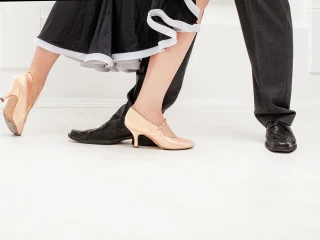
The feet and shoes of a man and a woman practicing ballroom and Latin dances, including Salsa.
A noted music change reveals whether your uncertainty arises during the dance or only in the transition.

Practice your first start in seven steps

  1. Transfer the schedule onto a sheet

    Write down the dances, their order, music durations and confirmed breaks, one below another. Clearly mark time slots; if there are several possible rounds, also note their structure as far as it is known. Your sheet is complete when the helper can manage the run-through without making decisions on the fly.

  2. Prepare the music sequence

    Queue up suitable tracks in the planned order and set the confirmed play times. If possible, also use music whose opening you don't know by heart. The helper ends each track at the scheduled time, not just at the end of your favorite passage.

  3. Set a safe re-entry point

    Agree on a simple, well-practiced sequence for each dance to return to after a mistake. Decide how you and your partner will reconnect and find the beat without pulling or trying to catch up on missed steps. The re-entry works when you both keep the same sense of rhythm.

  4. Warm up and wait at the edge of the dance floor

    Warm up with gentle movement and familiar steps, without dancing a full run-through yet. Then put your equipment and notes aside and wait for the simulated call. This way, the rehearsal begins with you waiting, rather than in the middle of an ongoing exercise.

  5. The call and the start of the music

    After you're called, step onto the floor, choose an open starting spot, and get in position with your partner. Listen for the musical pulse before you set off. A clear, coordinated start matters more than frantically trying to catch a supposedly mandatory first beat.

  6. Dance through the entire round

    Dance until the end of each piece of music and observe the planned breaks. Correct small mistakes using the agreed re-entry, not by restarting; save technical comments for later. After the final dance, leave the floor in a controlled manner. Stop if you feel pain or dizzy.

  7. Turn an observation into practice

    Right afterward, write down one observation each about the start, the flow of the dance, and the transitions. Choose the mistake that disrupted your routine the most, and practice that exact spot separately. Repeat the entire test only after you have recovered sufficiently, not as punishment for a slip-up.

What makes the test meaningful

Like this

  • Return to the shared pulse after a missed step
  • Respond to a blocked path with a controlled solution
  • After the music ends, disengage calmly and keep your distance
  • Relate feedback to a specific, observable moment

Not like this

  • Make up missed steps faster
  • Force the sequence of figures despite a blocked lane
  • Abruptly push your partner away when the music ends
  • Dismiss the whole run-through as bad

Your checklist for the run-through

Before the call-up

Setup

After the Round

Review

Before the next rehearsal

Adjustment

Frequently Asked Questions

  1. You don't have to dance every run-through in competition clothes, but you should rehearse once in your planned outfit from start to finish. A skirt hem, a sleeve, or an unfamiliar fastening can affect your movements and contact. Wear the shoes you plan to use, but break in new shoes separately first.

Standard and Latin Courses in Vienna

On udansa, you can find courses in Vienna to work on technical gaps noticed during the trial run.

Make your next rehearsal better

On udansa, you can find ballroom and Latin classes in Vienna for the part that's still disrupting your run-through. That way, you can turn your observation into a specific training goal.

Make your next rehearsal better