Choosing a class6 minutes

Which dance classes Zurich offers you for your learning goal

By Bernhard De LucaUpdated

In a nutshell
  • When choosing dance lessons in Zurich, consider your learning goals, age, prior experience, lesson format, and dance style.
  • Beginner courses teach the basics, while advanced courses expect you to already have confident steps and a sense of rhythm.
  • Group lessons offer the chance to practise together, while private lessons focus on your personal challenges.
  • Use the course filter on udansa to find specific options in Zurich instead of relying on general dance style names.

A fast choreography can impress and still miss the mark when it comes to what you want. If you want to dance confidently to music, you need different lessons than you would for a wedding dance or precise movements in front of the mirror.

DefinitionWeight Transfer

Weight transfer means shifting your body weight from one supporting foot to the other. This frees the unweighted foot for the next step.

Your learning goal determines the right dance style

If you're looking for a dance school in Zurich, it helps to start with a specific goal: Do you want to dance to music with another person, learn a choreography, or move freely? These goals involve different tasks. In partner dancing, signals between two people are added to your own sequence of steps. In a solo choreography, the sequence of movements, direction, and musical accents are more prominent.

Ballroom dance combines posture, movement together, and traveling across the floor. Salsa and Bachata use characteristic basic rhythms and interactions between partners. Hip Hop combines rhythmic bouncing, shifts in weight, and accents, among other elements. Jazz and Modern Dance draw on other movement vocabularies, such as clear lines or transitions between tension and release. Choose a style based on the movements you want to learn, not on a promised level of difficulty.

A wedding dance, by contrast, is primarily an occasion: the music, clothing, and desired length determine which steps make sense. You don't automatically need an extensive sequence of figures. A trial class to try out a dance style lets you experience whether you enjoy the movement tasks. You can then use the course filter on udansa to find offerings in Zurich that match this direction.
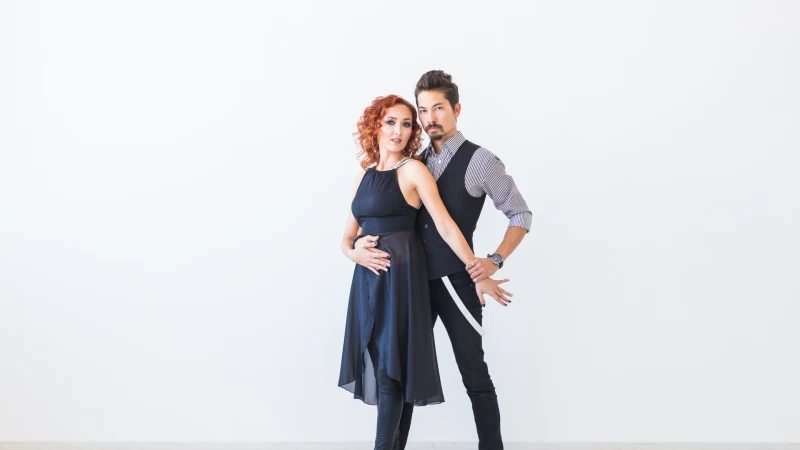
A couple dances Bachata against a white background
What happens between two exercises is part of learning: A short break helps you absorb new movements.

Age and experience describe different needs

An age range says something about how lessons are structured, but little about your dancing ability. Beginners can be young or older; extensive dance experience in one style does not automatically replace the fundamentals of another. If you already know choreography, you can still be new to partner dancing, because coordinating with another person is part of it.

In a beginners' class, small building blocks are explained clearly: Which foot carries your weight? When does the movement begin with the music? How can you keep your upper body mobile as you step? An intermediate class connects these building blocks and assumes you can recall them without constant demonstration. Returning to dance does not necessarily mean starting from scratch. What matters is which fundamentals you still have.

For children's dance, development is the focus. Younger children often explore rhythm and space through images, games, and short activities. As their attention span grows, longer sequences and more precise technique can be added. Parent-child dance also makes use of a familiar person's guidance. Senior dance can place a different emphasis on exertion, balance, and repetition without automatically being undemanding.

Equipment also depends on the activity, not age. The overview of functional dancewear explains why freedom of movement and suitable materials matter more than a particular look.

How to identify suitable requirements

A good fit

  • An introductory class explains steps before combining them
  • An intermediate class uses basic steps you know confidently
  • A children's class adapts activities to their development
  • A private lesson focuses on a clearly stated learning goal

Not a good fit

  • You’re expected to copy a long sequence without the basics being explained
  • You have to guess the missing basic steps as you go
  • Children are expected to repeat long technique sequences like adults
  • A private lesson is expected to cover all the basics at once

A clear explanation helps you understand why a step works, even if you don’t get it right every time yet.

Editorial team for dance guides

The Class Format Changes How You Make Progress

A class is a learning framework: it brings together explanation, practice, feedback and repetition. How these elements are distributed distinguishes group classes, private lessons and workshops. The right format therefore also depends on how you process new movements.

In an ongoing group class, fundamentals come up again and are combined with additional exercises. This helps if you want to first recognize a movement, then imitate it and later perform it independently. A workshop, by contrast, focuses on one topic, such as turning technique or a choreography. Without the right prior experience, this intensive focus can be overwhelming, even if the topic sounds exciting.

Private dance lessons give you room for precise feedback: perhaps you start a step too early, keep your shoulders tense or shift your weight only halfway. The teacher can simplify the exercise and then put it back together. For a wedding dance, the sequence can be adapted to the music, the couple and the available dance space.

A trial class also gives you a sense of the teaching language: Are movements counted, explained with imagery or demonstrated? None of these approaches is inherently better than the others. What helps is being able to turn the explanation into a specific movement. The class filter for Zurich leads you to individual offerings; this guide gives you the terms you need to understand their learning frameworks.

Two class formats, two strengths

Group

Follow a learning path together

A shared topic with recurring exercises

You see different solutions to the same task and learn by watching, too. The shared structure gives your practice direction, even when not every correction is directed at you personally.

Private lesson

Work more specifically on your movement

Exercises and feedback with a personal focus

The teacher can address a challenge from different angles and adjust the pace. You still need to practice on your own so you can apply the correction later without immediate support.

Frequently asked questions

  1. For your first dance class, comfortable everyday clothes that allow you to move and clean, comfortable shoes are usually enough. Avoid soles that grip the floor too much when you turn, and clothes that restrict big steps. Special dance shoes only become useful once the style and movement requirements are clear.

Choose dance classes in Zurich that suit you

Use the course filter on udansa to sort classes in Zurich by your dance style and learning goal.

Classes for your first steps

On udansa, you can find dance classes in Zurich and choose options that match your learning goal. Pick classes that help you build the foundations you really want.

Classes for your first steps