Attending an event5 minutes

Accessible dancing in Zurich: Get clear on access

By Bernhard De LucaUpdated

In brief
  • For accessible dancing in Zurich, you need specific information about the entire route to the dance floor.
  • The organizers should describe the entrance, accessible toilet, seating you can reach, and any support you may need during your visit.
  • Describe your requirements in a single message and ask them to confirm the arrangements in writing.
  • An unanswered question about access remains unresolved and does not mean the dance party is accessible.

You want to put your energy into dancing, not into an improvised solution at the entrance. What matters, then, is whether the event's arrangements meet your actual needs, even if you need a break now and then.

What you need to prepare

  • Name, date, and location of the selected event
  • Your requirements for routes, toilets, and breaks
  • Dimensions of your mobility aid, if relevant for narrow spaces
  • Contact details for the event organizers
  • A note for responses and open questions

The entire visit needs to be accessible

For a dance event in Zurich, “step-free” is useful information, but it is not a complete description. There may be more doors, a lift, thresholds or a different floor between the entrance and the dance floor. An accessible toilet also needs to be genuinely usable for you: maneuvering space, door width and the right approach side can all be crucial. A symbol alone does not answer these questions.

Describe what you need instead of looking only for the label “accessible.” This applies whether you dance in a wheelchair or have limited mobility, tire quickly or need clear communication. You do not have to disclose a diagnosis. Information such as “I need a chair with a backrest near the dance floor” is directly useful.

Access also depends on the actual setup of the event: the cloakroom, queue and extra chairs must not narrow the usable route. A photo of an empty room therefore cannot replace a description of the venue as it will be set up for the event. The general arrangements for your first social dance in Zurich are something to prepare for separately. If your stamina is limited, the guide to gradually increasing your dance activity can also help, although an accessible space is not automatically suitable for you.
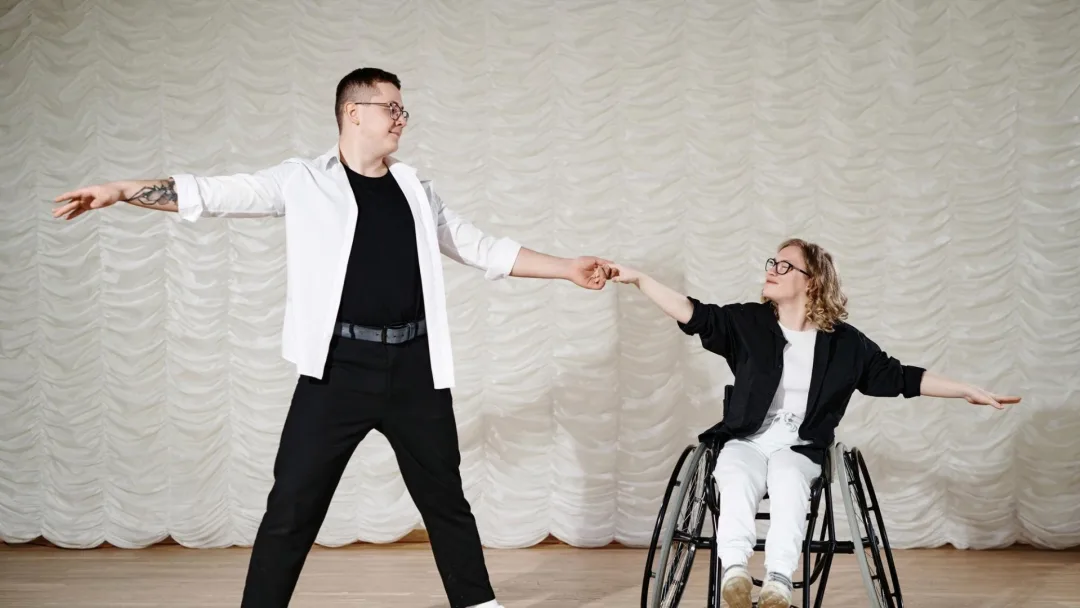
A wheelchair dancer and her partner on a stage
An accessible break area should remain usable even when other guests put down their bags.

Prepare for your visit in seven steps

  1. Write down your specific needs

    Write down which conditions are essential and which are simply helpful. Examples include a fully step-free route, specific toilet facilities, or a seat with a backrest. Include measurements only if they’re crucial for your use.

  2. Break the route into segments

    Note the entrance, entry point, cloakroom, dance floor, toilet and return route. Assign the required information to each segment, such as usable door width, threshold height, internal lift dimensions or floor surface, so no hidden section of the route is overlooked.

  3. Describe the restroom and break area

    Describe your need for maneuvering space, grab bars, or a particular approach side. Where relevant, describe the seat height, backrest, and proximity to the dance floor in the break area; for a wheelchair, a clear space with room to turn may be needed instead.

  4. Describe support as a task

    Specify whether you need help opening a heavy door, using an elevator or finding your way around. Name the task and when you need help, and explicitly mention any touching or adjustments to your mobility aid that you do not want.

  5. Send a consolidated message

    Send the event organizers: “I’d like to attend on [date] and need [requirements]. Please describe the entrance, route to the dance floor, toilet and break area, including relevant measurements, as well as available support and its on-site contact. Which details can you confirm in writing for this event?”

  6. Match the answer to your requirements

    Mark each item as suitable, unsuitable, or unanswered. For example, “There’s an elevator” isn’t enough if you need its dimensions; “our team can help” also leaves the task and availability unclear. Unanswered requirements remain unresolved.

  7. Decide whether to visit based on the confirmations

    Plan your visit only based on the conditions that have been described clearly enough for you. Save the agreed entrance and contact details; if an essential requirement remains unclear or unsuitable, the visit is not adequately prepared under these conditions.

How to make a detail useful

Do this

  • Record the usable door width in centimeters
  • Specify assistance as a concrete task
  • Make sure the toilet meets your space requirements
  • Ask for consent before helping with a wheelchair

Not like this

  • Accept “wide door” as an adequate description
  • Treat “someone will surely help” as a promise
  • Equate a toilet symbol with personal accessibility
  • Plan on unsolicited pushing or lifting as a solution

Your checklist before you go

Before the message

Preparation

After the response

Decision

On the day of the event

Arrival

Frequently Asked Questions

  1. No, a description of your requirements is enough for the organizational preparations. For example, it matters whether you cannot manage steps or need a seat with a backrest. Medical details are not necessary, and you decide for yourself which personal information you want to share.

Go dancing with all the details

On udansa, you can find dance events in Zurich for your next visit. Your prepared message helps you check whether the event announced there meets your personal accessibility needs.

Go dancing with all the details