Dances of the World5 minutes

Kizomba in Dortmund: Connection, Rhythm and Urban Kiz

By Bernhard De LucaUpdated

In short
  • You dance Kizomba through soft weight shifts, a clear connection and small steps close to the ground.
  • Urban Kiz also uses Kizomba music, but often focuses more on changes of direction, pauses and individual pathways.
  • In Dortmund, you can ask which music and movement style are actually taught when comparing courses.
  • For both styles, awareness, a relaxed upper body and a clear, respectful approach to closeness are helpful.

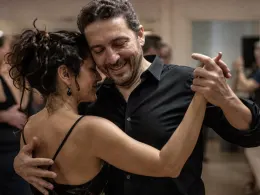
Closeness in Kizomba isn’t a demand to press tightly against each other. It comes from attentive connection and small movement cues that both dancers read and shape.

DefinitionConnection

Connection refers to the physical, attentive connection through which dancers perceive and respond to movement cues. It develops through balance, body tension, and mutual attentiveness, not through pulling or pushing.

Kizomba begins with weight shifts, not big figures

Kizomba is a partner dance whose impact often comes from calm weight shifts, small steps and a finely tuned connection. Instead of performing wide figures, you notice when your weight settles onto one foot and how that leads into the next step. Your upper body stays organized, your knees soft and your movement grounded. Closeness can be part of the dance, but there is no fixed measure: both dancers should feel comfortable and free to move.

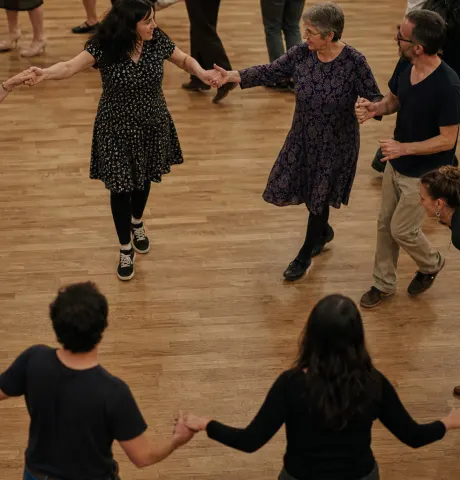
In Dortmund, Kizomba is part of a broader interest in dances from different cultures. The city profile mentions, for example, the TanzFolk festival at Dietrich-Keuning-Haus, where associations showcase traditional dances from Africa, Asia, Europe and South America. This does not point to any specific Kizomba classes, but it places the style in a diverse dance context. When you compare dance styles in Dortmund, pay attention to which music and teaching approach appeal to you.

When you are starting out, what matters less is whether you already know a figure and more whether you are consciously aware of your balance and rhythm. A course for dance beginners in Dortmund can help if it explains partner dance basics and gives you a chance to ask questions about contact and roles.

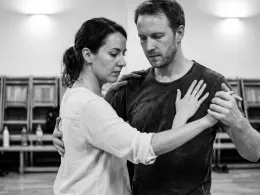
A young woman takes a lunge step with her partner while dancing Kizomba
If you notice the weight shift, you can change direction together even with small steps.

Urban Kiz shifts the focus to accents and freedom of movement

Urban Kiz is often taught as a related dance style with its own interpretation. The music may include electronic sounds, pronounced pauses or distinct changes; dancers often respond with changes of direction, stops and movements that are more independent of each other. This is not a fixed checklist. Depending on the teacher, the transitions between Kizomba and Urban Kiz can be fluid, and the course name alone does not always explain how much room there is for each element.

The difference is therefore not simply that Kizomba is slow and Urban Kiz is fast. Both can feel calm or dynamic. What matters more is how you respond to musical accents and how much independent movement you use while connected to your partner. At some moments, the contact stays close and continuous; at others, you visibly move apart without losing your shared sense of direction.

When comparing courses in Dortmund, it’s worth asking specific questions: Are the basics of shifting your weight taught, or does the class already assume experience with partner dancing? What music is used, and how are partner changes handled? A suitable social dance format can also be a way to observe different dance styles in practice later on, without immediately trying every movement yourself.

Closeness with clarity, not pressure

This is how

  • Choose a hold that lets both of you breathe and move freely
  • Give small impulses through your own body
  • Shift your weight first, then take the step
  • If you feel unsure, briefly release the connection and find it again

Not like this

  • Hold your dance partner's upper body or pull them closer
  • Force direction and tempo with your arms
  • Take steps before shifting your own weight
  • Dance closer without asking, even though the contact isn't reciprocated

When the connection is clear, neither partner needs to push the other through the step.

Kizomba dance instructor

A good connection comes from attentiveness and consent

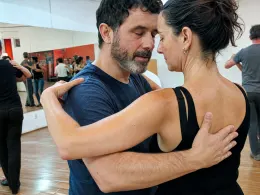
In Kizomba, connection is often communicated through body tension and weight shifts. That does not mean one person controls the other like a tool. The leading role suggests a direction of movement, and the following role picks up the impulse and responds while maintaining their own balance. Both contribute to the dance. A clear impulse is small enough not to hurt and to be answered without resistance.

Closeness is a shared decision, not a technique that can automatically be inferred from a style. Before dancing, you can ask whether a closer or more open hold feels comfortable, and pay attention to body language during the dance. If the connection becomes uncomfortable, you can create distance or end the dance. This applies regardless of which role you dance or how experienced your partner is.

Especially at the beginning, it helps not to use force to save figures. If the rhythm becomes uncertain, return to a simple step and find the shared pulse again first. Good teaching also means that instructors explain how contact, roles, and boundaries are connected. This leaves room for musicality without confusing closeness with pressure.

Two interpretations of the same musical foundation

Kizomba

Small steps, smooth flow

The movement often stays close to the floor

Many dancers experience Kizomba as calm and continuous: weight shifts and connection carry each step. That doesn’t mean all figures have to be close or look the same.

Urban

More breaks and individual paths

Musical accents become more visible

Urban Kiz can play with stops, changes of direction, and separate movement paths. Here too, shared awareness remains important, even when the dancers temporarily leave more space between them.

Frequently Asked Questions

  1. Urban Kiz is closely related to Kizomba, but often places different emphasis on movement and musicality. The boundaries are not the same everywhere: teachers and dance scenes sometimes use the terms differently. So ask about the music, basic movement and teaching focus before joining a class.

Partner Dance Classes in Dortmund

Compare current classes in Dortmund and check whether Kizomba or Urban Kiz is explicitly taught.

Find your rhythm together

On udansa, you can compare partner dance classes in Dortmund and find a way to get started that suits your experience and interest in Kizomba.

Find your rhythm together