
Find your dance connection
Here you can meet other Kizomba enthusiasts who, just like you, want to refine their dance posture. Find the right courses and dance partners in your area now.



By Bernhard De LucaUpdated
Here you can meet other Kizomba enthusiasts who, just like you, want to refine their dance posture. Find the right courses and dance partners in your area now.
Anyone who dances Kizomba feels the music as a single unit within the pair. The posture is the key to wordless communication that requires no force at all.
The Kizomba dance frame describes the stable, yet elastic posture of the upper body and arms in a pair. It serves as the primary communication channel to transmit movements and weight shifts without any effort.
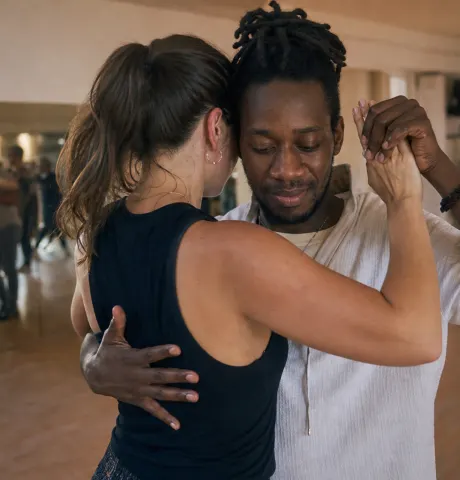
Kizomba differs fundamentally from Salsa or Bachata, as communication within the pair takes place almost exclusively through direct upper body contact. The correct Kizomba posture requires an upright, yet relaxed spine. You stand stably on both feet, with your body weight shifted slightly forward onto the balls of your feet. This minimal forward lean allows the rib cages of both dancers to touch gently without building up pressure.
A stable Kizomba dance frame is not created by muscle strength in the arms, but by the alignment of the entire upper body. The shoulders remain low and relaxed, while the chest is slightly lifted. This creates a natural connection that transmits every weight shift instantaneously. If you are interested in getting started, it is worth taking a look at the comprehensive guide Learning to dance Kizomba: The guide for partner dancing.
A stable Kizomba connection with your partner is based on the principle of a shared center of gravity. The contact point is located in the area of the sternum. This connection must never feel rigid or blocked: it behaves more like an elastic spring that adapts to movements in the room. The leader does not lead with their hands or arms, but moves their own chest, to which the follower reacts organically.
In the Kizomba dance frame, the arms primarily have a framing and protective function. The leader's right hand lies flat on the follower's back, usually in the area of the left shoulder blade. The follower's left arm rests relaxed on the leader's shoulder or upper arm. This closed posture ensures maximum stability and a sense of security on the dance floor, but it requires mutual trust and the conscious acceptance of closeness.
Correct
Wrong
In Kizomba, the posture is not a rigid corset, but a constant conversation without words, based on absolute trust.
A common misunderstanding regarding Kizomba posture in partner dancing is the assumption that you have to lean against each other. As soon as one partner gives their own balance to the other, the lightness is lost and painful pressure in the back arises. Every dancer must maintain their own axis. The art lies in standing completely independently and maintaining balance despite physical contact.
To optimally shape the Kizomba partner connection, it helps to imagine an invisible wall between the pelvises. While the upper body maintains close contact, there remains enough space in the hip area for free movement. If you would like to practice your posture in the protected setting of professional instruction, you will find suitable offers in your area on the udansa portal.
The elastic unit at eye level
The upper body is upright and the weight is slightly forward. The connection feels light, breathing, and flexible, so that every weight shift is understood immediately.
Cramping due to too much pressure
The partners lean against each other or cling with their arms. As a result, balance is lost and movements appear wooden, clumsy, and blocked.
Contact in Kizomba happens at the chest. The hips remain at a distance to guarantee maximum freedom of movement and to prevent the knees from knocking together.
No, you must maintain your own balance. If you lean against your partner, it creates heavy pressure that blocks smooth movements.
Keep your shoulders consciously low and relaxed. Breathe deeply into your belly and imagine that your arms are only gently framing your partner, instead of holding them tightly.
Find the right course to perfect your Kizomba posture with professional guidance.
Couple danceLimbach-Oberfrohna · Germany
Silberkurs für PaareSunday · 16:15 · Oct 25 - Nov 15
Limbach-Oberfrohna
Couple danceLimbach-Oberfrohna · Germany
PaartanzkreisSunday · 16:30 · Oct 25
Limbach-Oberfrohna
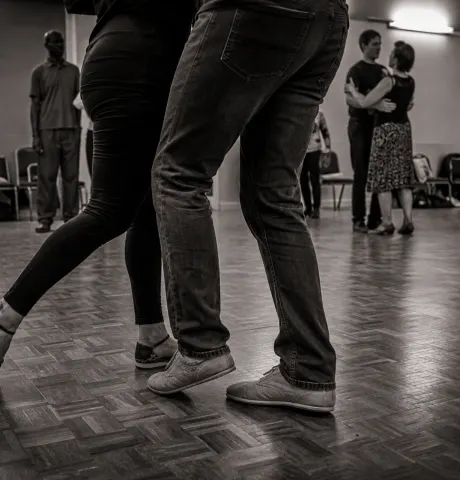 Learn Kizomba steps: An easy start for beginnersGetting started is easy: With our practical guide, you will learn the most important Kizomba basic steps and the correct posture for a harmonious dance experience.
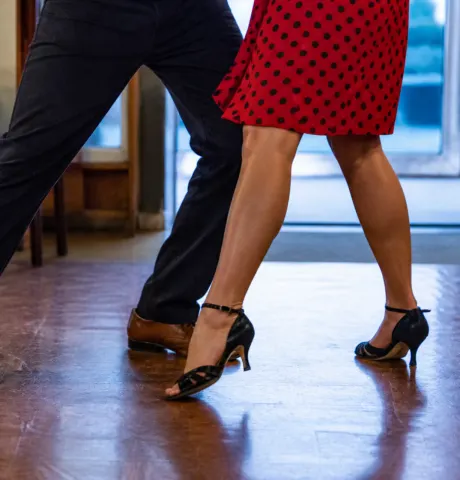 Kizomba Side Step: Guide to Weight TransferMaster the Kizomba side step with our simple guide. Learn how to shift your weight smoothly and bring more stability to your dance.
 Kizomba for beginners: The 5 most common mistakes in the basicsWhen learning Kizomba, you often stumble over the same hurdles at the beginning. This overview shows you the five typical beginner mistakes and how to correct them immediately.
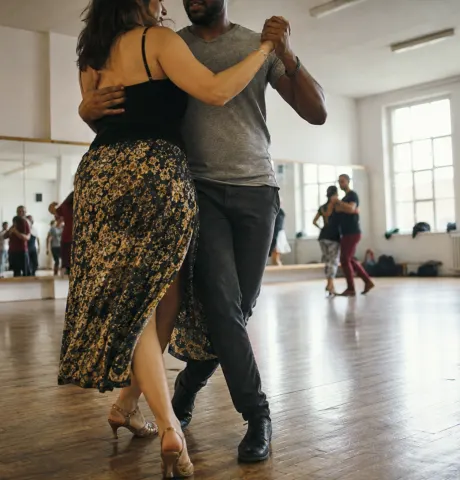 Kizomba Level Test: Do you already master the basics?Do you really master the Kizomba basics already, or should you keep working on your foundation? Take our quick level test now and find out.
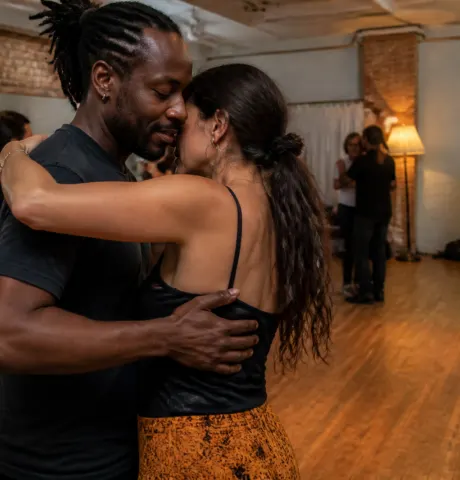 Leading and following in Kizomba: The art of weight transferDiscover how leading and following in Kizomba works through subtle chest weight transfers and how you can maintain a perfect connection.
 Learn Kizomba turns: Simple quarter turns for beginnersLearn how to execute simple quarter turns in Kizomba with control and harmony, without losing the close connection to your partner.
 Learn to hear the Kizomba beat: How to always stay on rhythmLearning to hear the Kizomba beat is the key to smooth steps. Find out how to recognize the rhythm in class immediately and make your dancing harmonious.