

Find your Kizomba partner on udansa
Find like-minded people in your area on udansa who share your passion for the subtle leading in Kizomba, and discover suitable courses for your start together.


Kizomba fascinates with an almost magical connection that requires no words or grand gestures. Anyone who understands the secret of subtle weight shifting will experience a completely new feeling of lightness in partner dance.
Weight transfer refers to the conscious shifting of the body's center of gravity from one foot to the other. In Kizomba, it is the primary tool used to signal changes in direction and step tempo to your partner without the use of arm strength.
Kizomba is not a dance of loud signals, but of quiet nuances. While in many Latin American dances the arms and hands serve as primary antennas to signal changes in direction, the hold in Kizomba remains relaxed and calm. The secret lies in the upper body: the actual leading is created by a minimal, yet precise weight shift in your own chest. The leader initiates every movement by shifting their own center of gravity. The follower does not react to a pulling or pushing of the hands, but feels this subtle weight shift directly through the close contact of the upper bodies.
To understand this connection, it helps to take a look at the basics of Kizomba. When you shift your weight onto your left foot, your chest inevitably moves a bit to the left. Since your partner is standing close to you, their body follows this movement quite naturally in order to stay in balance. This intuitive transmission makes the dance so fluid and organic. It is not about moving the other person, but about moving yourself so precisely that the partner cannot help but go along with you.
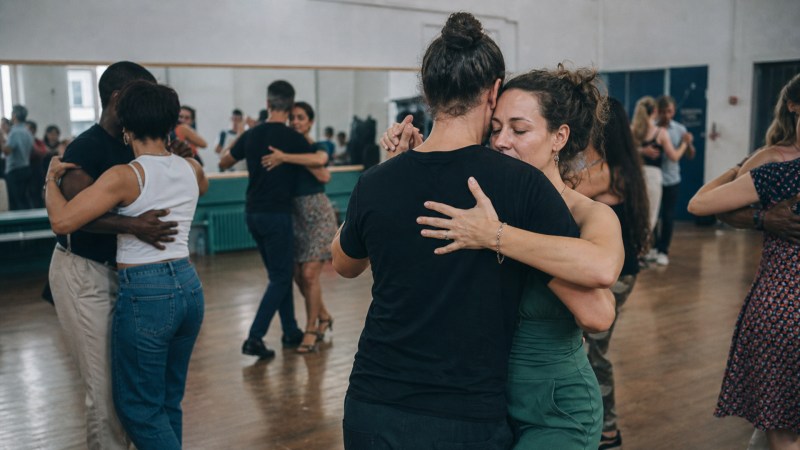
A common misconception among beginners is the belief that leading is synonymous with muscular force or mechanical pressure. Anyone who tries to steer their partner in a direction using their arms blocks the natural flow of movement and creates painful tension. In Kizomba leading and following, it is much more about managing a shared center of gravity. Imagine that your bodies share a single pendulum. Every movement you initiate in your pelvis and chest continues like a gentle wave through the other person's body.
To maintain this sensitive connection, your own core must have a pleasant basic tension without becoming stiff. This so-called connection requires a high degree of mindfulness. If you as a follower are too limp in your posture, the leader's signals will dissipate into thin air. If you are too rigid, however, you will block every change of direction. The goal is an elastic connection that functions like a fine shock absorber and transmits every nuance of weight shifting without delay.
Feel free to close your eyes during practice. Without visual focus, you will feel the subtle weight shift of your partner in the chest area even more intensely and learn to follow purely intuitively.
In Kizomba, the leader never moves the partner, but always only themselves. The other person simply follows the gap created by your own movement.
The key to a harmonious Kizomba dance lies in the conscious play with gravity. Every time you prepare a step, you lower your center of gravity minimally. This tiny preparation signals to your partner that a movement is about to follow. Only then does the actual weight transfer occur. Through this two-step principle, the lowering and subsequent shifting, the follower always knows blindly on which foot the leader's weight rests and which foot is free for the next step.
This non-verbal communication works so precisely that even complex changes of direction become possible without any hand signals. If you would like to dive deeper into the fascinating world of this dance, it is also worth taking a look at the history and development of Kizomba to better understand the African roots of this close connection. On udansa you will also find a vibrant community to try out the fine interplay of leading and following directly in practice.
The invitation through your own movement
As a leader, you initiate every movement from your own center. You focus on shifting your own weight precisely and invite your partner to follow this movement fluidly through your stable chest.
Responding sensitively to impulses
As a follower, you maintain a pleasant body tension and feel your partner's weight shift. You actively wait for the impulse in the upper body instead of anticipating steps or going your own way.
Leading is done through the chest and close upper body contact. The leader shifts their own center of gravity, which the follower feels immediately through the direct connection and balances out.
Find the right course on udansa now and learn the art of subtle leading from experienced instructors.
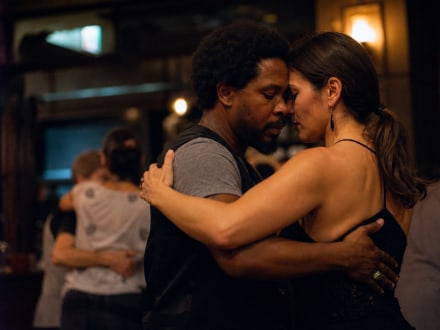 Learn to dance Kizomba: The guide to the partner danceKizomba combines African rhythms with a deep, emotional connection in partner dance. Learn how to master this fascinating dance style from scratch.
 The history of Kizomba: From its Angolan roots to a global danceDive into the history of Kizomba. Learn how Angolan traditions and Caribbean beats combined to create a global dance phenomenon.
 Learn Kizomba steps: An easy start for beginnersGetting started is easy: With our practical guide, you will learn the most important Kizomba basic steps and the correct posture for a harmonious dance experience.
 Learn Kizomba turns: Simple quarter turns for beginnersLearn how to execute simple quarter turns in Kizomba with control and harmony, without losing the close connection to your partner.
 Learn to hear the Kizomba beat: How to always stay on rhythmLearning to hear the Kizomba beat is the key to smooth steps. Find out how to recognize the rhythm in class immediately and make your dancing harmonious.
 The 5 essential Kizomba moves for beginnersPrepare perfectly for your first Kizomba social. These five simple basic figures give you confidence on the dance floor and strengthen your connection as a couple.
 Kizomba floorcraft: Mastering space in partner danceKizomba thrives on connection, not large steps. In this guide, learn how to optimize your space on the dance floor and shine even in the tightest spots.
 Learn Kizomba Saida: Step-by-step guide for couplesThe Saida is the heart of Kizomba. With our simple step-by-step guide, leaders and followers will learn how to perfectly harmonize this elegant lunge as a couple.
 Train your Kizomba balance: 5 solo exercises for more stable stepsDo you want to train your Kizomba balance? Discover five effective solo exercises that improve your stability and give you more confidence on the dance floor.