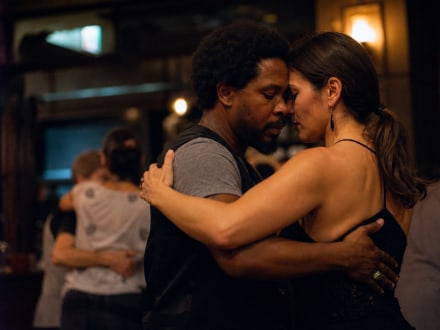
Find your partner for social dancing
On udansa, you will find like-minded people to refine your technique with, as well as suitable courses in your area. Sign up and start your next dance adventure!


A stable stance is the foundation for smooth movements. With these targeted exercises, you strengthen your balance without a dance partner and gain noticeably more self-confidence on the dance floor.
Solo suitability
All presented exercises can be performed without a partner and in the smallest of spaces.
Simple implementation
The exercises do not require any expensive equipment and are suitable for every fitness level.
Kizomba focus
The focus is purely on the functional strengthening of the typical Kizomba axis.
Doable anywhere, 2 minutes daily
While standing, lift one knee until your thigh is parallel to the floor. Hold this position for 30 seconds per side to stabilize your ankles and activate your deep core muscles.
Living room, 3 minutes per round
Shift your weight extremely slowly from one foot to the other, without tilting your upper body. This exercise simulates the precise weight transfer that is essential for the smooth transitions in Kizomba.
Secure surface, hold for 1 minute
Close both eyes while standing securely and try to distribute your weight evenly on the balls of your feet. Switching off your visual sense forces your nervous system to regulate your balance through the soles of your feet.
Smooth floor, 10 repetitions per side
Bend your knees slightly (Kizomba flexion) and move your free leg in a semicircle around your standing leg, without touching the floor. This strengthens your thighs and secures your hip stability during changes of direction.
Barefoot recommended, 15 repetitions
Push yourself up onto your tiptoes in a controlled manner, hold the position briefly, and slowly lower your heels again without letting them touch the floor completely. This strengthens your calves and prepares you for precise steps.
If you want to train your Kizomba balance, solo training within your own four walls is the most effective way. Many dancers make the mistake of trying to solve stability issues only when dancing as a pair. However, if you wobble while standing alone, you cannot provide security for your partner either. Through targeted individual training, you build the necessary deep muscles in your core and ankles, which are essential for the typical grounded Kizomba connection.
For successful Kizomba solo training, you need neither much space nor special equipment. It is important, however, that you perform the exercises barefoot or in flat socks to receive direct feedback from the floor. Later, you can repeat the sequences in your regular dance shoes. Focus on controlled execution with every movement and keep your spine elongated at all times. If you want to delve deeper into the basics, our guide on learning to dance Kizomba will help you.
You should train your Kizomba balance because a secure stance is the basic requirement for subtle, touch-based leading and following in partner dance. Without your own balance, you block your partner's movement.
Put your new stability into practice in your next dance course and find suitable offers.
 Learn Kizomba steps: An easy start for beginnersGetting started is easy: With our practical guide, you will learn the most important Kizomba basic steps and the correct posture for a harmonious dance experience.
 Kizomba footwork: How rolling your feet supports the close embraceLearn how to make your steps smoother with the right Kizomba footwork and fluid rolling motion. This guide shows you the path to perfect legwork.
 Kizomba classes 2026: What's changing for beginnersKizomba learning trends 2026 shows you how modern dance schools are shaping the beginner experience today. Learn all about the latest teaching approaches for quick success on the dance floor.
 Kizomba to fast and slow music: adjusting your stepsFind out how to flexibly adapt your Kizomba steps to any music tempo without losing the basic step. Perfect for beginners!
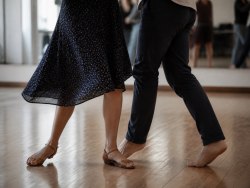 Learning the Kizomba basic step: A precise guideEvery beginning is easy: With our precise guide to the Kizomba basic step, you are guaranteed to get started with this fascinating partner dance, even without prior experience.
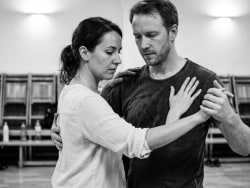 Kizomba posture: How to master the perfect connection and dance frameThe right Kizomba posture is the foundation for a harmonious connection on the dance floor. Learn how to dance with stability and fluidity through correct upper body contact.
 Kizomba Side Step: Guide to Weight TransferMaster the Kizomba side step with our simple guide. Learn how to shift your weight smoothly and bring more stability to your dance.