

Find your dance connection
On udansa you can find dance enthusiasts in your area who want to feel the rhythm with you and try out what you have learned directly on the dance floor.


Different speeds on the dance floor can quickly throw Kizomba beginners off balance. With a few simple adjustments to your technique, you will maintain absolute control with every beat.
Adjusting Kizomba tempo describes the ability to adapt step size and the dynamics of weight shifting to the speed of the song, without changing the structure of the basic step.
The music in Kizomba is incredibly versatile, ranging from sustained, almost floating melodies to driving, fast beats. To remain confident in every situation, you need to be able to adjust your Kizomba tempo. The most important rule here is: the basic step always remains the same in its structure, only the dynamics and step size change. If you try to use the same stride length for a fast song as you would for a slow ballad, you will inevitably lose your balance and contact with your partner.
To get started, it helps to focus on the basics, as taught in Learning Kizomba steps: The easy introduction for beginners. As soon as your feet find their way all on their own, direct your attention to the music. At high speeds, reduce your steps radically. Your feet stay extremely close to the floor and move almost exclusively under your own center of gravity. This way, you save valuable milliseconds and keep up with the beat effortlessly without stumbling.
When the DJ plays a song with a significantly reduced tempo, a whole new challenge often arises: balance. To maintain control during slow music, you must consciously celebrate every weight shift. Instead of hastily falling from one foot to the other, use the entire duration of the beat to shift your center of gravity smoothly. This requires stable body tension and a close connection as a pair, which you can deepen in our comprehensive guide on learning to dance Kizomba: The guide for partner dance.
Use the slowness of the music to make your movements more fluid. Instead of simply slowing down your steps, you can keep your knees slightly bent and execute the rolling of your feet in an extremely controlled manner. This gives you the necessary grounding and prevents the movement from appearing shaky. Slow songs are no reason for boredom, but rather the perfect opportunity to take your own precision and intuitive understanding as a pair to a new level.
Listen to private Kizomba playlists with widely varying speeds and tap the beat with your hand. This trains your ear for tempo changes.
The music dictates the size of your steps. Anyone who learns this will dance in a pair, even at extreme speeds, in a completely relaxed and harmonious way.
The biggest hurdle when dancing to different speeds is usually in your head. Many dancers tend to get frantic as soon as the music picks up. A mental trick helps here: focus exclusively on the heavy basic beat, the so-called downbeat. Don't let the subtle intermediate rhythms distract you. As long as your foot lands precisely on the main beat, you are absolutely in time. This applies to slow ballads just as much as it does to driving, modern Kizomba tracks.
If you want to train your flexibility in partner dancing, consciously switch back and forth between extremely different songs while practicing. Dance the same basic step to a very slow piece once, and switch directly to a fast track afterwards. You will quickly notice how your posture and the intensity of the lead have to adapt automatically. With a little practice, this Kizomba speed adjustment happens completely intuitively, and you can enjoy every song on the dance floor.
Compact and stay low to the ground
For fast songs, keep your steps extremely small and compact. Your feet stay close to the ground, and you move almost exclusively under your own center of gravity to avoid losing time.
Fully enjoy weight shifts
Slow music demands maximum control. Every weight shift is fully enjoyed and executed in an extremely smooth way, which requires high body tension and conscious balance.
Reduce your steps to a minimum. The faster the music gets, the closer your feet should stay to your own body to save time and energy.
Find the right course and learn to adapt flexibly to any rhythm.
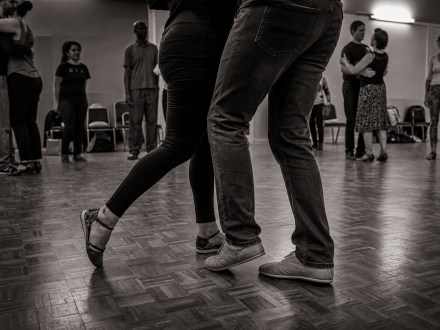 Learn Kizomba steps: An easy start for beginnersGetting started is easy: With our practical guide, you will learn the most important Kizomba basic steps and the correct posture for a harmonious dance experience.
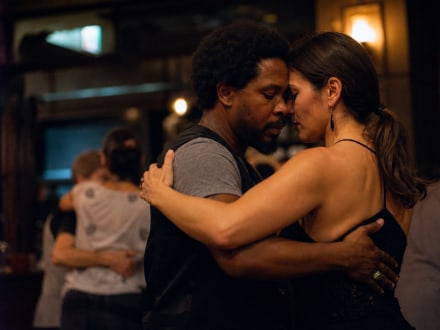 Learn to dance Kizomba: The guide to the partner danceKizomba combines African rhythms with a deep, emotional connection in partner dance. Learn how to master this fascinating dance style from scratch.
 Learn Kizomba steps: An easy start for beginnersGetting started is easy: With our practical guide, you will learn the most important Kizomba basic steps and the correct posture for a harmonious dance experience.
 Learning the Kizomba basic step: A precise guideEvery beginning is easy: With our precise guide to the Kizomba basic step, you are guaranteed to get started with this fascinating partner dance, even without prior experience.
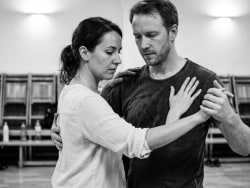 Kizomba posture: How to master the perfect connection and dance frameThe right Kizomba posture is the foundation for a harmonious connection on the dance floor. Learn how to dance with stability and fluidity through correct upper body contact.
 Kizomba Side Step: Guide to Weight TransferMaster the Kizomba side step with our simple guide. Learn how to shift your weight smoothly and bring more stability to your dance.
 Kizomba for beginners: The 5 most common mistakes in the basicsWhen learning Kizomba, you often stumble over the same hurdles at the beginning. This overview shows you the five typical beginner mistakes and how to correct them immediately.
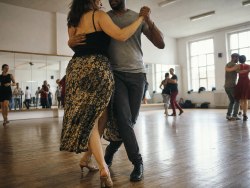 Kizomba Level Test: Do you already master the basics?Do you really master the Kizomba basics already, or should you keep working on your foundation? Take our quick level test now and find out.
 Leading and following in Kizomba: The art of weight transferDiscover how leading and following in Kizomba works through subtle chest weight transfers and how you can maintain a perfect connection.