

Find your Kizomba partner on udansa
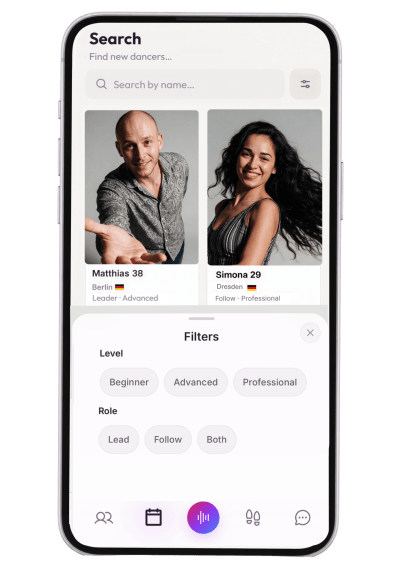
Whether you want to solidify your basics or learn new moves right away: on udansa you will find dance enthusiasts in your area who share your passion.

Kizomba fascinates with its deep connection and gentle movement. Find out with our quick self-test how confident you are in the basics and which next steps will really help you progress.
Anyone starting with Kizomba quickly realizes: this dance does not thrive on spectacular jumps or countless, fast turns. The true magic lies in the subtle connection within the pair, the precise feeling of weight, and the shared flow. Many beginners learn various step combinations quickly in their first few weeks, but often underestimate the technical depth of the seemingly simple basics. Yet, it is precisely this foundation that determines whether the dance feels smooth and harmonious for both partners or whether it feels clunky on the dance floor.
To realistically assess your current level and find out if you have already internalized the basics, an honest look at your habits during social dance helps. Do you master the gentle rolling of the feet? Can you lead direction changes blindly or follow them effortlessly? With our targeted Kizomba level test, you can find out where you currently stand in just a few minutes. If you want to deepen your theoretical knowledge, it is also worth taking a look at the comprehensive guide Learning to dance Kizomba: The guide for partner dance, which offers you an excellent overall overview.
You are still at the very beginning of your Kizomba journey, or you should repeat the absolute basics once more at your own pace. Over the next few weeks, focus primarily on hearing the beat reliably and executing weight shifts precisely. A solid beginner course is exactly what you need right now.
You have the basics down, but they still wobble a bit in stressful situations or during fast tempo changes. Work specifically on your footwork and the stability of your dance frame. A follow-up course or targeted practice evenings will help you gain the necessary confidence for social dancing.
Congratulations, your basics are rock solid and you move in perfect harmony with your partner. You feel the subtle signals of weight shifts effortlessly and execute them precisely to the beat. You are ready for more demanding courses, complex step combinations, and fluid transitions.
| Criterion | Kizomba beginner (Type A) | Advanced beginner (Type B) | Confident basic dancer (Type C) |
|---|---|---|---|
| Sense of rhythm | Often still looking for the beat in the song | Keeps the beat in familiar songs | Dances perfectly in sync with the music |
| Weight transfer | Unsure, eyes often looking down | Noticeable, sometimes needs correction | Intuitive feeling through the upper body |
| Dance frame | Tends to tense up in the arms | Stable during simple steps | Consistently soft and extremely stable |
| Use of space | Needs a lot of space for steps | Slowly avoids obstacles | Dances easily in a tight spot |
The self-assessment is based on typical curricula of modern Kizomba dance schools in 2026.
Practice shifting your weight in Kizomba on your own at home in front of the mirror. If you can move your weight cleanly from one foot to the other without tilting your upper body, you have already won half the battle for a smooth social dance.
The result of your level test shows you in black and white what you should focus on in your next dance classes. If you notice that you still lack absolute confidence in the basics, that is no reason for concern, but rather the perfect starting point for targeted training. Often, small adjustments in posture or a more conscious listening to the beat are enough to take your dancing to a completely new level. For getting started and refining your first steps, the guide Learning Kizomba steps: The easy entry for beginners will help you particularly well.
Use your test result to work specifically on your weaknesses in class or during social dancing. Ask your dance partners for honest feedback: Does the weight transfer feel clear? Is the posture stable without being tense? Kizomba is a constant dialogue without words, and the clearer your signals and the more sensitive your reactions are, the more intense and beautiful the shared dance experience becomes at every social.
A Kizomba level test helps you realistically assess your own skills and find the right follow-up course. This way, you avoid being under-challenged in beginner courses or feeling frustrated by figures that are too difficult for advanced dancers.
Find the right course that fits your current dance level perfectly.
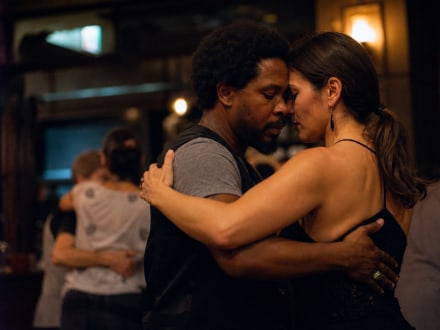 Learn to dance Kizomba: The guide to the partner danceKizomba combines African rhythms with a deep, emotional connection in partner dance. Learn how to master this fascinating dance style from scratch.
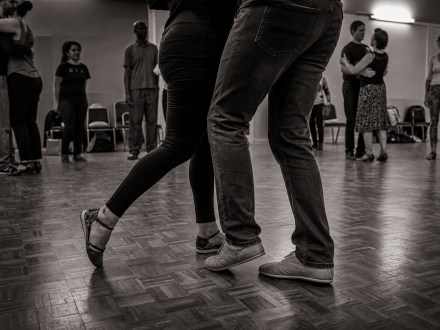 Learn Kizomba steps: An easy start for beginnersGetting started is easy: With our practical guide, you will learn the most important Kizomba basic steps and the correct posture for a harmonious dance experience.
 Learn Kizomba steps: An easy start for beginnersGetting started is easy: With our practical guide, you will learn the most important Kizomba basic steps and the correct posture for a harmonious dance experience.
 Leading and following in Kizomba: The art of weight transferDiscover how leading and following in Kizomba works through subtle chest weight transfers and how you can maintain a perfect connection.
 Learn Kizomba turns: Simple quarter turns for beginnersLearn how to execute simple quarter turns in Kizomba with control and harmony, without losing the close connection to your partner.
 Learn to hear the Kizomba beat: How to always stay on rhythmLearning to hear the Kizomba beat is the key to smooth steps. Find out how to recognize the rhythm in class immediately and make your dancing harmonious.
 The 5 essential Kizomba moves for beginnersPrepare perfectly for your first Kizomba social. These five simple basic figures give you confidence on the dance floor and strengthen your connection as a couple.
 Kizomba floorcraft: Mastering space in partner danceKizomba thrives on connection, not large steps. In this guide, learn how to optimize your space on the dance floor and shine even in the tightest spots.
 Learn Kizomba Saida: Step-by-step guide for couplesThe Saida is the heart of Kizomba. With our simple step-by-step guide, leaders and followers will learn how to perfectly harmonize this elegant lunge as a couple.