

Find your Kizomba partner on udansa
On udansa you will find like-minded people in your area who share your fascination for this rhythmic partner dance. Simply sign up and discover suitable courses and dance partners.


Anyone learning Kizomba quickly realizes that the dance does not live from large steps, but from the intense connection within the couple. Learn how you can make optimal use of the space and dance confidently even on the most crowded dance floors.
Kizomba floorcraft describes the way dance couples move on the dance floor while taking into account the available space and other couples. In Kizomba, it is primarily based on adjusting step size and alternating between stationary and traveling elements.
Anyone stepping onto a Kizomba dance floor for the first time often brings expectations from other dances that you have to move continuously through the room. In Kizomba, it is different. The Kizomba floor craft in partner dancing differs fundamentally from ballroom dances or Salsa. While those often involve covering long distances, Kizomba focuses on the connection within the pair. The actual space required for Kizomba is surprisingly small, as dance partners usually move in a very close embrace. This proximity makes it possible to transmit signals through minimal weight shifts of the upper body, without the need for large steps.
For beginners, this realization is often a great relief. You do not have to conquer the entire room immediately or keep complicated paths in mind. It is perfectly sufficient to focus on your own axis and your partner. Movement in the room arises organically and fluidly in Kizomba, rather than following a rigid pattern. If you want to learn the basics, our guide on Kizomba steps for beginners will help you develop an initial feel for these subtle movements.
In a crowded dance school or at a cozy social, things can quickly get tight. This is where the true strength of dance shows: dancing Kizomba on the spot is not a makeshift solution, but an art form in its own right. When space is limited, you simply make your steps smaller. Instead of placing your foot far forward or to the side, you just lightly tap the floor or shift your weight without moving your foot at all. These micro-movements keep the flow of the dance going without you colliding with other couples.
Restricting Kizomba steps in the room by no means implies that the dance becomes boring. On the contrary: the reduction to the tightest of spaces sharpens your perception of the music and the connection with your partner. You learn to use the pauses in the music more intensely and to direct the movement into your body instead of into the room. This skill is particularly valuable for staying relaxed at socials, even when the dance floor is well filled. This way, you always maintain full control over your movements.
When practicing at home, consciously use a small area, such as a single carpet tile, to develop a feel for micro-movements and dancing on the spot.
Kizomba is not a dance where you have to cover distance. The most beautiful journey in Kizomba does not take place in space, but in the shared movement of the couple on a single spot.
The key to good floor craft lies in flexibility. Beginners often tend to dance learned step patterns rigidly, regardless of how much space is currently available. Experienced dancers, on the other hand, dynamically adapt their Kizomba steps to the environment. If the dance floor opens up a gap, you can use it for smooth, flowing steps. If the gap closes, you seamlessly switch to dancing on the spot.
To develop this flexibility, it helps to consciously switch between both extremes during training. Try to alternate for the duration of a song, using as much space as possible for two eight-count bars, and then dancing on an imaginary postage stamp for the next two eight-count bars. This way, you lose your fear of tight situations and develop a natural sense for the space. If you want to delve deeper into the basics, the comprehensive guide on learning to dance Kizomba offers excellent orientation for your next steps.
Dynamic movements and wide steps
When dancing in a room, you use open spaces for fluid movements and larger steps. This is particularly suitable when the dance floor is emptier and you want to translate the dynamics of the music into wide paths.
Micro-movements in the smallest of spaces
Dancing on the spot focuses entirely on the connection within the couple and minimal weight shifts. It is the perfect choice for crowded dance floors and slow, soulful passages in Kizomba music.
Compared to ballroom dances or Salsa, Kizomba requires extremely little space. Since the dance can take place largely on the spot and in a close embrace, a single square meter is often enough to dance harmoniously.
Find the right course and learn Kizomba from scratch in a relaxed atmosphere.
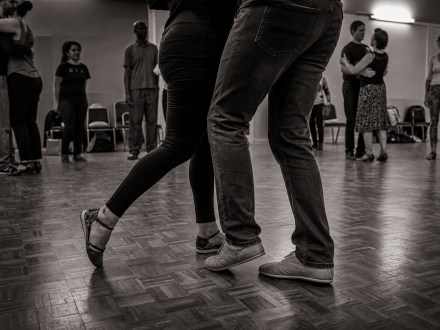 Learn Kizomba steps: An easy start for beginnersGetting started is easy: With our practical guide, you will learn the most important Kizomba basic steps and the correct posture for a harmonious dance experience.
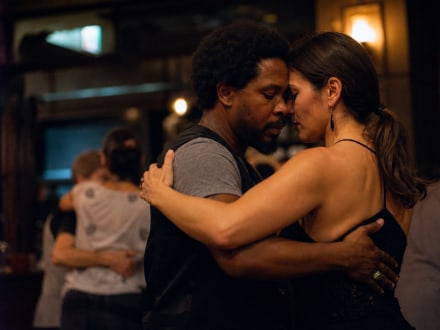 Learn to dance Kizomba: The guide to the partner danceKizomba combines African rhythms with a deep, emotional connection in partner dance. Learn how to master this fascinating dance style from scratch.
 Learn Kizomba steps: An easy start for beginnersGetting started is easy: With our practical guide, you will learn the most important Kizomba basic steps and the correct posture for a harmonious dance experience.
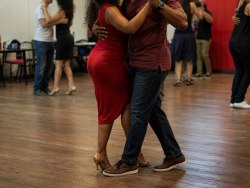 Learn Kizomba Saida: Step-by-step guide for couplesThe Saida is the heart of Kizomba. With our simple step-by-step guide, leaders and followers will learn how to perfectly harmonize this elegant lunge as a couple.
 Train your Kizomba balance: 5 solo exercises for more stable stepsDo you want to train your Kizomba balance? Discover five effective solo exercises that improve your stability and give you more confidence on the dance floor.
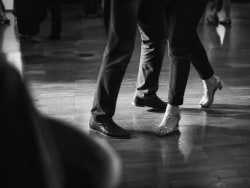 Kizomba footwork: How rolling your feet supports the close embraceLearn how to make your steps smoother with the right Kizomba footwork and fluid rolling motion. This guide shows you the path to perfect legwork.
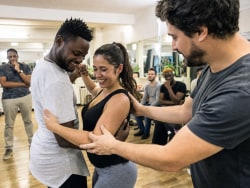 Kizomba classes 2026: What's changing for beginnersKizomba learning trends 2026 shows you how modern dance schools are shaping the beginner experience today. Learn all about the latest teaching approaches for quick success on the dance floor.
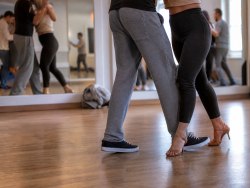 Kizomba to fast and slow music: adjusting your stepsFind out how to flexibly adapt your Kizomba steps to any music tempo without losing the basic step. Perfect for beginners!
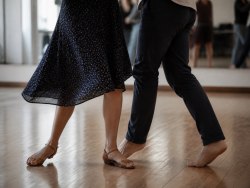 Learning the Kizomba basic step: A precise guideEvery beginning is easy: With our precise guide to the Kizomba basic step, you are guaranteed to get started with this fascinating partner dance, even without prior experience.