

Find your rhythm together with udansa
Whether you are still looking for the perfect dance partner or want to book the right course in your city immediately: at udansa, we connect you with the right dance community.


Getting started in the world of African rhythms can be confusing. With the right tricks, you will decode the beat in no time and immediately gain more confidence with every step.
The Kizomba beat describes the rhythmic foundation of the music, which is usually characterized by a distinctive, heavy bassline in 4/4 time. It serves as a temporal guide for dancers for every step and every weight shift.
Kizomba fascinates with its smooth movements and the deep connection between partners. However, for beginners, the music often presents a small puzzle at first: Where exactly is the one? Unlike other dances where a loud instrument clearly dictates the beat, the Kizomba rhythm often feels like a soft, flowing carpet. If you want to learn Kizomba steps here, you first need to learn to open your ears.
To learn how to hear the Kizomba beat, it helps to look at the structure. The music is usually based on a steady four-four time. This means we count evenly from one to four. The art lies in isolating the heavy, deep bass beat that gives the dance its characteristic grounding. This heartbeat of the music is your compass on the dance floor.
Many dance students make the mistake at the beginning of letting themselves be distracted by the subtle melodies, the vocals, or the higher percussion sounds. They try to dance every little embellishment with their feet. This quickly leads to frantic movement and the loss of connection within the pair. If you want to find the Kizomba beat, you have to consciously shift your attention downwards: focus on the low frequencies.
A proven trick in dance class is to count along quietly. Counting Kizomba music helps you anchor the rhythm in your body. Try to mark the heavy beats silently in your head as one and three. As soon as your brain automatically recognizes these anchor points, the signals transfer to your feet as if by themselves, and you dance precisely in harmony with the music.
Before you start dancing in class, close your eyes for a few seconds and just sway your hips to the bass before you take your first step.
Whoever learns not only to hear the bass in Kizomba, but to feel it as a heartbeat in their own body, will never lose the beat again.
As soon as you have the beat in your ear, it is time to put it into practice on the dance floor. Every step in Kizomba should be completed exactly when the bass beat kicks in. This means that you shift your weight completely onto the new foot at the exact moment the beat sounds. This creates the typical, almost floating smoothness that characterizes this dance.
This is particularly important for the harmonious coordination between dance partners. Only when both feel the same rhythm in their ears and bodies does the subtle communication without words work. If you want to delve deeper into the basics, it is worth taking a look at our comprehensive guide learning to dance Kizomba, which shows you how music and movement merge into a perfect unit.
Listen to the rhythmic foundation
When listening, focus exclusively on the heavy, deep bass beats. They form the rhythmic foundation on which you build your steps securely.
Ignore background gimmicks
Consciously tune out vocals and synthesizer melodies to focus on the rhythm. They often tempt beginners to rush their steps and lose the beat.
Kizomba is almost always played in a classic four-four time signature. This means that the rhythmic patterns repeat in even four-step sequences, with the heavy bass setting the beat.
Find the right course now and learn to feel the rhythm perfectly.
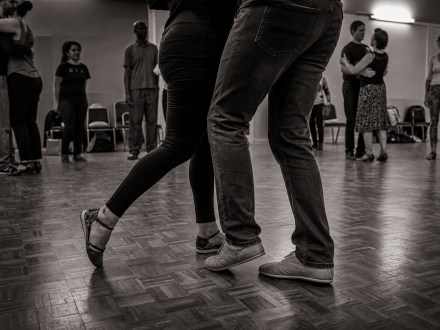 Learn Kizomba steps: An easy start for beginnersGetting started is easy: With our practical guide, you will learn the most important Kizomba basic steps and the correct posture for a harmonious dance experience.
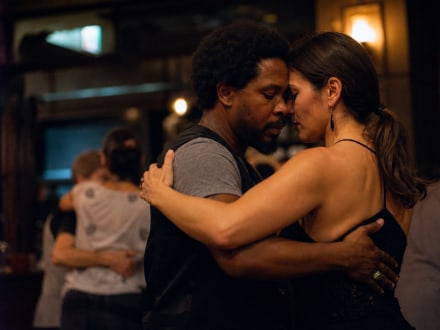 Learn to dance Kizomba: The guide to the partner danceKizomba combines African rhythms with a deep, emotional connection in partner dance. Learn how to master this fascinating dance style from scratch.
 Learn Kizomba steps: An easy start for beginnersGetting started is easy: With our practical guide, you will learn the most important Kizomba basic steps and the correct posture for a harmonious dance experience.
 The 5 essential Kizomba moves for beginnersPrepare perfectly for your first Kizomba social. These five simple basic figures give you confidence on the dance floor and strengthen your connection as a couple.
 Kizomba floorcraft: Mastering space in partner danceKizomba thrives on connection, not large steps. In this guide, learn how to optimize your space on the dance floor and shine even in the tightest spots.
 Learn Kizomba Saida: Step-by-step guide for couplesThe Saida is the heart of Kizomba. With our simple step-by-step guide, leaders and followers will learn how to perfectly harmonize this elegant lunge as a couple.
 Train your Kizomba balance: 5 solo exercises for more stable stepsDo you want to train your Kizomba balance? Discover five effective solo exercises that improve your stability and give you more confidence on the dance floor.
 Kizomba footwork: How rolling your feet supports the close embraceLearn how to make your steps smoother with the right Kizomba footwork and fluid rolling motion. This guide shows you the path to perfect legwork.
 Kizomba classes 2026: What's changing for beginnersKizomba learning trends 2026 shows you how modern dance schools are shaping the beginner experience today. Learn all about the latest teaching approaches for quick success on the dance floor.