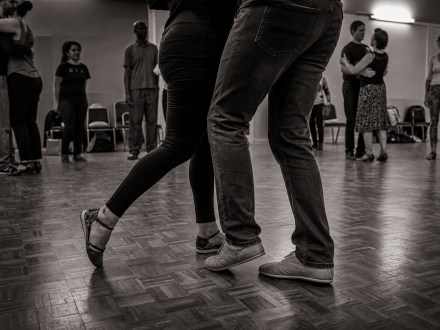
Find your partner for the next turn
On udansa you will find like-minded people in your region who want to take their first steps on the dance floor with you or refine their technique.


Kizomba thrives on the subtle connection within the couple. With the controlled quarter turn, you can effortlessly bring variety to your dance flow without disturbing the harmonious embrace and the shared rhythm.
Anyone starting with Kizomba quickly realizes that this dance lives from a deep, almost floating connection. Fast spins or expansive loops, as you know them from other dances, do not fit this intimate flow. Instead, a good Kizomba turn is based on absolute precision in the small details. The quarter turn is the perfect tool to elegantly change direction on the dance floor without jeopardizing the close embrace or the shared rhythm. If you want to learn Kizomba steps, these gentle changes of direction form the stable foundation for your dance flow.
In Kizomba, the couple does not turn via hectic arm signals, but through the direct contact of the upper bodies. Every Kizomba quarter turn is initiated by a minimal weight shift in the chest. The leader turns their own axis by only a few degrees, and the follower immediately feels this intention through the closed posture. Anyone who tries to pull with force or push the partner around here will instantly lose their balance. Focus on keeping the movement flat and close to the floor. The feet almost drag across the dance floor while the upper body dictates the direction.
Practice the quarter turn extremely slowly at first and completely without music. Focus only on how the rotation of your ribcage is transferred to your partner.
Build a stable, upright posture and find gentle chest contact with your partner. The frame remains stable, without creating any push or pull in the arms.
Start by dancing a few basic steps on the spot to internalize the common rhythm of the music and to feel the weight transfer.
The leader rotates their chest by exactly 90 degrees to the side at the moment of the step. The follower follows this movement intuitively through the firm connection.
Place your foot gently on the new axis and shift your body weight completely onto the new standing leg to ensure your balance.
Close your free foot without weight in a controlled manner to complete the turn and be ready for the next basic step immediately.
A Kizomba turn is led through the weight shift in the leader's upper body. Due to the constant chest contact, the follower feels the change of direction immediately and follows the movement on their own axis.
Find the right course now and learn Kizomba from scratch.
 Learn Kizomba steps: An easy start for beginnersGetting started is easy: With our practical guide, you will learn the most important Kizomba basic steps and the correct posture for a harmonious dance experience.
 Learn to hear the Kizomba beat: How to always stay on rhythmLearning to hear the Kizomba beat is the key to smooth steps. Find out how to recognize the rhythm in class immediately and make your dancing harmonious.
 The 5 essential Kizomba moves for beginnersPrepare perfectly for your first Kizomba social. These five simple basic figures give you confidence on the dance floor and strengthen your connection as a couple.
 Kizomba floorcraft: Mastering space in partner danceKizomba thrives on connection, not large steps. In this guide, learn how to optimize your space on the dance floor and shine even in the tightest spots.
 Learn Kizomba Saida: Step-by-step guide for couplesThe Saida is the heart of Kizomba. With our simple step-by-step guide, leaders and followers will learn how to perfectly harmonize this elegant lunge as a couple.
 Train your Kizomba balance: 5 solo exercises for more stable stepsDo you want to train your Kizomba balance? Discover five effective solo exercises that improve your stability and give you more confidence on the dance floor.
 Kizomba footwork: How rolling your feet supports the close embraceLearn how to make your steps smoother with the right Kizomba footwork and fluid rolling motion. This guide shows you the path to perfect legwork.