
Find your dance partner for Kizomba
On udansa you can find like-minded people in your city who, just like you, share the fascination for this rhythmic dance and want to practice the basics together.



By Bernhard De LucaUpdated
On udansa you can find like-minded people in your city who, just like you, share the fascination for this rhythmic dance and want to practice the basics together.
The Kizomba side step brings dynamics and variety to your dance, without you having to learn complicated figures. With the right technique, every step feels completely effortless.
The appeal of Kizomba does not lie in spectacular show figures, but in the deep, almost silent connection between partners. To feel this harmony, you do not need to memorize dozens of figures: it is completely sufficient to focus on the essentials. Anyone who masters the Kizomba basics can already enjoy the entire evening on the dance floor. The side step, often closely related to the so-called Kizomba passadas (the walking steps) in a traditional context, forms the perfect foundation for this. It breaks up the linear forward movement and gives you the space to interpret the music in a whole new way.
The secret to a smooth side step lies in the complete shift of weight. Unlike European ballroom dances, where a continuous, flowing movement through the room is often aimed for, udansa thrives on conscious presence in every single step. Each step is a clear statement. Only when your center of gravity rests completely over the new standing leg is the step complete. This apparent simplicity requires concentration and good body awareness, but rewards you with an irrepressible stability that is immediately transferred to your partner.
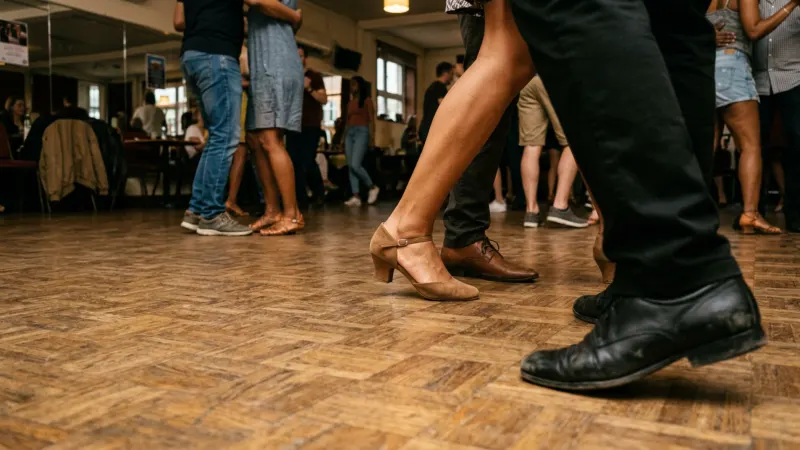
Stand up straight, relax your shoulders, and bend your knees very slightly. Shift your entire body weight onto your right leg so that your left foot rests completely free and unweighted on the floor.
Place your free left foot in a controlled, flat manner a comfortable step to the left. Make sure that you do not throw the foot, but rather guide the movement softly from the hip.
Now consciously shift your center of gravity over your left foot. You will know it worked when you could lift your right foot off the floor effortlessly and without losing your balance.
Slowly drag your unweighted right foot toward you without applying pressure until it is parallel to your left foot again. Keep your weight entirely on your left leg so you are ready for the next step immediately.
How it works
Things you should avoid
Preparation
Arrival
During
The side step differs through the complete weight transfer and the conscious, flat placement of the feet. While you often spring elastically or keep your weight centered in other dances, in Kizomba you stand completely on one leg with every step.
In Kizomba, feet should be placed as flat as possible, rolling softly over the sole of the foot. Avoid dancing only on the balls of your feet, as this removes the typical grounding and stability of the dance.
Leading is done exclusively through a minimal weight transfer of your own upper body. When you shift your center of gravity to the side, your partner follows this movement quite naturally, without you having to pull on their hands.
Find the right course and learn the smooth steps right in your area.
Couple danceLimbach-Oberfrohna · Germany
Silberkurs für PaareSunday · 16:15 · Oct 25 - Nov 15
Limbach-Oberfrohna
Couple danceLimbach-Oberfrohna · Germany
PaartanzkreisSunday · 16:30 · Oct 25
Limbach-Oberfrohna
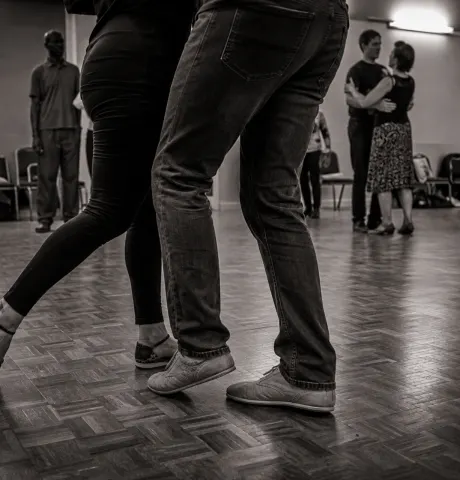 Learn Kizomba steps: An easy start for beginnersGetting started is easy: With our practical guide, you will learn the most important Kizomba basic steps and the correct posture for a harmonious dance experience.
 Kizomba for beginners: The 5 most common mistakes in the basicsWhen learning Kizomba, you often stumble over the same hurdles at the beginning. This overview shows you the five typical beginner mistakes and how to correct them immediately.
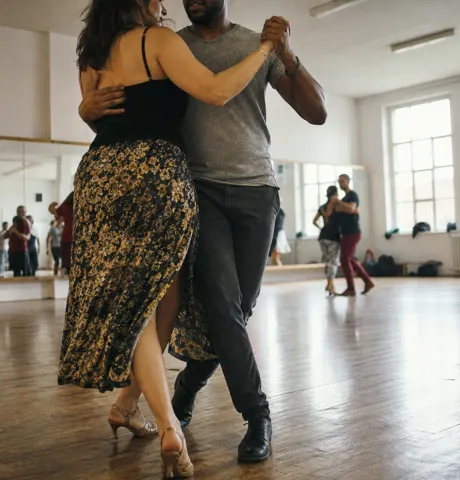 Kizomba Level Test: Do you already master the basics?Do you really master the Kizomba basics already, or should you keep working on your foundation? Take our quick level test now and find out.
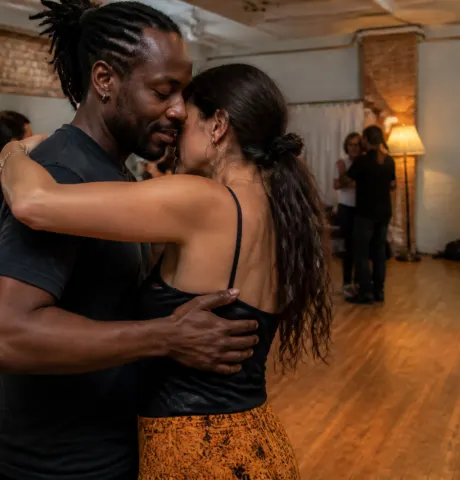 Leading and following in Kizomba: The art of weight transferDiscover how leading and following in Kizomba works through subtle chest weight transfers and how you can maintain a perfect connection.
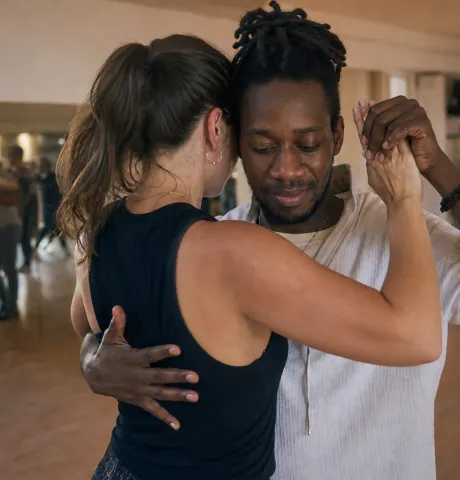 Learn Kizomba turns: Simple quarter turns for beginnersLearn how to execute simple quarter turns in Kizomba with control and harmony, without losing the close connection to your partner.
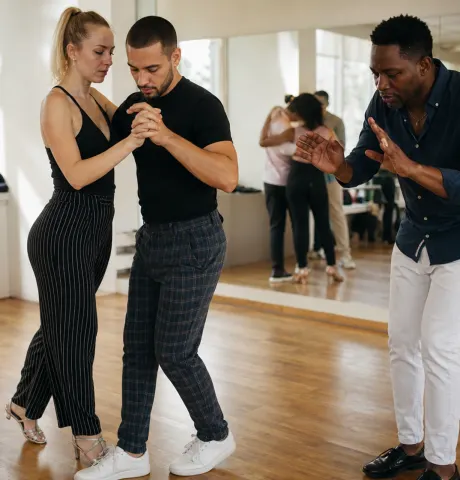 Learn to hear the Kizomba beat: How to always stay on rhythmLearning to hear the Kizomba beat is the key to smooth steps. Find out how to recognize the rhythm in class immediately and make your dancing harmonious.
 The 5 essential Kizomba moves for beginnersPrepare perfectly for your first Kizomba social. These five simple basic figures give you confidence on the dance floor and strengthen your connection as a couple.
