Social Dance5 minutes

Dance Floor Etiquette in Dortmund: Feel Confident at Social Dance

By Bernhard De LucaUpdated

In short
  • On a crowded dance floor, keep your movements compact and watch out for nearby couples.
  • Move with the flow of the dancers instead of cutting across their paths.
  • Ask someone to dance first, and respect a no or a request for more space.
  • If you bump into someone, apologize briefly and give them room to keep dancing.

On a social dance floor, people share the same space even though they bring different steps, tempos, and levels of experience. Consideration often shows in small adjustments that barely interrupt your own dancing.

DefinitionLine of Dance

Line of dance refers to the direction in which couples move together around a dance floor. Observing it helps you judge gaps better and avoid unnecessary collisions.

A dance floor has active and quieter zones

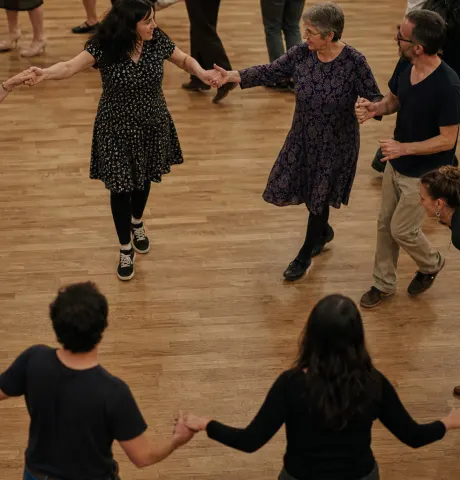
On a social dance floor, different areas often emerge: couples tend to move along a path around the outside, while dancing in the middle more often takes place in a smaller space. This is not a rigid boundary, but a guideline that shifts with the music, the space and the group's movements. In Dortmund, this basic principle helps you stay aware of your path, just as it does elsewhere.

Before you start a figure, briefly look in the direction it will take you. If a couple is moving there, wait, make your movement smaller or change its course. Turns that briefly take your eyes off your surroundings need plenty of clear space. If you want to join the flow on the outside, look for a gap and move with the flow rather than suddenly crossing the path.

The zones do not have to be perfectly organized. When tempos change or many people are dancing, the direction of movement can become unclear. Then the safest guide is not an imagined line, but the visible distance between you and the people around you.

A man and a woman dance Bachata on a dance floor at a Latin dance event
If you keep track of how others are moving, you can keep your movements small even on a crowded dance floor without losing your own rhythm.

Consideration also means respecting closeness and consent

In partner dancing, physical closeness is part of many movements, but it does not give you free rein to make any kind of contact. Keep the frame comfortable so both of you can move safely, and adjust the pressure and distance to your partner’s response. A step back or a gentler lead may be enough if the floor is crowded or the situation feels unfamiliar.

An invitation to dance should also leave room for a genuine choice. Ask clearly, without tugging on someone’s arm or hand. A friendly no is not up for negotiation, and no one has to explain why they don’t want to dance right now. This applies whether or not you know each other, and whether or not you have danced together before.

If you bump into someone, a brief apology is usually more helpful than a long interruption. Give them space, see whether they want to keep dancing, and adjust how much room your movements take up. Repeated collisions are a sign that you should slow down or briefly leave the floor. This makes consideration practical, without turning every small mistake into a big scene.

How to share the dance floor

Do this

  • Join the flow of dancers at the edge of the floor
  • Make your turns smaller when another couple comes close
  • If you bump into someone, briefly apologize and give them space

Not like this

  • Enter the dance floor right through a moving line
  • Force a big turn despite nearby couples
  • Keep pushing after bumping into someone or blame them

On a crowded floor, a small step is often a better choice than a last-minute evasive maneuver.

Partner dance instructor

Read the room, instead of just planning your moves

Social dance isn’t a test where executing a move well matters more than sharing the floor. The music, crowding and skill levels of the dancers vary from one dance night to the next. In Dortmund, you can’t assume there’s one fixed etiquette for every event, so first observe how people move and how closely they dance.

If the group stays compact, expansive movements are likely to be out of place, even if you can do them confidently. When there’s more space, you can make your movements bigger, but you should still pay attention to the space in front of and beside you. If a couple suddenly stops, keep your movements small instead of reflexively jumping into another gap.

If you’d like to get a feel for different event formats beforehand, you can check out the overview of dance night formats in Dortmund. And if you want to better assess your own skills, the article on assessing your dance level offers helpful guidance. Neither replaces observing the room in person: the situation on the dance floor sets the pace.

Two ways to share space

On the Move

Dance with the Flow

For couples moving across the floor

If you move with the overall flow, it's easier to find open lanes. This calls for awareness of your surroundings and quick adjustments when other couples slow down.

On the spot

Compact in tight spaces

For couples with small movements

Small steps and limited turns work well when space is tight or the surroundings are busy. Even then, it’s worth looking around so other dancers have enough room.

Frequently Asked Questions

  1. Make your steps smaller and skip large moves until there’s more room. If you can barely move safely, go to the edge or take a short break. Other couples shouldn’t have to move out of the way so you can finish a move.

Partner dance courses in Dortmund

In a partner dance class, you can practice spatial awareness and confident movement paths before you need them on a crowded floor.

Dancing on the floor is better together

On udansa, you can find partner dance classes and dance opportunities in Dortmund to practice dancing together on the floor. Compare options that match your experience level.

Dancing on the floor is better together