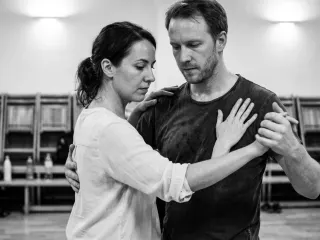
Dance partners5 minutes

Is a regular dance partner in Freiburg im Breisgau right for you?

By Mary De LucaUpdated

In brief
  • A regular dance partnership in Freiburg im Breisgau is right for you if you’re looking for familiarity and shared growth.
  • Changing dance partners are a better fit if you want to stay flexible and get to know different ways of moving.
  • Similar availability and a shared dance goal contribute more to a lasting partnership than a single successful dance.
  • A regular dance partnership means reliability on the dance floor, but not necessarily a romantic commitment or exclusive collaboration.

An evening of dancing can feel wonderful, even if your expectations for staying in touch differ widely. So deciding to pursue a committed relationship also means considering the place another person will have in your everyday life.

DefinitionDance Familiarity

Dance familiarity is an understanding of a person's movement habits that develops through dancing together repeatedly. This includes things like the usual timing of a signal and the size of the steps you take together.

Familiarity changes what you pay attention to while dancing

If you're looking for a regular dance partner in Freiburg im Breisgau, you're initially looking for continuity with another person. You don't have to start over with unfamiliar movement habits every time you meet. For example, a familiar partner is more likely to notice whether you're hesitating or deliberately taking a small step. This can free up your attention for the music, balance, and moving together.

This is especially suitable if you want to deepen your skills in a dance over a longer period. A sequence of figures you both know offers a familiar framework: you can feel whether transitions are becoming smoother, instead of simply checking each time whether you can complete the sequence at all. Familiarity is a condition for learning, not proof of flawless technique. Unhelpful habits can also take hold in a familiar partnership.

Meeting different partners offers a different appeal. You experience how differently people respond to the same music and signals. This challenges your ability to adapt and can show you which parts of your dancing work regardless of your partner. If you're just settling in, Dancing and making connections after moving explores this open approach in more detail. For this decision, what matters is whether you're looking for familiarity or variety.

Two young women dance together and learn a new dance in a dance studio
Taking breaks is part of dancing together too, without any obligation to stay for the whole evening.

A great dance doesn't mean you see a future together

Good coordination on the dance floor can happen right away. Maybe your stride length matches, or you hear the same musical accents. It's easy to start expecting everything outside that moment to fit too. But someone can enjoy dancing with you and still not want a lasting commitment.

How available someone is therefore matters. Someone who sees dancing as a regular part of their free time experiences repeated cancellations differently from someone who joins in spontaneously from time to time. Neither preference is wrong. It becomes difficult when you understand the same connection differently: for you, missing a shared evening is a loss, while for the other person, just one possible leisure activity has fallen through.

The same applies to your dance goals. If you want to shape your movement more precisely to the music, while the other person mainly wants to learn new figures, even dancing together often can become frustrating. On the other hand, different levels of experience don't have to be a problem if you both enjoy the same focus. The article on different levels in a partner dance class looks at the teaching side of this.

Commitment, available time, and dance goals need to align. A good atmosphere alone can't make up for lasting tension between these three things.

How to recognize a sound decision

Do it this way

  • Mention growing together as a reason for your connection
  • Take the time you actually have into account
  • Treat other dance connections as a separate question
  • Accept a no without taking it personally

Not like that

  • Assume lasting compatibility after a lovely dance
  • Hope for free evenings in the future
  • Automatically infer exclusivity from regularity
  • Interpret a cancellation as a lack of affection

A beautiful dance shows that a moment clicks, but not yet that two people want the same kind of commitment.

udansa-Redaktion

Your decision can change along with your everyday life

A regular dance partnership is not a reward for advanced dancing. You can enjoy learning with the same person from the very beginning. Likewise, with plenty of experience, you may prefer dancing with different people because you appreciate their different interpretations of the music. The right arrangement depends on your desire for continuity, not on a prescribed sequence.

You can also combine both approaches. Having a familiar partner to develop together with does not rule out dancing with other people. Conversely, casual connections can last a long time without becoming a regular partnership. What matters is the expectations attached to repeated contact. A regular partnership is not automatically exclusive.

To help you find your bearings, consider this contrast: Would a dance evening without this person disappoint you mainly because you would miss developing together? Or would you still look forward to dancing with other people? This helps you recognize how important continuity is to you right now, without turning a passing mood into a final decision.

If your work, family life, or interest in dancing changes, the way you connect with dance partners can change too. An honest decision to commit less is more dependable than a firm promise that has no place in your everyday life.

Two Forms of Closeness on the Dance Floor

Continuity

A Familiar Dance Partner

Less time spent coordinating anew, more time deepening things together

With the same person, you can build on what you’ve already experienced together. Even when things feel less smooth, you share a common context because you know what you’re working on. That makes this person’s availability more important in your dance routine.

Variety

Different Encounters

More Adaptability, Less Shared Commitment

With different people, you experience the same music through different ways of moving. An evening doesn't have to lead to anything further. Sometimes, though, you miss the shared experiences that a familiar couple can draw on right away.

Frequently asked questions

  1. No, a regular dance partnership does not require a romantic relationship. Dancing together can be a practical collaboration, a friendship, or part of a relationship. Physical closeness on the dance floor does not reveal anyone’s private wishes and is no substitute for mutual consent.

Partner dance classes in Freiburg im Breisgau

In the course filter, you'll find current classes and dates in Freiburg im Breisgau to help you reach your dance goals together.

Feeling at ease takes a dance partner

On udansa, you can find people in Freiburg im Breisgau who also want to dance together regularly. That way, you can look for a connection that suits your dance goal.

Feeling at ease takes a dance partner