Partner Dancing5 minutes

Ballroom Dancing in Freiburg im Breisgau: Posture and Floorcraft

By Bernhard De LucaUpdated

In a nutshell
  • Ballroom dancing in Freiburg im Breisgau includes the dance family of Slow Waltz, Tango, Viennese Waltz, Slow Foxtrot, and Quickstep.
  • The shared hold connects both bodies, without you needing to hold on to or lean on your partner.
  • Many ballroom figures move the couple around the room in the direction of dance, rather than staying in one spot.
  • Ballroom dancing is a good fit for you if you're looking for a steady connection with your partner and movement that is varied, flowing, or bold.

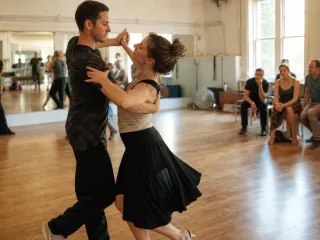
From the outside, upright upper bodies often stand out. When you're dancing yourself, you feel something different: A small shift in weight changes how much room your partner has for the next step.

DefinitionDance frame

Dance frame refers to the flexibly supported connection between the upper body, arms and hands, through which a dance couple senses movement cues. It remains adaptable and is not a rigid arm position.

Five dances belong together, but sound different

Standard ballroom dancing in Freiburg im Breisgau can be put into context through a specific local reference: At the documented Freiburg edition of the Euro Dance Festival at Ballhaus Freiburg, Standard and Latin were part of the workshop program. This shows a connection, but not an equivalence: Standard is its own dance family. The overview of the Euro Dance Festival provides context for the event, while this page focuses on the movement itself.

Standard ballroom dancing includes five dances. Slow Waltz uses a triple meter with a flowing movement and rise and fall. Viennese Waltz combines triple meter with faster, continuous rotation. Slowfox moves smoothly in 4/4 time, while Quickstep combines fast movement across the floor with light rhythmic actions. Tango emphasizes clear changes of direction and movement, and does away with the characteristic rise and fall of the traveling dances.

The shared hold makes these dances related, not interchangeable sequences of steps. So you can enjoy Standard ballroom dancing and develop different preferences within this family. Perhaps the steady sway appeals to you at first, while later you come to enjoy the precise contrasts. This range of styles gives you a better basis for choosing a style than the image of a single elegant dance couple.
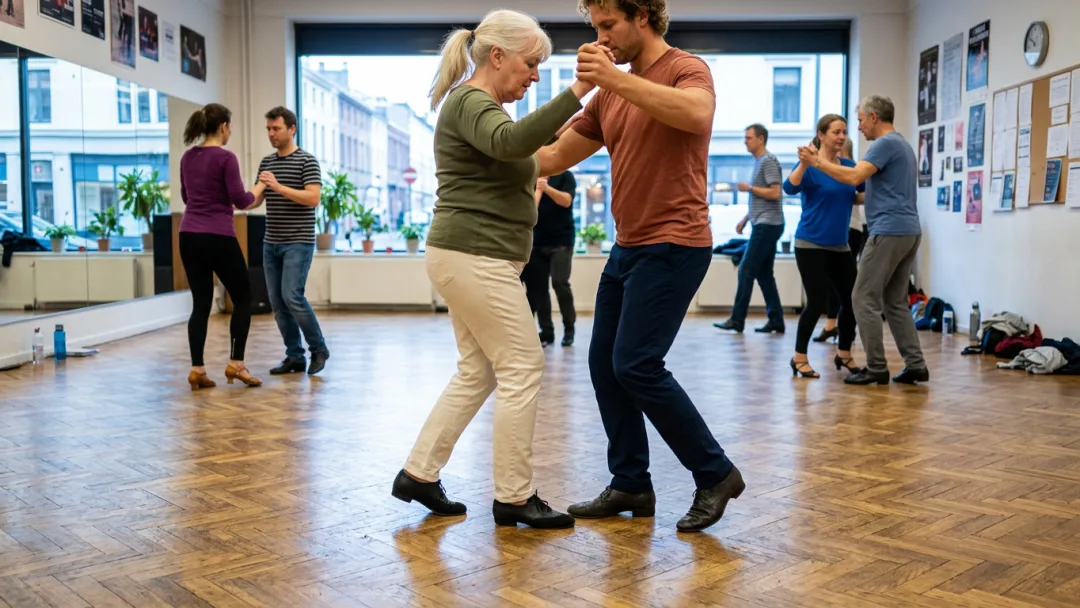
A small step with full weight transfer can look clearer than a large step where the body is left behind.

Posture transmits movement, not muscle power

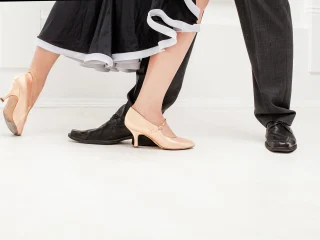
In the closed standard hold, the bodies are slightly offset so that the legs and steps can pass one another. The leading role offers a direction through body movement and frame. The following role picks up this impulse and moves independently. Both need their own balance for this: no one is pushed across the floor like an object.

A common misunderstanding comes from the visible arms. They look as if they control everything. In reality, a pull on the hand quickly loses its clarity if the upper body is doing something else. If one person moves forward while the other only places their foot backward and holds their weight back, pressure builds between them. The problem then is not a lack of arm strength, but incomplete movement.

This connection becomes especially noticeable when dancing fluidly. The explanation of weight transfer in Slowfox explores why the body does not stop between every step. Good posture allows these transitions. It provides orientation while remaining elastic enough to make room for breathing, turning, and different body sizes. So even as the following person, you are actively involved.

How to recognize a stable partner hold

Yes, like this

  • Keep your weight over your own feet
  • Keep your shoulders down and your elbows softly supported
  • Move with backward steps from your body
  • Shorten your shared stride when space is tight

Not like this

  • Rest your weight on your partner
  • Raise your shoulders and lock your elbows
  • Step back and leave your body forward
  • Stick to a practiced stride length despite an obstacle

A big dance figure only looks calm when both partners know where their shared weight is going.

udansa editorial team for partner dancing

Floorcraft turns figures into shared journeys

Many standard figures are designed for traveling. On a shared floor, traveling couples generally move counterclockwise. Within this direction of dance, steps can travel diagonally and turns can reorient the body. A figure is therefore more than a sequence of feet: it has a starting point, a path, and a finishing direction.

This explains why a familiar sequence can suddenly feel difficult. If a turn ends differently than expected, the next step may lead toward the center of the floor instead of along the open path. When linking Quickstep figures, the right alignment is just as important as the rhythm. On a crowded floor, paths get shorter, and a smaller movement can convey the same musical idea.

For your choice of style, this means you should enjoy sharing your attention between the music, your partner, and your surroundings. The leading role plans the available path, while the following role actively shapes their movement and signals obstacles they see. Standard does not demand large steps all the time. Its characteristic sense of space comes from two people staying connected as they travel, even along short paths.

Two ways into the same dance family

Connection

Understanding Your Partner's Movement

Your interest begins with the feeling you share

You enjoy noticing how a small impulse is received by your partner. Ballroom dancing offers you a steady connection where you can perceive timing and weight shifts in detail. Even a simple sequence can feel varied as a result.

Space

Shape a path with music

Your interest begins with direction and dynamics

You like the feeling of traveling across a floor and connecting curves with music. Ballroom dancing gives this movement different forms: swinging, flowing or pronounced. The partner hold helps you coordinate your path with another body.

Frequently Asked Questions

  1. You need an upright posture, but without overextending. Your rib cage stays aligned over your pelvis, while your knees and ankles allow movement. Pushing your chest out or pulling your head back, by contrast, creates tension and makes moving together more difficult.

Ballroom Dancing in Freiburg im Breisgau

Use the course filter to find current courses and dates in Freiburg im Breisgau as you continue your search.

Moving together takes coordination

On udansa connect, you can find dance partners in Freiburg im Breisgau to practice ballroom dancing with. Describe whether you mainly want to develop your connection as a couple, fluid movement, or confident navigation around the dance floor.

Moving together takes coordination