Urban Dance4 minutes

Dancehall in Hamburg: How to learn your first steps

By Bernhard De LucaUpdated

In a nutshell
  • Dancehall is a Jamaican dance style where you learn individual steps with their own groove and musical connection.
  • In Hamburg, look for a class that teaches Dancehall fundamentals rather than general fitness training.
  • Female and Male Steps often refer to different movement vocabularies, but they don’t assign you a fixed role.
  • Start with one step, practise it slowly, and only then put it together with the music.

In class, a short movement often seems simple until rhythm, accent, and posture come together. You don't have to learn every choreography right away; observing more closely will get you further than dancing as big as possible.

What you need beforehand

  • Comfortable clothing that allows free movement in your hips and shoulders
  • Clean indoor shoes or suitable dance shoes
  • A Dancehall class covering the basics or with an open beginner level
  • Water and a phone for short practice recordings

Dancehall is learned through context and repetition

Dancehall has its roots in Jamaica and is closely connected to music, culture, and an ever-expanding movement vocabulary. A class that only demonstrates choreography therefore does not automatically teach you how an individual step works or the musical context it belongs to.

As you get started in Hamburg, it’s worth taking a look at the course description: Does it explain the basics, individual steps, and their names? Is there room to practise movements multiple times and at different tempos? That tells you more about whether the class is a good fit than a particularly challenging video. If you’re weighing up different types of classes, the overview of dance class formats in Hamburg can help. To explore other styles available in the city, you can also check out the overview of dance styles in Hamburg.

The terms Female Steps and Male Steps appear in classes as a guide to certain movements or variations. They describe a traditional classification, not a rule about who is allowed to dance which step. A good learning process lets you explore technique, expression, and your own freedom of movement without prescribing a role. Pay attention to whether the teacher explains differences clearly and welcomes questions. That way, you can make the movement your own instead of simply copying a form.
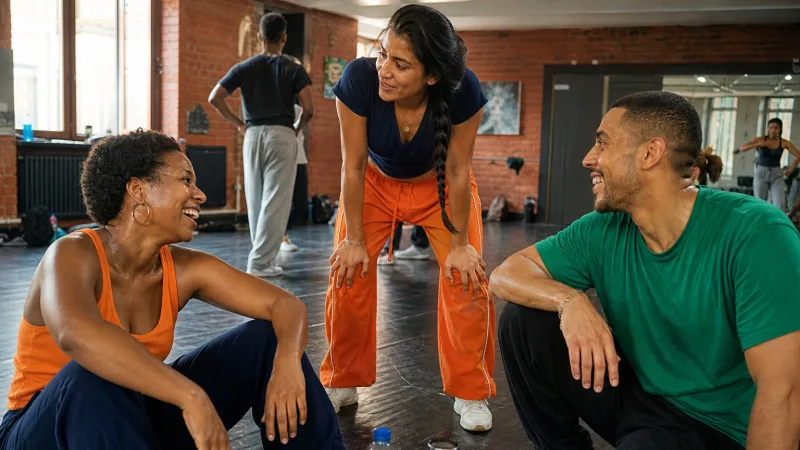
Two dancers perform a classic dance pose
A subtle movement path only becomes clear in rhythm, so precise timing matters more than big gestures.

How to get into Dancehall

  1. Check course content for Dancehall

    Read the course description for Dancehall, fundamentals, and step vocabulary. If anything is unclear, ask whether the class covers the dance's roots and music or is mainly a fitness choreography.

  2. First, notice the groove and accents

    Before joining in, notice where the music is accented and how the instructor shifts their weight. Start with small movements to the basic pulse instead of immediately swinging your arms and legs as far as possible.

  3. Learn a Step on Its Own

    Have a movement sequence shown to you from several angles and pay attention to your feet, knees, pelvis, and upper body. Practice without tempo at first, until you can shift your weight in a controlled way.

  4. Putting Female and Male Steps into Context

    Ask about the names, context, and typical execution of the steps shown. Try different variations without treating them as rules you have to follow based on your gender or body.

  5. Transfer Movement to Music

    Perform the step first at a slow tempo and then in the original groove. Record no more than one short practice clip and check whether the accent and direction of movement remain clear.

Practice steps with respect and precision

This way

  • Ask your instructor about step names and cultural context
  • Start by performing movements small and with control
  • Try and compare Female and Male variations
  • Listen for the accent in the music before increasing the tempo

Don't do this

  • Copying a step from clips without context
  • Forcing or overstretching movements with momentum
  • Treating gender as a requirement for certain steps
  • Increasing the tempo when the rhythm still feels uncertain

Your start at a glance

Before choosing a course

Selection

In class

Join in

After Practice

Reinforcement

Frequently Asked Questions

  1. The terms often describe variations or movements traditionally associated with a particular gender. They are not requirements that you have to tie to your gender. Ask in class which stylistic features are meant, and learn the way of performing them that feels right and safe for you.

Compare dance classes in Hamburg

Use the course filter to find current options in Hamburg and check whether Dancehall basics are explicitly included in the lessons.

Find your own groove

On udansa, you can compare dance classes in Hamburg and look for a beginner-friendly option that teaches Dancehall as a dance style. Check the course description and level before signing up.

Find your own groove