Dance Night5 minutes

Social Dance in Hamburg: What to Expect on Your First Night

By Bernhard De LucaUpdated

In a nutshell
  • A social dance is an open dance night where you dance with different partners without a set choreography.
  • In Hamburg, the specific format depends on the organizer and the type of dance event.
  • You can come alone or with someone, skip individual dances, and take a break whenever you like.
  • Friendly invitations, a clear no, and consideration for others are part of dancing together.
DefinitionSocial Dance

Social Dance refers to dancing together at an open dance night, where meeting people and spontaneous dances are the focus. Participants often switch dance partners.

A social dance doesn't follow a class plan

At a social dance, there usually isn't a class that takes everyone through the same steps from start to finish. The music plays, people dance together, and between songs there are changes of partners and brief conversations. Some people come with a partner, others on their own. No one has to be on the dance floor the whole time.

For your first evening in Hamburg, it helps to read the description of the specific event beforehand. It should be clear which dance style or music to expect and whether the evening is intended for free dancing. If anything is unclear, ask the organizer about how the evening works, not for step-by-step instructions. The page on dance styles in Hamburg also gives an overview of the styles represented in the city.

When you arrive, take a moment to settle in: put away your jacket, set down your water, and briefly observe how the group uses the space. An open area isn't automatically meant for every couple, and it's completely fine to sit on the sidelines until you've found your bearings.
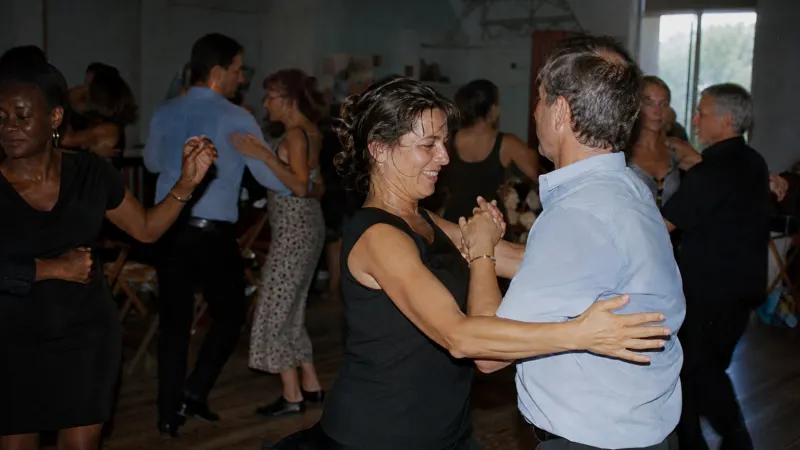
If you watch first, you'll get a feel for the rhythm of the evening and can join in more easily later.

Open Doesn't Mean Rule-Free

The word “open” is sometimes understood to mean there are no etiquette rules at all. In reality, the freedom of social dance comes from everyone looking out for one another. An invitation is an offer. It can start with a brief sentence, eye contact, or a gesture; the important thing is to wait for a response. A no is not a judgment of your abilities and needs no justification.

Awareness matters on the dance floor, too. Keep your movements small enough that you don't put others at risk, and don't focus only on your partner when you turn. If it gets crowded, adjust your step or skip a figure. That way, dancing remains enjoyable for people who aren't yet confident moving around the room.

The style influences how closely people dance, which figures are common, and what the music sounds like. That's why it's helpful not to assume that one social dance is like all the others. The overview of dance options and open formats in Hamburg puts different opportunities into context, without making any one evening stand for the entire scene.

Invitations and breaks go hand in hand

How to do it

  • Invite someone to dance with a smile or a quick question
  • Accept a no graciously and move on without asking why
  • Leave space at the edge when others are dancing
  • Between songs, briefly check whether the other person wants to keep dancing

Not like this

  • Pull someone onto the dance floor by the arm without saying a word
  • Argue with a no or ask again right away
  • Walk between a dancing couple to get to the other side
  • After one song, simply keep leading without paying attention to their reaction

An invitation is an offer, not an entitlement to a dance; a friendly no belongs just as much to the evening as a yes.

Partner dance instructor

The Evening Is Shaped by Small Choices

Your first visit doesn’t have to begin with a successful dance. Perhaps you arrive while a song is already playing and wait for the next one. Perhaps you ask someone who’s standing off to the side. Both are ways to get started on your own terms. You can also ask someone you know to take a look at the dance floor with you first, without making dancing feel like an obligation.

It’s practical to bring only what you need and keep valuables somewhere safe. Choose shoes that don’t slip or leave marks; if you’re unsure about the type of floor, ask before your first dance. A drink and short breaks can help you stay focused. If you expect the evening to last a while, you can bring a fresh top in case you sweat a lot.

A brief thank-you is enough after the dance. You don’t have to arrange another dance straight away or explain why you’re saying goodbye. If the music or the way people interact doesn’t suit you, you can leave early. That way, your first visit becomes an experience that helps you decide which kind of event you’d like to visit again.

Two sides of an open dance night

Invite

Make the first move

Brief, friendly and without pressure

A short question or an open gesture is enough to invite someone to dance. If the other person declines, the evening can still be enjoyable for both of you if you simply accept their no.

Accepting

Shape your own evening

Yes, no, or watch for a while

You don’t have to accept every invitation, and you can ask someone yourself. Taking a break on the sidelines is also a normal choice, not a sign that you’re not making the most of the evening.

Frequently asked questions

  1. Yes, you can attend many open dance evenings on your own, unless the event description says otherwise. Once there, you can invite people to dance or see how the group organizes itself. If you’d rather not dance right away, take some time to observe how things work.

The first dance often begins at the edge

On udansa, you can find dance nights and open sessions in Hamburg, where you can compare opportunities to dance socially. That way, you can choose when to take the next step from watching to dancing yourself.

The first dance often begins at the edge