First meeting6 minutes

How to plan a trial dance with your dance partner in Nuremberg

By Mary De LucaUpdated

In short
  • For your trial dance with a dance partner in Nuremberg, choose a public place and agree on a limited duration.
  • Before you meet, agree on a dance, dance roles and a simple opening sequence.
  • Start with familiar basic steps and check in from time to time about whether the distance, tempo and contact feel comfortable.
  • After the meeting, decide whether to have another trial dance based on how you feel and how well you work together.

At the first song together, even familiar steps can suddenly feel awkward. A low-key meetup gives you room to sit with that nervousness without having to turn it into a whole evening or a committed partnership right away.

What you need for your first try

  • An existing dance connection
  • A basic step you both know
  • A publicly accessible place where dancing is allowed
  • Comfortable clothing and clean shoes suitable for the floor
  • Music for the agreed dance and water

A quick trial dance isn't an entrance exam

A first trial dance in Nuremberg is meant to show how you interact in person. It's neither a lesson nor an audition: you don't have to work through a list of moves or judge your partner as if you were taking an exam. An unfamiliar hold, a different stride length or nerves can make the start feel halting, even when you both know the basic step.

That's why a setting with few distractions is helpful. A crowded dance floor requires you to make room and react quickly, making it hard to tell whether the space or your partnership is causing difficulties. A permitted practice area with other people nearby combines room to move with a public setting. You don't need a stage for that.

Pay particular attention to how you respond to small misunderstandings. Can you stop, say something specific and start again without tension? For example, coordinating lead signals in Rumba shows why a delayed signal doesn't automatically mean a lack of skill. You don't have to work through this technique during your meeting. If you decide you'd like to take lessons together afterward, the page about couples' courses in Nuremberg can help with the next step. For now, the first meeting is simply a chance to dance together, not a commitment to sign up.
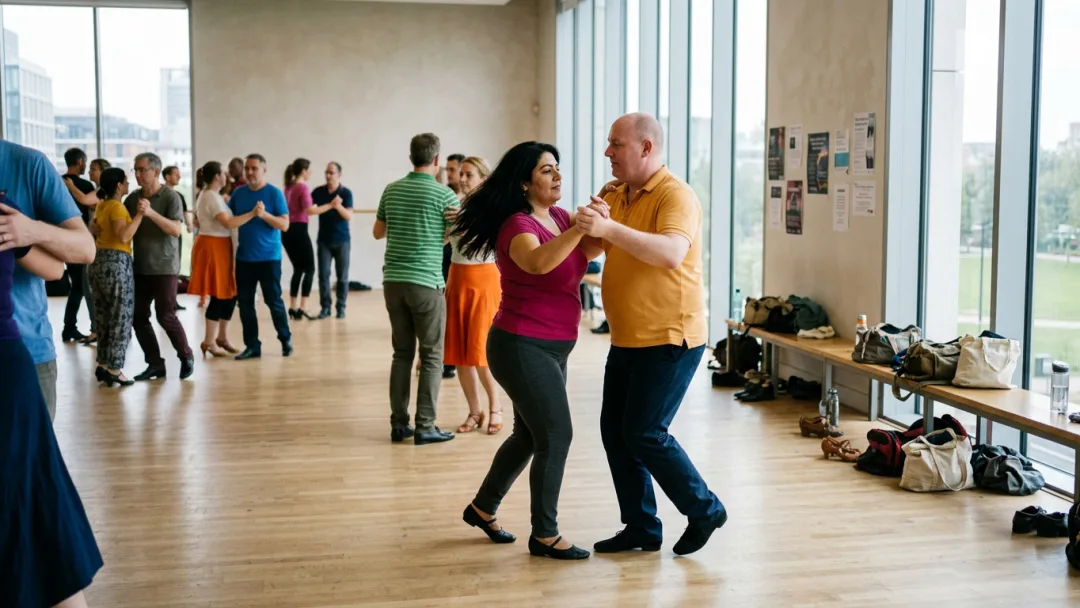
A bag close at hand makes breaks hassle-free, so you don't have to search all over the room for your things.

Your first trial dance in seven steps

  1. Agree on the specific arrangements

    Agree on a place in Nuremberg where dancing is allowed, a clear meeting point and, for example, 30 to 45 minutes as a shared time frame. Also agree on how you’ll split any admission or room-use costs; this doesn’t obligate either of you to meet again.

  2. Set a simple starting point

    Agree on a dance, your roles, and a familiar basic sequence without unexpected turns. Use music with a steady tempo; if you play music yourselves, make sure permission to do so is part of the agreement.

  3. Settle In and State Your Boundaries

    First greet each other outside the dance position and put your bags down. Before starting, say what distance feels comfortable for you and whether there are any movements you want to exclude; an agreed “stop” means stopping immediately, not waiting until the figure ends.

  4. Begin with small steps

    Get into your agreed dance hold and start by dancing only the basic sequence with small steps. Stick with this until you find the beat together; if you stumble, release the hold and start again instead of pulling each other along.

  5. Share a quick piece of feedback

    After the first song, take a break and each describe one specific observation, such as “The hand contact feels too firm to me.” Then change only that one thing. Making this kind of adjustment shows how you work together better than making several corrections at once.

  6. Dance a Second Round

    Dance the same simple sequence again and notice whether you can feel the agreed adjustment. Add a familiar move only if you both want to; finish at the agreed time, even if things aren't running smoothly yet.

  7. Be fair when sharing the outcome

    To wrap up, say whether you'd like to meet again, need more time to think, or would rather leave it at this attempt. If you're unsure, agree on a time to follow up; a kind rejection needs neither a scorecard nor a justification.

Small choices that make meeting up more relaxed

Yes, like this

  • If you're running late, send a quick message with your new arrival time
  • Phrase feedback in terms of your own perception
  • Take photos or videos only with explicit consent
  • During a break, release your hands and leave room for others to step back

Not like this

  • Arrive significantly later at the meeting point without letting the other person know
  • Attribute mistakes to the other person as fixed traits
  • Film without asking so you can assess the dancing later
  • Hold someone by the arm or hand during a break

Your checklist for the appointment

Before heading out

Preparation

Before the First Song

Arrival

After the Meeting

Wrap-Up

Frequently Asked Questions

  1. As a time frame you choose yourselves, 30 to 45 minutes is often enough for arriving, dancing to a few songs and having a final chat. This is a practical recommendation, not the duration of an event in Nuremberg. Include breaks for conversation so you don’t have to make a decision when you’re exhausted, and only extend the session if you both explicitly want to stay longer.

Couple dance courses in Nuremberg

If you’d like to keep learning together after trying out dancing, you can find current courses and dates in Nuremberg in the course filter.

A second dance takes two yeses

On udansa, you can arrange another meeting with your dance connection in Nuremberg. If the first attempt wasn't a match, you can also find other connections there for another try at dancing together.

A second dance takes two yeses