Find your Musette partner
On udansa connect, you can find dance partners in Paris to share your love of turns or small steps with. Describe what you'd like to try together.

By Mary De LucaUpdated
On udansa connect, you can find dance partners in Paris to share your love of turns or small steps with. Describe what you'd like to try together.
An accordion can make you want to spin, or draw your attention entirely to your feet. Which movement appeals to you says something about your approach to music, even if you haven't taken a dance class yet.
Bal musette refers to a dance event and its musical tradition, not a single fixed sequence of steps. In Paris, various partner dances were danced within this tradition, including Valse musette and Java. This explains why you can see different movement patterns to similar accordion sounds. You can find more cultural context in How Dance Styles Shaped Paris.
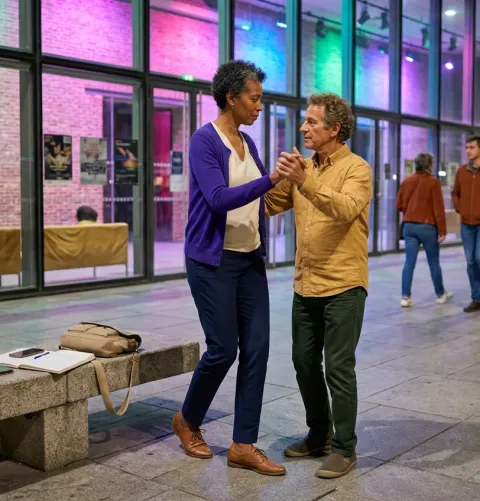
In Valse musette, turning together shapes the feel of the movement. The weight changes follow the triple meter as the couple circles around a shared center. The steps do not have to be large: a compact turn in particular calls for coordinated changes of direction. The arms maintain the connection, they do not pull your partner around the curve.
Java places more emphasis on short, low-to-the-ground steps and a closer connection between partners. Its small weight changes can create a springy, rhythmically crisp impression. It also includes turns, so it is not purely a dance in place. Conversely, Valse musette is not all expansive whirling.
So when deciding which suits you, focus on your preference rather than a rigid either-or. Count your A or B answers and choose what appeals to you more instinctively. If it is a tie, both approaches suit you; start with the movement you would rather try right now.
You tend to focus on moving together and changing directions. Valse musette offers a fitting movement feel without requiring you to already be confident turning. Start with calm weight shifts in triple time, and add a small turn only once your feet land steadily.
You prefer to experience the rhythm through short steps and precise weight shifts. Java offers a compact way in, where small movements get plenty of attention. Start by practicing low, grounded steps with relaxed knees and keep a steady pulse before adding individual accents.
| Criterion | Valse musette, Type A | Java, Type B |
|---|---|---|
| Your standout feature | Moving in circles together and changing direction | Short steps and rhythmic accents |
| Musical foundation | Triple meter with a continuous flow of movement | Triple meter with sharply defined steps |
| First practice exercise | Shifting your weight with a small change of direction | Short weight shifts with relaxed knees |
| Typical challenge | Keeping your balance while turning | Taking small, clear steps without tensing up |
| Common misstep | Pulling your dance partner with your arms | Rushing ahead of the beat with hurried feet |
| How you connect | Guiding turns through coordinated steps | Sharing the rhythm without pressure at a closer distance |
The comparison describes movement tendencies, since Valse musette can also be compact and Java can include turns.
You can find current classes in Paris using the course filter if you want to practice weight changes together and partner hold.
You can try out your result to start with, without learning a full choreography. If you lean toward Waltz, begin on your own with slow weight shifts in three-beat time: one, two, three. Only then add a small change of direction. Step in the new direction instead of twisting your upper body against a planted foot. As a couple, the turn comes from your coordinated steps, not from a strong pull on the arm.
If you lean toward Java, keep your steps short and your knees relaxed. Shift your weight deliberately before moving your other foot. A small step can be clearly danced without stamping. Leave out extra embellishments at first: once the pulse is steady, you can add individual accents without throwing your dance partner off balance.
For both approaches, closeness is something you agree on, not an obligation. Choose a distance where you can breathe freely and move your feet without restriction. You can choose your roles freely; leading means clearly suggesting a direction. If you're looking for someone to practise with, a clearly worded dance partner profile for Paris can help. You could write: “I’d like to practise compact turns slowly” or “I’d like to explore small Java steps in a shared rhythm.” That way, your test result becomes a concrete first step together.
Java is a distinct musette dance in triple time, related to the waltz. Its characteristic movement emphasizes small, low-to-the-ground steps and a compact partner hold. The shared meter does not make it the same dance form as the Valse musette.
You don't need waltz experience to get started with Valse musette. Familiar weight changes in triple time can help, but you still need to coordinate your shared turn. Start slowly and with small changes of direction instead of simply carrying over a fast turn from another form of waltz.
You don't have to dance Java with a level of body contact that makes you uncomfortable. The traditional movement is compact and often close, but the distance between you should feel right for both of you. Keep your arms flexible and leave room for your feet so closeness doesn't lead to pressure or getting in each other's way.
For starting out, choose well-fitting shoes with good support and soles that allow controlled changes of direction. High heels aren't required. A sole with too much grip can make turns difficult, while one that's too slippery makes weight changes uncertain, so start with small movements on a clear, level floor.