Your next Dance night in Paris
On udansa, you’ll find people in Paris to go to a dance night with. Going together for the first time can make it easier to step onto the dance floor.

By Mary De LucaUpdated
On udansa, you’ll find people in Paris to go to a dance night with. Going together for the first time can make it easier to step onto the dance floor.
Maybe you’ve only recently moved to Paris, or maybe you have a visitor with little dance experience. An evening can work for both of you if there’s time for social dancing, watching, and taking breaks.
A social is a dance gathering where you dance freely with others to music played by a DJ or performed live, without performing a set choreography together. Usually, a particular dance style or a related group of styles is the focus.
If you want to go dancing in Paris, first distinguish between a party, social, festival and performance. A party offers free movement to the music, sometimes without a specific style. A social focuses the music more on particular dances. A festival brings together different program items, while a performance presents a choreographed stage show for the audience. These differences tell you more about your visit than an evocative event name.
Paris has both public dance traditions and stage dance. The 1937 ball at the Carpeaux fire station is considered the first public Bal des pompiers: an example of celebrating and dancing together. The Palais Garnier, which opened in 1875, represents the history of the Paris Opera Ballet. Both are part of the city, but describe different kinds of visits.
The Festival d'Automne, founded in 1972, also included contemporary dance in its cross-disciplinary program. So the word dance festival doesn't automatically mean you can get out on the dance floor. For an example of how workshops and parties can come together, see this line dance festival with a learning and dance program.
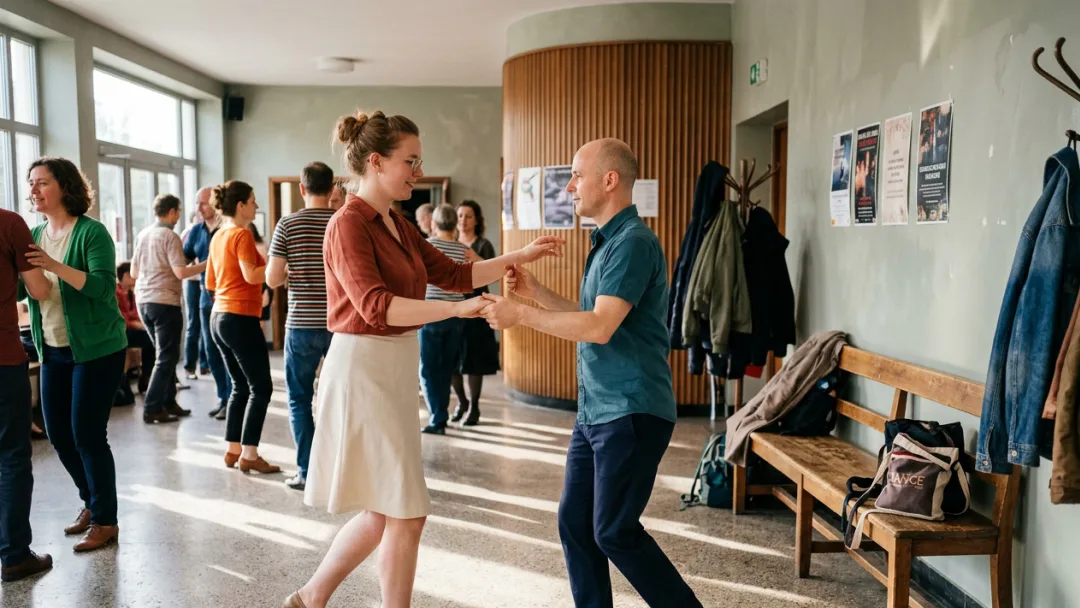
Arriving alone at an open dance night means you decide for yourself when to join in. At a party without partner dancing, you can move to the music without inviting someone else. At a partner dance social, each dance is a small agreement between two people. An invitation is an offer, not an obligation, and you can take a break at any time.
Coming with someone gives you a familiar starting point. You can begin together, but you don't have to dance every song with each other. Partner changes are part of the format at many socials, but they're not required. Roles in partner dancing are also not automatically determined by gender.
When experience levels differ, dancing well together depends on moving as a team. The more experienced person slows down and uses simpler figures instead of pulling the other person through difficult turns. If you're new, you don't have to copy movements you've observed right away: often you can see the foot, but not the weight shift that came before it. The article about common mistakes when copying dance movements you've observed explains this difference. That way, a night out together doesn't turn into an unplanned lesson.
Looks good
Don't conflate
A dance evening that suits you leaves room for what you already know and for the break you need.
For your first evening of dancing, a manageable activity is more helpful than a packed program. An introduction gives you a movement and a rhythm to start with. The free dancing afterward shows you what both feel like without instructions. This is what sets a participatory dance night apart from regular lessons: you can try something out without immediately committing to a long-term learning plan.
If you live in Paris, the same evening may feel different as you gain experience. At first, you observe a lot; later, you need less guidance and dance for longer. As a guest or on vacation, on the other hand, you benefit from a format where each visit stands on its own. A festival with several learning sessions demands more attention and physical stamina than a party where you choose when to take breaks.
Open-air dancing adds the ground surface to this decision. On rough or uneven ground, turns become harder because your shoes do not glide evenly. Smaller steps and less rotation make sense in that case. You can find current dance events in Paris for your visit on udansa. In the event description, take a moment to check which parts are intended for dancing along and which for watching.
For an evening centered on movement
You don't need an extensive repertoire of figures to enjoy a dance on your own terms. A steady weight shift and a shared rhythm are already enough to carry an entire song. Repetition gives you time to take in the music and your partner.
For an evening with room to observe
You can listen to the music first and see how the dance floor fills up. Watching doesn’t make your visit any less worthwhile. Maybe you’ll join in later, or maybe you’ll simply enjoy an evening watching others move.
For an informal dance night, comfortable everyday clothes and shoes that fit securely are a good choice. Your clothes should not restrict your steps or arm movements. On an outdoor dance floor, sturdy shoes are a better choice than delicate dance shoes with suede soles. For a specifically formal ball, follow the stated dress code.
You don't need to speak fluent French to dance freely. You can keep an invitation, a thank-you and a polite refusal brief, for example with “On danse ?”, “Merci” and “Non, merci”. For a guided introduction, however, understanding the language helps, as directions for movements and partner changes are also explained.
You can politely turn down a dance invitation without giving a reason. “Non, merci” or “No, thank you” is enough. You don't have to promise to dance later or explain why you're taking a break. If you invite someone to dance, accept the same brief refusal without pressuring them further.
Yes, if the parts you want to attend are suited to your experience. A festival may combine workshops, open dancing and performances, each with different requirements. A beginner workshop explains the movements, while an open party does not automatically include lessons. So don't assume that every item on the program is a learning opportunity.
A single dance night can be a great fit, even during a short stay. You don't need to plan on attending regularly. If you already know a style, you can use familiar basic steps. If you have no experience, an introduction is more helpful than expecting to pick up the dance just by watching.