Find your first beat together
On udansa connect, you can find people in Paris who also want to try their first dance evening. That way, you can meet up with someone who’s also starting with just a few steps.

By Mary De LucaUpdated
On udansa connect, you can find people in Paris who also want to try their first dance evening. That way, you can meet up with someone who’s also starting with just a few steps.
Between the last instructor-led step and the first song for open dancing, everything can suddenly feel too fast. The right evening gives you enough room to practise what you already know, while others are already dancing more elaborately.
For your first dance party in Paris, the connection between the lesson and the dance floor matters. An introduction can teach a single figure or actually start with rhythm, weight shifts and basic movement. Only the second option can reliably take you from no prior experience to your first song of open dancing. The phrase “all levels,” on the other hand, describes a mixed crowd, not necessarily a class starting from scratch.
What matters is whether you can use what you learn afterward. At an evening focused on one dance style, a repeatable basic step is more useful than an isolated combination. If several styles are played, the introduction may apply to only some of the music. You don’t have to dance to every song. Set sequences also require different skills from movements you can combine freely.
Public dance halls have been part of Parisian history since the bal musette became popular in the 1880s. This tradition is no proof that a present-day event teaches beginners. For more background, see the history of dance in Paris. But you don’t need to know any history for a single visit. And if you’d like to continue learning in a more structured way later, the overview of dance classes in Paris describes the different ways to learn. For today, an evening where the introduction and the open dancing go together is enough.
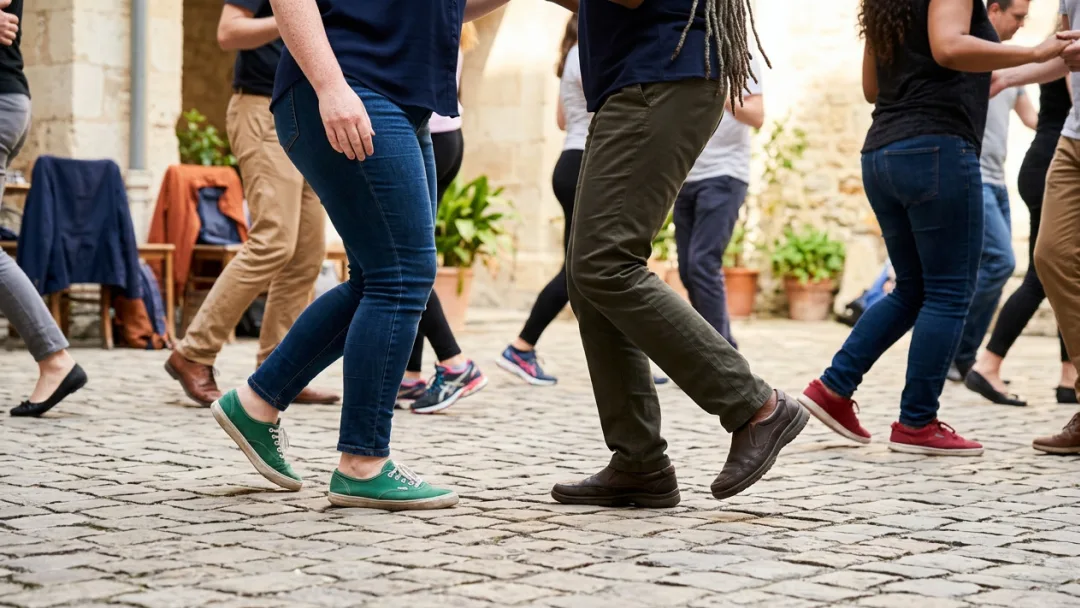
When viewing an event on udansa, read the details about the introduction, prerequisites, and dance session afterward together. A suitable starting point is one for complete beginners with open practice afterward; if the description already requires knowledge of dance figures, choose a different option for this visit.
Arrive in time so you don’t miss the start, and leave your bag and jacket away from the dance floor. The first explanations often cover posture, rhythm, or direction of movement; without this foundation, later steps can seem unnecessarily complicated.
Transfer your weight fully onto the demonstrated supporting foot instead of just tapping the other foot. Keep your steps small and your knees flexible; you can tell the difference because your free foot can continue without being dragged.
Stick with the simplest movement shown until you can repeat it without constantly looking at the instructions. If you make a mistake, pause briefly and start again from the demonstrated starting point instead of trying to catch up with extra steps.
During the first free song, use the movement from the introduction, even if others dance lots of figures. When dancing with a partner, say before you start: “I’ve only just started.” Stick to what you’ve been shown and leave out turns you don’t know.
Notice whether you were able to keep breathing and still know which foot your weight is on. If you can do both, repeat the same basic step during the next suitable song; if you feel overwhelmed, take a break instead of adding a new figure.
Do this
Not like this
Preparation
Transition
Looking Back
No, you don’t need to be able to recognize the beat confidently before an introduction for complete beginners. An instructor can help you find the steady pulse by counting, clapping, or shifting your weight in simple ways. At first, follow this cue rather than every instrument. Small movements help you stay in time with everyone else.
Yes, after the introduction you can dance along using the basics you’ve learned, without already knowing a whole dance. This assumes the open dancing session is suited to this introduction. For now, your goal is to repeat a movement throughout one song. The more difficult combinations other guests dance are no measure of whether you belong there.
Pause briefly and start again with the simplest movement. In partner dancing, let your partner know you’re pausing so they don’t keep leading while you stand still. Don’t try to remember the whole sequence in the middle of a movement. A steady weight shift is more helpful than hurriedly catching up on steps that throw you off balance.
You don’t necessarily need special dance shoes for your first visit. Your shoes should fit securely and allow small turns without slipping uncontrollably. Soles with too much grip can hold your foot in place as you turn. So keep your movements small at first. New high heels also make it harder to get started when you’re still figuring out which foot to stand on.
It means you should already be able to do the basics of the announced dance style on your own. Depending on the style, these include the basic rhythm, typical weight shifts, and sometimes simple changes of direction. A workshop with these requirements doesn’t start from scratch, even if the move is new. So this combination is usually not suitable for your first visit.
During an open dancing session, you can sit out a song and watch from outside the dance floor. Focus on one thing, such as the size of the steps, instead of trying to copy entire sequences of moves. The guide to copying dance moves explains why watching can sometimes lead to the wrong movements.