Dance together with just a few words
On udansa connect, you can find dance partners in Paris and agree on a shared language. Be specific about which language you'd like to use for quick arrangements.

By Bernhard De LucaUpdated
On udansa connect, you can find dance partners in Paris and agree on a shared language. Be specific about which language you'd like to use for quick arrangements.
A conversation that falters can feel more awkward when meeting someone than missing a step. You can search for the right words and ask someone to repeat themselves without apologizing for your language skills.
If you're looking for a dance partner in Paris without speaking French, what matters is being able to understand this particular person. You can't infer someone's language skills from where they live, their name or their dance style. English is one option, if you both understand it well enough. Another language you share could work too. You don't need to be able to have long conversations: what matters is that brief requests, a no and feedback come across clearly.
When you dance, your attention is divided between the music, your balance and your movements. A sentence you understand in a quiet conversation can get lost in the moment. That's why a fluent conversation before dancing doesn't replace testing how well your brief signals work. Demonstrating a movement can help, but it doesn't automatically explain whether you want to repeat it or stop. A nod can also mean, “I heard you,” without making its meaning clear.
For general advice on getting in touch, see the guide to messaging a dance partner in Paris. This page is about how you communicate once you're talking to each other. You can find terms for leading and following separately under naming dance roles clearly. Language uncertainty and lack of dance experience are two different things: someone searching for a word doesn't automatically need an explanation of the basic step.
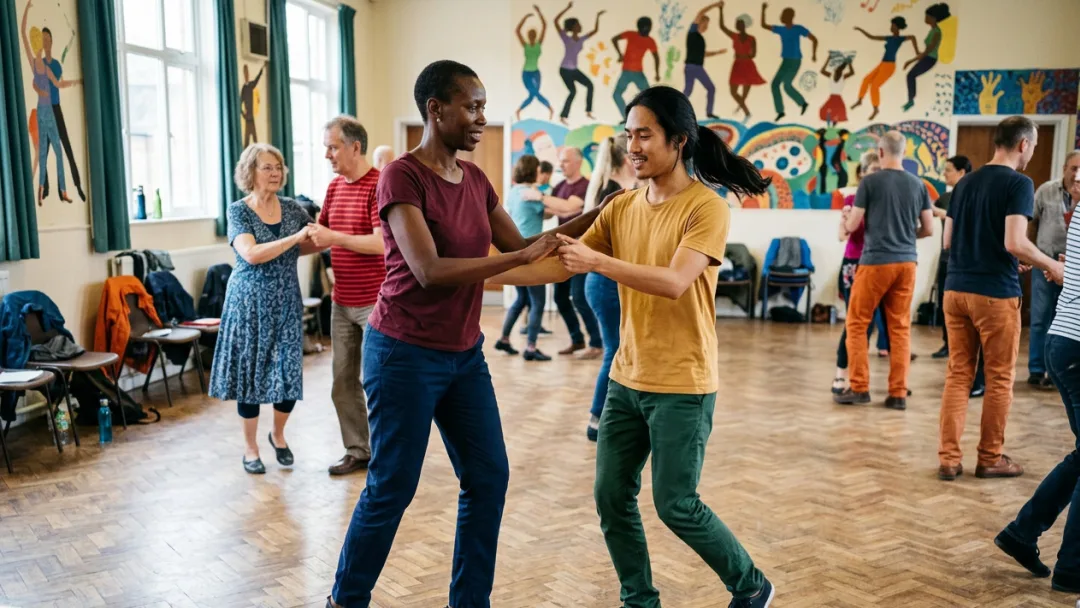
Say explicitly which language you can use: for example, “Can we speak English? I need short sentences.” Let the other person reply in that language. You have a starting point when both of you can understand and express a simple request.
Agree on this: one statement at a time, a normal volume, and time to respond. Ask for something to be rephrased if you miss a word. “I didn’t understand” should be an acceptable response, not an embarrassing interruption. No one should have to repeat their entire sentence more loudly for that.
Write down stop, pause, slower, again and understood in a language you both share. In English, for example, you could use “stop”, “break”, “slower”, “again” and “understood”. Agree on this: Stop ends the movement immediately, and pause interrupts dancing together until you both agree to continue.
Try a simple, familiar movement without music. One person says a word, the other responds; then switch. For stop, add an open hand at chest height. The signal works if both stop without finishing the move.
Agree that “slower” initially means a pause: you show the movement afterward without music, at a slower tempo. For “one more time,” name the starting point, for example, “from the turn.” That way, you repeat the same part instead of unknowingly starting from different points.
Describe an observable effect instead of making a judgment: “The pull on my hand is too strong. Please use less pressure.” Ask your partner to briefly repeat the change you want. You know you understand each other when the next movement shows that change, not just an acknowledging nod.
Dance a short, familiar sequence and use your signals if needed. Step out of the movement and to the side for longer explanations. If a word gets lost in the music, replace it with a shorter, clearer word and try again.
On udansa, you can find current classes and dates in Paris if you want to take lessons together with your dance partner.
This is good
Not like this
Foundation
Test
Review
No, English is just one possible shared language. What matters is which language you and your dance partner can actually understand. If you cannot find a language you can both use, demonstrated steps alone are not enough to communicate safely. In that case, this person is not a good fit for practicing together for now.
For brief exchanges, “stop”, “pause”, “plus lentement” and “encore une fois” can help. They mean stop, pause, slower and once more. “J’ai compris” means “I understand”. Use these words only if you have tested the pronunciation and meaning together. A memorized list does not guarantee that you will understand each other.
Say directly, in your shared language, “I didn’t understand”, and ask for a short sentence or a demonstration. In English, for example, you can say, “I didn’t understand. Please show me.” Then say which part you did understand. That way, the missing information stays clear instead of being hidden behind a polite yes.
A translation tool can help bridge gaps in unfamiliar words before or after dancing, but it cannot replace a stop signal that is understood immediately. Enter short, literal sentences and avoid idioms. Read the translation together and connect it to a specific action. Keep the device put away while you are moving.
Talk about a specific movement and the change you would like, instead of judging the person. “Please take smaller steps, I’m losing my balance” is clearer than “You dance badly”. Start by asking for just one change. A friendly tone helps, but should never weaken a clear no or a necessary stop.
Stop moving together and only start again once your stop signal is clearly understood. Also use the hand signal you agreed on, and break contact as soon as it is safe to do so. If your partner understands the signal but ignores it, language is not the problem. Do not continue dancing together.