Find your perfect role match
On udansa connect, you can find dance partners in Paris and specify your preferred role directly. That way, it's clear who wants to try the same role setup with you.

By Bernhard De LucaUpdated
On udansa connect, you can find dance partners in Paris and specify your preferred role directly. That way, it's clear who wants to try the same role setup with you.
An outstretched arm alone doesn’t reveal who wants to suggest the next step. When getting to know someone, a short sentence is often enough to turn two different expectations into a shared movement.
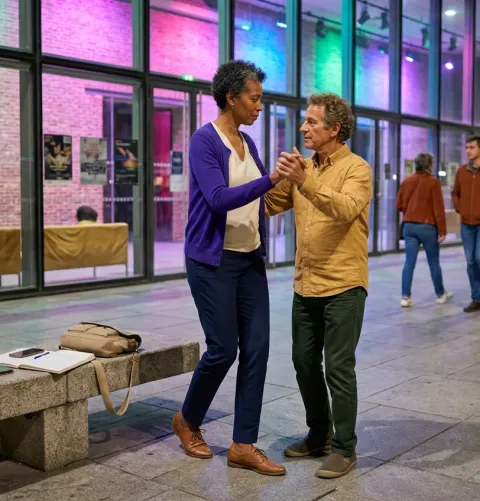
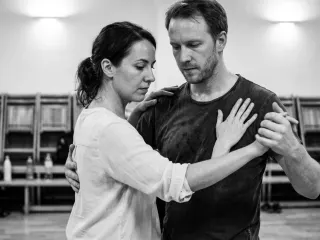
Lead and follow describe the roles in partner dancing: physically offering a movement, then sensing that offer and responding to it through dance. The roles describe how partners work together in the dance, not the personalities of the people involved.
If you're looking for a dance partner in Paris, a role description helps you bring your dancing tasks together. In a guided movement, for example, the leading person suggests a direction or an impulse to turn. The following person picks up the information and acts on it with their own steps. Both keep their rhythm, support their own weight, and influence how the movement actually works.
Leading therefore doesn't mean pulling the other person's body into place. Following also requires attention and independent decisions: Is the direction clear? Is there room? Does the movement stay balanced? An unclear invitation doesn't get better if someone pushes harder or the following person guesses a figure.
The words also don't describe a permanent hierarchy. A woman can lead and a man can follow; height and demeanor don't determine someone's role. The role also says nothing about who has more experience. So, for your search, “I want to follow” is more informative than “I'm looking for a man.”
Paris's historical partner dance culture includes Valse musette and Java, which were danced at the Bal musette. However, these traditions don't tell you what role someone today prefers. If you want to state your role publicly, you can add it as a short description to your dance partner search profile for Paris.

English role terms can be used briefly: “I prefer to lead” means “I prefer leading,” and “I prefer to follow” means “I prefer following.” Saying “I dance both roles” tells people that you dance both roles. Leader and follower are role terms, they do not imply a gender.
In French, phrases with verbs are especially helpful. “Je préfère guider” expresses your preference for leading. “Je préfère suivre” expresses your preference for following. The short form “je suis,” on the other hand, needs clear context: it can mean both “I follow” and “I am.” “Je préfère suivre en danse” avoids this ambiguity.
“Danseur” and “danseuse” do not resolve the question of roles either: these words mean male dancer and female dancer, not reliably the leading or following role. Instead, you can say: “Je danse les deux rôles, mais je préfère guider.” This distinguishes your skills from your current preference.
A question like “Tu préfères guider ou suivre ?” asks only which dance role you prefer. It does not assume a gender or any experience. How you go about contacting a dance partner in Paris is a separate question. To clarify roles, a clear sentence that the other person can respond to specifically is all you need.
Yes, like that
Not like this
On udansa, you can find courses in Paris where you can develop your chosen dance role.
A role description is useful when it says what role you want to take on, rather than categorizing the other person by their appearance.
“I dance both roles” can mean different things: You’re flexible when looking for a partner, want to learn a second role, or want to switch roles during a dance. These are not the same thing. A role switch means the person who was leading now follows, and vice versa. With a partner change, the makeup of the couple changes, while your role can stay the same.
Flexibility does not replace agreeing on who does which role for a particular dance. If you both like leading, you can still agree on who does which role. But that doesn’t mean one person already knows how to follow. A familiar figure feels different from the other side: Instead of suggesting when it happens, you notice the timing and respond to it.
You could be specific and say: “I lead confidently and am currently learning to follow.” This explains what you can offer without devaluing your second role. Conversely, “I prefer to follow and would like to lead occasionally” is just as clear. You don’t have to justify having a preferred role.
To switch roles during a dance, you need a transition you both understand. Simply letting go of a hand could also mean a pause or the end of a figure. If you want to switch, saying “Let’s switch roles at the next dance” is clear and avoids sending conflicting signals mid-movement.
Your lead leaves room for a response
You prepare movements so your partner can sense them. You respond to their timing and balance instead of forcing a planned figure against the movement that's actually happening.
Your movement remains your own
You listen with your body to the direction and timing of the lead. You move from your own balance and contribute your own musical interpretation, rather than waiting for the next impulse.
Yes, “je suis” can mean “I follow,” but without context it is ambiguous. The same form also means “I am.” With “Je préfère suivre en danse,” you clearly say that you prefer to take the following role when dancing.
No, when you switch roles, you swap leading and following, while when you change partners, the person by your side changes. You can continue leading or continue following after changing partners. So when looking, you should specify which kind of change you mean.
Yes, your experience can differ significantly between the two roles. You may know the music and figures, but still need to learn the other task in the connection. A statement like “I follow confidently and am learning to lead” makes this difference clear.
No, you can focus on one preferred role. Experience in the other role can show you how your movements feel to your partner, but it is not a requirement for a clear search for a dance partner. What matters is that the roles you choose work well together for dancing as a pair.