Course levels6 minutes

Salsa course in Stuttgart: What the course level means

By Bernhard De LucaUpdated

In short
  • For a Salsa course in Stuttgart, the dance style, counting system, and balance of partner work and solo elements are key.
  • Salsa Cubana often uses circular movements, while linear styles focus more on moving along a shared path.
  • On 1 and On 2 refer to different rhythmic patterns, not different difficulty levels.
  • Partner work teaches communication through leading and following, while solo elements develop independent steps and body coordination.

A familiar figure name can feel unfamiliar in a new class. If your feet start with the counting pattern you’re used to, but the group accents a different beat, simply remembering the figure won’t help you.

DefinitionShines

Shines are solo step sequences in Salsa, danced without a hand connection, that combine rhythmic footwork, balance, and personal expression.

The Dance Style Shapes the Shared Space of Movement

If you want to learn Salsa in Stuttgart, the name Salsa alone tells you little at first about how a couple moves through the space. Different traditions lie behind the shared name. Their differences are not just about individual figures, but also about the paths you take as you approach your partner, pass by them, or turn with them.

In Salsa Cubana, also called Casino, circular paths and changing orientations are typical. The couple continually reorganizes the space they share. Linear styles work more with an imagined path: one person, for example, opens the way while the other passes them. Both forms require a sense of space, but their orientation works differently.

Names such as LA Style and New York Style offer further clues. LA Style is often associated with On 1, and New York Style with On 2. This association is not a complete course description, since there are different teaching priorities within each style.

A clear description therefore connects the name with movement principles: for example, Cubana with circular partner figures, or linear Salsa with changes of place. If you come from another style, that does not necessarily mean you have to start from scratch. Weight changes and balance remain useful, while familiar paths need to be reorganized.
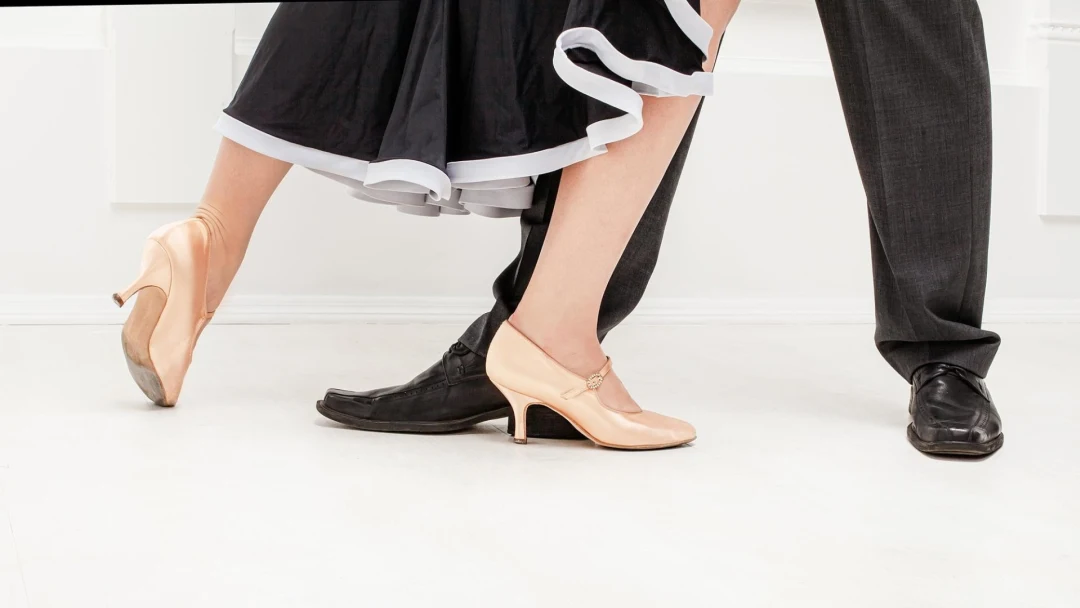
The feet of a man and a woman wearing dance shoes during a ballroom and Latin dance practice, including Salsa
Small steps give you time to hear the next beat before shifting your weight.

On 1 and On 2 change the rhythmic reference

Salsa music is usually in 4/4 time; in class, two bars are often grouped into eight counts. A common basic rhythm places six weight changes across these eight counts. On 1, the steps often fall on 1, 2, 3 and 5, 6, 7. There is usually no additional weight change on 4 and 8, although the movement can continue to flow.

On 2 does not simply mean shifting every On 1 step by one count. In the common New York style of counting, the steps can also fall on 1, 2, 3 and 5, 6, 7, while the emphasized direction change happens on 2 and 6. Other On 2 systems assign the steps differently. The term therefore refers to a rhythmic orientation, but does not specify every detail of the method.

You can dance to the same song using different step patterns. What matters is that both people share the same musical orientation. Mismatched timing can make a familiar figure feel awkward, even when the paths through space are correct.

When looking at courses on udansa, check three details: dance direction, the specific counting method used, and whether the focus is on partner work or solo elements. If a detail is left open, that part of the class remains unspecified. To reinforce a new timing pattern, a simple practice routine between classes can help.

How to Read Course Names Correctly

That's right

  • Classify Cubana and linear style as different movement paths
  • Interpret On 2 as a rhythmic variation
  • Understand Shines as standalone footwork
  • Recognize Rueda as a group format called out together

Not like this

  • Treat Cubana and linear style as interchangeable lists of figures
  • Automatically equate On 2 with an advanced level
  • See Shines only as decorative arm movements
  • Equate Rueda with every Salsa class in a circle

A course title only becomes useful when you can tell from it the movement path, musical timing, and how you’ll work together.

udansa Editorial Team

Partner work and solo elements serve different purposes

A Salsa class can cover the same basic step first on your own and then with a partner. That is no contradiction: On your own, you learn to transfer your weight fully and prepare the next step without pulling your partner along. With a partner, communication comes into play. A preparatory lead has to come through in time so the other person can find their own way.

A focus on partner work therefore involves more than just figures. It includes a responsive connection, clear changes of direction and finding a shared basic rhythm again. A long sequence of figures may rely on these fundamentals without covering them in depth.

A focus on Shines or Body Movement takes a different approach. Footwork, body coordination and musical accents are developed independently of a partner connection. These elements can be part of a regular partner dance class or make up most of the instruction. Rueda, in turn, adds shared calls and orientation within a group.

This explains why two classes at a similar level can offer different learning experiences. A lot of solo work does not mean there is no partner dance instruction, and many partner figures do not guarantee intensive rhythm work. When joining a group that is already underway, it also matters which fundamentals are already assumed. The guide to joining a dance class later explains why a familiar movement pattern does not necessarily mean you share the same learning foundation.

Two learning perspectives within Salsa

Connection

Responding to movement as a pair

Timing becomes tangible between two people

A small change in the connection can prepare you for a change of direction. You learn to give or receive such impulses without pushing the other person. This shows whether your own step still leaves room for a response.

Independence

Shape your rhythm solo

Without hand contact, your timing is your own

Without a connection, you have to manage your own timing, balance, and step size. You can develop a rhythmic idea with your feet and coordinate your body movement independently. This gives you a way to express yourself that can also find a place in partner dancing later on.

Frequently asked questions

  1. No, Salsa Cubana is a dance style, while Rueda de Casino is a group dance based on it. In Rueda, couples dance in a circle and respond to shared calls. You can also dance Cubana as a pair, without a circle or called figures.

Salsa Classes in Stuttgart

In the course filter on this page, you'll find the current classes and dates in Stuttgart to narrow down your options.

Find your Salsa-Rhythm

On udansa, you can find Salsa lessons in Stuttgart that suit your preferences for counting style and learning focus. To practice together, you can also look for suitable dance partners there.

Find your Salsa-Rhythm