Find your acrobatics community on udansa
On udansa connect, you meet like-minded people who share your passion for spectacular choreographies and discover suitable offers in your area.

By Mary De LucaUpdated
On udansa connect, you meet like-minded people who share your passion for spectacular choreographies and discover suitable offers in your area.
If you dare to take the leap into the air, you shouldn't lose the financial ground beneath your feet. This budget planner shows you transparently which real costs you will actually face in an acrobatic club year with udansa.
The competition license is an official, annually renewable authorization from a sports association that entitles a dancer to participate in national and international championships. It ensures that all participants are judged according to the same sporting guidelines.
Anyone who chooses the fascinating world of dance acrobatics dives into a sport that perfectly combines aesthetics and athleticism. But before you master your first handstand, the financial question arises. The good news first: compared to commercial dance schools or individual training, training in a non-profit club is usually very affordable. The basis for your planning is the monthly or annual membership fee. This covers the use of the hall, insurance through the state sports association, and regular training.
For families and adults, the prices for an acro-dance club are usually very socially responsible, as clubs often offer discounts for siblings, pupils, or students. While adults generally have to expect a slightly higher fee, families benefit from special rates that noticeably relieve the budget. If you want to get an impression beforehand, it is best to use a non-binding acrobatics trial training to get to know the trainers and the hall facilities before the first membership invoice arrives.
In addition to the monthly fee for training, other expenses will arise throughout the year that are often underestimated. A significant factor is the costumes for shows, performances, and championships. Since acrobatic costumes must be extremely durable, elastic, and at the same time non-slip, they are usually custom-made. Clubs often invest in a shared collection, to which members contribute via an annual rental fee. However, if the outfit has to be individually tailored, one-time acquisition costs arise.
Added to this is the appropriate training clothing. Here, good equipment is essential to prevent friction on the mat and to guarantee maximum freedom of movement. Anyone who wants to train injury-free in the long term should also focus on targeted physical preparation. A look at the guide on the topic of strength building for acrobatics in dance shows that, besides the actual training at the club, often only little additional equipment is needed for supplementary home training, which in turn saves money.
Saving in the dance year
Unnecessary expenses
Find the right club or course for your acrobatics training and get started safely with udansa.
Modern Dance for kidsBerlin · Germany
Modern Dance & Akrobatik ab 10 J.Wednesday · 17:00 · Nov 11
Flow Motion Studio Wedding
The costs in the club are manageable when you take advantage of the community. Thanks to costume rental fees and shared bus trips, dance acrobatics remain affordable for every budget.
As soon as a group or duo takes the leap from pure training to the competition stage, financial planning changes. For every entry in official championships, an entry fee for acrobatic tournaments is required. These fees are charged per participant and discipline, and they cover the organization, the judges, and the rental of the venue. In addition, sports associations usually require an annual competition license (start book), which is mandatory for registration in the tournament system.
Travel and accommodation costs for tournaments should also not be underestimated. Since championships rarely take place right on your doorstep, travel expenses, hotel stays, and on-site catering quickly add up. Although many clubs organize group bus trips or subsidize travel from the club treasury, active tournament dancers should still firmly include this item in their annual budget. If you are still unsure whether the tournament circuit is right for you, you can first try out smaller Acro Dance moves for beginners in your familiar training environment.
The classic membership for recreational sports
Ideal for everyone who appreciates fixed training times, wants to benefit from affordable fees, and is looking for sociability and cohesion in a permanent club group.
Specialized workshops and block courses
Perfect for dancers who want to specifically improve their skills in individual acrobatic techniques through specialized workshops or time-limited courses, without being tied to a permanent club membership.
A typical annual membership fee for adults in a sports club is usually between 120 and 300 euros. This already includes the weekly training sessions as well as sports insurance.
Yes, most non-profit clubs offer significant discounts for families, siblings, as well as pupils, students, and apprentices. This often reduces the per-capita fee considerably.
A typical acrobatics tournament entry fee is between 15 and 40 euros per entry and person, depending on the association and age group. In addition, there is a one-time annual fee for the competition license.
The basic equipment includes tight-fitting, elastic sportswear and possibly special gymnastics slippers. For beginners, simple equipment for under 50 euros is usually completely sufficient.
 Find an acrobatics club: Your path to training and show dance
 Acro Dance Competition: Procedure and Scoring
 The Big Day: Your Acrobatics Show Checklist
 Acrobatics for adults: mastering your start in a club
 Acrobatic Show Trends 2026: Fresh Ideas for Your Performance
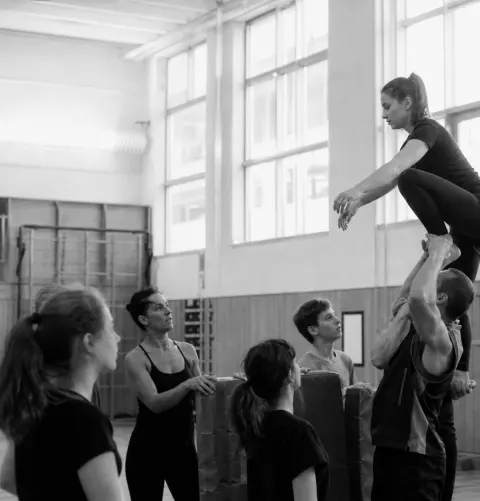 Together on stage: A portrait of an acrobatic show group
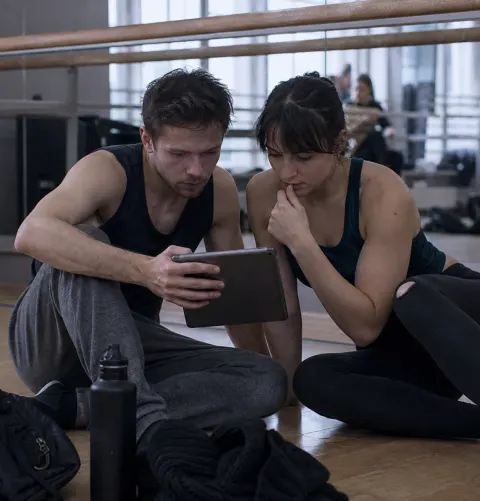 Trust on the dance floor: The partner acrobatics team test