Ballet equipment5 minutes

Pointe shoes for adults: Determining hardness and box shape

By Bernhard De LucaUpdated

In short
  • Adult beginners usually require a medium to firm hardness to safely support their higher body weight compared to children.
  • The choice of box shape depends on the width of the toes and feet, with square shapes being optimal for wide feet.
  • A professional fitting at a specialized store is mandatory to avoid misalignments and injuries during your first pointe work.

Starting pointe work at a mature age is a fascinating adventure for the body. For this dream to succeed, the equipment must be perfectly tailored to the adult anatomy.

DefinitionBox shape

The box is the front part of the pointe shoe, hardened by glue and layers of fabric, that encloses and supports the toes. Its shape must fit the width and alignment of your forefoot exactly.

Anatomical characteristics for adult late starters

The dream of pointe dancing does not have to remain a dream in adulthood, but it requires far more precise preparation than for children. While the bones and joints of young dancers are still growing and extremely flexible, late starters encounter a fully developed, often firmer skeletal structure. This is exactly where the hardness of pointe shoes for adults comes into play: It determines whether the shoe stabilizes the foot or painfully blocks it. An adult foot usually exerts more body weight onto the tip, but at the same time possesses a less flexible arch than someone who has trained daily since childhood.

For this reason, the choice between a hard or soft pointe shoe is not just a matter of taste, but an anatomical necessity. Anyone who starts with a sole that is too hard will hardly manage to bend the sole enough so that the center of gravity lies exactly over the standing surface (the so-called platform). The result is constantly standing behind the tip, which overloads the calf muscles and increases the risk of injury. Models that are too soft, on the other hand, do not offer enough support for heavier bone structures and wear out in record time.

Young ballet dancer sitting on the floor and tying her pointe shoes with ribbons
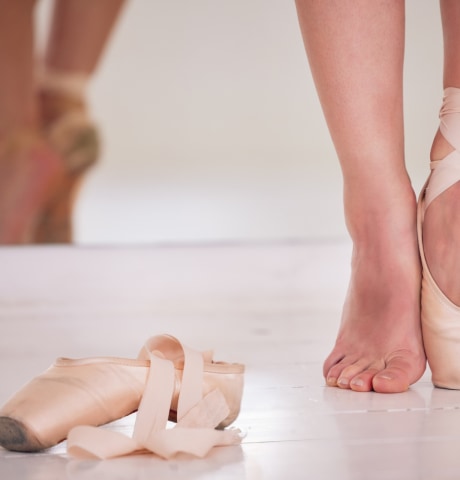
The exact alignment over the platform protects the joints and only succeeds with the right level of hardness.

The perfect box shape for wide and narrow feet

The box is the front, hardened casing of the shoe that encloses the toes. For adults, the shape of this box is the key to pain-free dancing. Since toes have been individually shaped over the course of a lifetime by everyday and sports shoes, a standard model is rarely sufficient. The width in the area of the metatarsal bones is particularly important. Those with wide feet need a square box shape that offers the toes enough space side by side without painfully squeezing them together.

A typical mistake when buying is the attempt to use ballet shoes with a full or split sole as a reference for the fit of the box. The rigid box behaves completely differently than a soft slipper. It must distribute the pressure evenly over the entire forefoot. If the box is too narrow, there is a risk of pressure points and chronic inflammation: if it is too wide, the foot slips down through it, and the entire body weight rests painfully on the tip of the big toe.

The path to the perfect pointe shoe

Correct

  • Go to a professional fitter in a specialty store
  • Use the toe width as a measure for the box
  • Wear the pads in the shoe when trying them on

Wrong

  • Buying shoes blindly based on your street shoe size
  • Trying to force a sole that is too hard
  • Slipping into the box without padding

A perfectly fitted pointe shoe is not an instrument of torture, but a custom-made tool that supports adult anatomy exactly where the foot cannot yet manage on its own.

Ballet teacher, Hamburg

Why a professional fitting is essential

Buying pointe shoes online without prior consultation is the surest way for adult beginners to end up with injuries and frustration. Every foot is unique in terms of arch height, toe length, and heel width. Experienced late starters get their pointe shoes fitted by a certified fitter in a specialized shop. A professional fitting often takes over an hour and involves trying on a wide variety of brands and stiffness levels under pressure.

During the fitting, it is also determined which pads made of silicone, foam, or lamb's wool best suit the chosen box. This padding takes up additional space and must be inside the shoe when purchasing. Only when the sole lies flush against the heel while standing and does not uncomfortably cut into the Achilles tendon when rising onto pointe has the right model been found. Never blindly trust your normal street shoe size for this.

Hard vs. soft pointe shoes compared

Soft

Soft pointe shoes

Flexibility for flat feet

Soft soles are suitable for feet with a less pronounced arch. They make it easier to reach the platform, but offer significantly less stability for heavy feet and wear out faster.

Hard

Hard pointe shoes

Stability for a high instep

Hard soles provide optimal support for a higher body weight and relieve the tendons. However, they require strong foot muscles and a well-defined instep to bend the shoe properly.

Frequently Asked Questions

  1. For adult beginners, a medium hardness is usually ideal. It offers sufficient support for a higher body weight compared to children, but can still be bent in a controlled manner with well-trained foot muscles.

Ballet for adults near you

Find the right studio for your start in the world of classical dance.

View all suitable courses

Reaching the top together

On udansa connect, you will find like-minded people who share your passion for classical ballet, as well as the right studios for your start in pointe work.

Reaching the top together