Ballet equipment5 minutes

Ballet shoes with full or split sole: Which is better?

In a nutshell
  • A full sole offers beginners important stability and strengthens the foot muscles through the natural resistance of the material.
  • A split sole grants advanced dancers maximum flexibility and emphasizes the visual line of the pointed foot.
  • The switch from a full to a split sole should only happen once your own foot strength has been sufficiently developed.

The choice of sole determines how well you feel the floor and how intensely your foot muscles are trained. Find out which shoe optimally supports you during your first steps at the ballet barre.

DefinitionSplit sole

Split soles are shoe constructions where the firm outer sole is recessed in the midfoot area. This keeps the middle of the shoe highly flexible, allowing it to adapt seamlessly to the extension of the foot.

Two designs for different needs

If you start ballet at a mature age, you are faced with a surprisingly large selection of equipment. The most important decision concerns the sole of your practice shoes. A classic ballet slipper has either a full sole made of sturdy leather or a split sole, where the heel and ball are reinforced separately. This seemingly small difference in construction significantly influences how your foot moves on the studio floor and how intensely your muscles have to work.

Choosing the right sole shape is not just a matter of taste, but is closely linked to your current training level and your anatomical requirements. While one variant stabilizes the foot and acts like a training tool, the other emphasizes the visual line and provides maximum flexibility. To find the option that is right for you, it is worth taking a closer look at the mechanical properties of both designs.
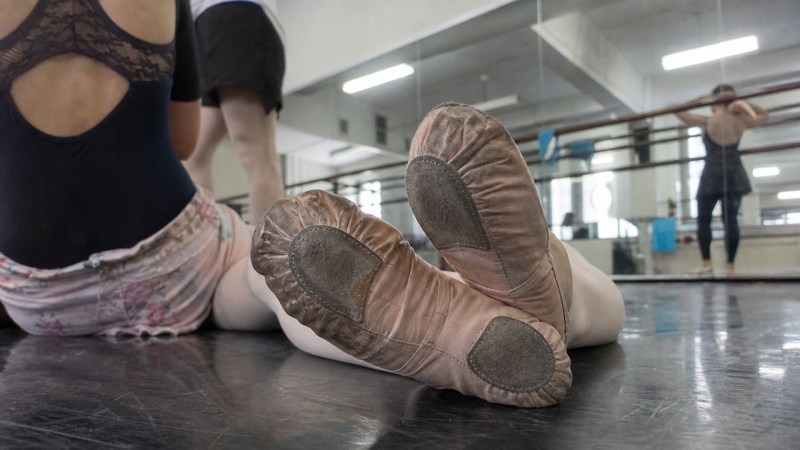
The firm leather strip of a full sole offers noticeable resistance and trains your sense for even floor contact in the studio.

Why the split sole requires strength

The split sole leaves the area under the arch of the foot completely free. As a result, it offers no significant resistance when stretching the foot. One of the great advantages of a split sole in ballet is that the shoe clings to the sole of the foot like a second skin and makes the hard-earned foot extension look particularly aesthetic in the mirror. However, this freedom also requires highly developed, individual musculature to avoid falling into incorrect postures.

In contrast, there is the classic, full sole. A full sole for ballet beginners offers exactly the firm feedback that you need at the beginning of your training. It forces the foot to actively work against the resistance of the leather with every movement at the barre. This systematically strengthens the tendons and muscles in the arch of the foot and prevents beginners from unknowingly buckling inward when standing on one leg. If you are wondering whether your body is ready for training, our ballet body awareness self-test will help you with an initial assessment.

How to choose the right sole for your dance shoes

Correct

  • Use a full sole for the systematic development of foot strength
  • Only choose a split sole once you have sufficient joint stability
  • Ensure an absolutely wrinkle-free fit at the midfoot

Wrong

  • Wearing slippers that are too soft without muscle tension as a beginner
  • Forcing the split-sole version just for the sake of aesthetics
  • Buying slippers with too much room in the toe area

The full sole is like a small gym for the foot. It does not forgive any carelessness and builds exactly the strength you need later for demanding turns.

Ballet teacher, Hamburg

The right decision for your training level

For adult beginners, choosing a full sole is almost always recommended for the first few months. It trains your sense of floor contact and builds the necessary basic tension. Only when the foot muscles are stable enough and the joints can be precisely aligned does switching to a split sole make sense. If you already have previous experience or are specifically working on your visual line, you will find the split variant to be the ideal tool for advanced classes.

When buying, make sure that the slippers fit snugly without curling your toes. Regardless of the sole, the material should optimally support the shape of your foot. If you are still at the very beginning and wondering what you can wear to your first trial class without buying complete equipment right away, you will find valuable tips in our guide on the first ballet class without professional clothing. For additional stability and stretching in the pelvic area, you can also prepare with special ballet stretching exercises for the hips.

The two sole constructions in direct comparison

Full

The full sole

Stability and muscle building for beginners

Offers continuous support for the entire arch of the foot. It forces the foot to perform active muscle work against the resistance of the material and is excellently suited for muscle building at the beginner stage.

Split

The split sole

Flexibility and aesthetics for advanced dancers

Consists of two separate sole patches under the heel and the ball of the foot. It hugs the arched instep perfectly and enables intricate footwork for advanced dancers with stable muscles.

Frequently Asked Questions

  1. For absolute beginners, a full sole is the best choice. It provides support for the untrained foot, prevents rolling, and systematically strengthens the foot muscles through the resistance when stretching.

Ballet classes for adults near you

Find the right studio and start your first trial lesson with the right slippers.

View all matching courses

Find your ballet class with udansa

On udansa, you can find like-minded people for your new hobby and search directly for suitable ballet schools in your area. Exchange ideas and get started at the barre together.

Find your ballet class with udansa