Children's dance4 minutes

Cross-body movements in children's dance: brain training for the little ones

In short
  • Cross-body movements in children's dance activate both hemispheres of the brain simultaneously by consciously crossing the midline of the body.
  • This special coordination training promotes neuroplasticity and strengthens neuronal networking in the child's brain.
  • Kinesthetic learning links physical movement directly to cognitive processes such as concentration.
  • Modern concepts focus on playful diagonal movement patterns instead of rigid, one-sided choreographies.

Modern dance pedagogy today goes far beyond simply learning steps. Discover how innovative movement trends playfully and effectively promote your child's mental development.

How modern movement trends for children emerge

Dance trends for the youngest ones do not emerge overnight and rarely spread at the rapid pace of digital social media feeds. While teenagers follow new steps on their smartphones, a new trend in children's dance establishes itself in a much more sustainable way: directly in dance schools, at family workshops, and in parent-child gymnastics. Because the physical and mental health of the little ones is the focus, dance educators examine new concepts very carefully before integrating them into their classes. A trend only catches on when it proves itself in practice and visibly brings joy to the children. As a result, curricula change more slowly, but all the more soundly.

The impulses for these new movement concepts today come directly from modern developmental neurobiology and movement therapy. Educators and therapists work hand in hand to develop playful exercises that go far beyond merely imitating steps. The goal is holistic development that starts in the brain. The trends are moving away from rigidly rehearsing fixed formations toward free, dynamic movement patterns that truly challenge children's brains. Anyone visiting a modern children's dance class today will see children swirling diagonally across the room, consciously crossing their midlines, and laughing while their synapses fire in the background.

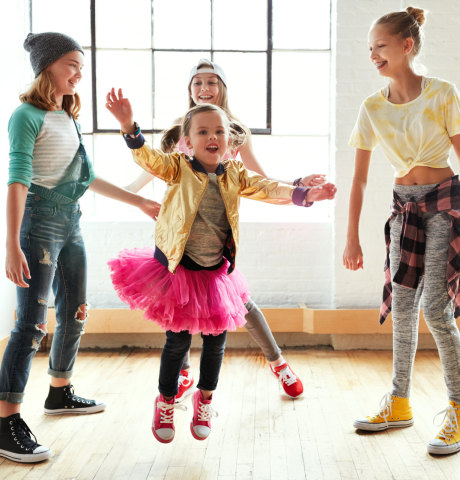
A group of children dancing in a music studio while rehearsing a Hip-Hop choreography in front of a wall
With playful diagonal movements and colorful scarves, children in dance class unconsciously train both hemispheres of their brain.

The latest trends in modern movement pedagogy

  • Animal diagonal movements

    With this trend, children imitate animals that move diagonally, such as creeping tigers or crawling crabs. The playful approach ensures that the little ones perform the complex cross-body movements completely unconsciously and with immense joy.

    • Creativity
    • coordination
    • animal stories
  • Rhythmic midline crossing

    Under the concept of kinesthetic learning, modern courses combine rhythm games with targeted crossing of the limbs. Clapping on the opposite shoulder or hip to the beat of the music trains coordination and strengthens concentration.

    • Rhythm
    • brain training
    • haptics
  • Figure-eight scarves in space

    By using colorful chiffon scarves or elastic bands, children are encouraged to paint large figure-eights in the air. These fluid movements across the center of the body promote eye-hand coordination and activate both hemispheres of the brain.

    • Props
    • visual coordination
    • flow

Playful brain development for your own living room

To continue the positive effects of this movement training in everyday life, parents do not need to be trained dance teachers. Simple, playful impulses in the living room are enough to support neural networking. It is particularly important that the movements are performed without pressure to perform and with plenty of joy. If you want to practice children's dance at home with your little ones, you can specifically incorporate diagonal games. For example, have your child throw a colorful scarf up on the left side with their right hand, or tap their knees diagonally with their hands to the rhythm of the music. Such small units can be wonderfully integrated into the day.

In addition to physical progress, dancing together also strengthens the bond and self-confidence. Children learn playfully to perceive their body consciously and to coordinate it in space. If you notice that your child enjoys these movement patterns, attending a professional dance school is the next logical step. There, experienced educators guide the exercises professionally and embed them in a motivating group community where learning happens as if by itself.

When children learn to consciously cross their midline while dancing, they build the bridges in their brain that they will later need for logical thinking and concentration in everyday life.

Dance educator and expert in early childhood movement, Hamburg

How to succeed with playful development in everyday life

Correct

  • Playfully incorporate diagonal movements into dance stories
  • Challenge both sides of the body evenly and with variety
  • Focus on the joy of movement without the pressure to perform

Wrong

  • Train only right or left orientation for a long time
  • Demand rigid choreographies without room for free movement
  • Strictly correct incorrect execution instead of guiding playfully

Frequently Asked Questions

  1. Cross-lateral movements are sequences where a hand or foot crosses the imaginary vertical midline of the body. A typical example is touching the left knee with the right hand while dancing.

Creative children's dance near you

Find playful dance courses now that optimally promote your child's coordination and brain development.

View all suitable courses

Find the right dance class for kids

On udansa you will find play-oriented dance classes for children that focus on modern movement development. Discover offers in your area and support your child's development from the very beginning.

Find the right dance class for kids