

Together discovering the world of dance
On udansa connect you can find playful dance offers for the little ones and exchange ideas with other parents. Discover suitable courses in your area now and give your child movement that makes them happy.


On udansa connect you can find playful dance offers for the little ones and exchange ideas with other parents. Discover suitable courses in your area now and give your child movement that makes them happy.
For children, dancing is far more than just movement to music. It is a holistic engine for physical, mental, and social development, playfully setting the course for growing up healthy.
Children's dance development describes the process in which children playfully unfold their motor, cognitive, and socio-emotional skills through age-appropriate dance and movement games. The focus is on the joy of moving to music.
When children hear music, they usually start to sway, clap, or spin in circles quite intuitively. This natural joy of movement is the perfect starting point for holistic development. Sound development through children's dance starts exactly here by combining playful impulses with structured movement. Unlike pure sports, dance pedagogy is not just about strength and endurance, but about the interaction between body and mind. Through dancing, children learn to use their own body as a means of expression, which contributes significantly to building a healthy body awareness.
Dance pedagogical work uses this curiosity to consolidate motor foundations. The little ones learn to coordinate their limbs purposefully, maintain their balance, and orient themselves in space. Every class is structured in a way that directs the natural urge to move without restricting it. In this way, the foundation for a lifelong joy of movement is laid, which extends far beyond the boundaries of the dance studio.

The physical benefits of dancing are diverse and well-documented by science. Dancing engages muscle groups that are often neglected in everyday life. This strengthens posture and prevents misalignment. Targeted coordination training in children's dance also trains the interaction between the two hemispheres of the brain, as movements are often performed crosswise or asymmetrically. Children learn to move their arms and legs independently of each other, which creates new synapses in the brain.
In particular, children's motor skills when dancing benefit from varied step sequences and rhythm changes. Children have to stop, turn, jump, and adjust their speed. This dynamic trains the deep muscles and improves reaction time. In addition to the physical aspects, dancing makes an invaluable contribution to children's health: it strengthens the cardiovascular system, promotes joint flexibility, and provides a healthy balance to the often sedentary everyday life at school or daycare.
Like this
Not like this
When dancing, a child learns more than just steps, it experiences its body as a tool with which it can express feelings and understand the world.
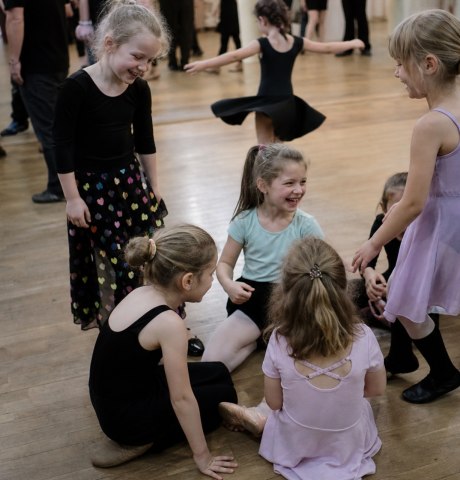
Dancing is always a social act as well. In a dance class, children meet their peers and learn to see themselves as part of a group. A creative effect of children's dance is particularly evident in how they interact with one another: the children must pay attention to each other, maintain distance, and stay in rhythm together. This trains empathy and mutual consideration. When a child experiences how a shared movement in a circle harmonizes, it immensely strengthens their sense of belonging.
At the same time, self-confidence through children's dance grows with every new skill. A successful movement or mastering a short sequence of steps gives children tangible experiences of success. They learn to show themselves in front of others and to be proud of their own achievements. This emotional strength also helps them in everyday life to face challenges with more self-confidence. Professional dance pedagogy for children creates a protected space for this, where mistakes are allowed and the individual personality is at the forefront.
Let your feelings and imagination run free
In free dance, your own creativity is the focus. Children translate feelings and images into movement without fixed guidelines, which stimulates the imagination and strengthens individual expression.
Train coordination and rhythm in a targeted way
Structured exercises and short choreographies train memory and discipline. Children learn to coordinate movements precisely and adapt to rhythmic requirements.
Starting around three years old is ideal. At this age, children can follow simple, playful instructions and take great joy in rhythmic imitation.
Creative children's dance focuses on free expression and imagination, while ballet trains fixed techniques and positions. Both approaches complement each other well, but they address different areas of development.
Dance pedagogy uses movement as an educational tool to strengthen a child's personality. It is not about performance, but about the holistic development of body and mind.
Find playful dance courses that optimally support your child's development.
Creative Dance for Kids (from age 3)Berlin
Kreativer Kindertanz 3-5 J.Sep 8, 2025
Hebammenpraxis Rahnsdorf
Creative Dance for Kids (from age 3)Berlin
Kreativer Kindertanz 5-7 J.Sep 8, 2025
Hebammenpraxis Rahnsdorf
Creative Dance for Kids (from age 3)Berlin
Kreativer Kindertanz & Tanzakrobatik 3-5 J.Sep 10, 2025
Flow Motion Studio Wedding
 How children's dance improves motor skills and balanceChildren's dance is much more than just moving to music. It is a highly effective workout for toddlers to improve their motor skills, coordination, and balance.
 Boost your child's sense of rhythm through playWith this simple guide, parents can test and develop their child's sense of rhythm through playful everyday activities. No pressure, just lots of fun with movement.
 Boosting social skills and team spirit through kids danceDancing is a team sport for the soul. Discover how kids dance playfully strengthens your child's social competence, empathy, and teamwork within a group.
 What is my child's dance type? A playful learning style testWhat is your child's movement type? Take our test for parents and find out if your child learns best visually, auditorily, or through movement.
 How dance boosts children's concentrationDance is much more than just moving to music. Find out how specific dance steps sustainably strengthen cognitive development and children's ability to concentrate.
 5 Posture issues in children that dance correctsLong periods of sitting and a lack of exercise quickly lead to poor posture in children. Learn how kids' dance playfully strengthens the back and corrects posture issues.
 Boosting confidence in shy children through danceCreative dance helps shy children build new self-confidence through their own bodies. Discover how free movement strengthens emotional expression.