Children's dance and development5 minutes

Boost self-confidence for shy children through dance

In a nutshell
  • Creative children's dance strengthens self-confidence for shy children by offering them a non-judgmental space for physical expression.
  • Through playful role-playing and free movement, children learn to confidently occupy their own space.
  • Improved body awareness for children helps them to stand taller and more securely in everyday life as well.
  • Encouraging shy children works particularly well through dance, because emotional expressiveness is trained without any pressure to speak.

Some children need a little longer to come out of their shells. Creative children's dance offers them the opportunity to build a strong connection to their own bodies and to grow beyond themselves internally, completely without the pressure to perform or the need for words.

DefinitionCreative Children's Dance

Creative children's dance is a form of dance pedagogy that avoids fixed, rehearsed choreographies and instead focuses on the free, playful development of children's movement impulses.

How movement gently opens the shy soul

When a child prefers to seek protection behind their parents' legs in new situations or falls silent in groups, it is not a flaw, but a personality trait. Shy children often perceive their environment particularly intensely and carefully weigh risks. To gently dissolve this hesitation, there is no need for loud demands, but rather a space where communication works without words. This is where the concept comes in, to playfully build self-confidence for shy children through movement.

Creative children's dance uses the natural joy of movement to anchor a healthy self-esteem in children's dance. Unlike performance-oriented sports, there is no right or wrong in creative dance pedagogy. The child learns that their body is a wonderful tool to make feelings, stories, and ideas visible. This experience of self-efficacy is the first and most important step to strengthen one's own voice and presence in everyday life.

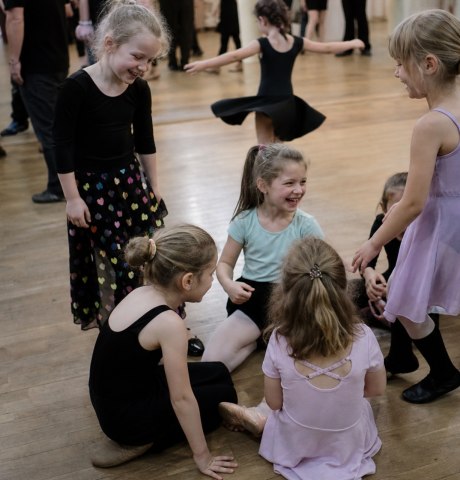
A group of happy children during Hip-Hop dance training in a studio
In the community of creative children's dance, every child experiences acceptance and learns playfully to courageously occupy their own space.

Body awareness as the key to inner strength

In creative children's dance, it is not about performing perfect pirouettes or memorizing rigid sequences of steps. Instead, the focus is on experiencing one's own body. Through free movement games, little ones learn to occupy their space and feel themselves. This intensive body awareness for children is the foundation for a confident demeanor. Anyone who knows what it feels like to stretch tall like a giant or stand firm like a tree carries this feeling into their everyday life at school or kindergarten.

Another important aspect is the ability to express emotions. It is often difficult for reserved children to put feelings like anger, joy, or pride into words. When dancing, they can simply live out these emotions physically. They stomp their anger into the ground or whirl their joy through the room. If you are looking for ways to support your child in their social development, it is also worth taking a look at the guide Strengthening social behavior and team spirit through children's dance, which shows how interaction in a group strengthens trust.

The sensitive approach to shy dancers

That's how

  • Let the child determine their own pace when participating
  • Praise free movement and creative expression
  • Appreciate small progress within the group

What not to do

  • Pushing the child to join in or putting them in the spotlight
  • Correcting movements or comparing them with others
  • Forcing big performances in front of an audience

When children experience that their own movements fill the space and are appreciated, a deep, unshakable trust in their own personality grows from it.

Dance educator, Hamburg

Fantasy and roleplay as a safe space for courage

To support shy children, dance teachers often design their classes as imaginative journeys. The children transform into brave lions, quiet cats, or flying birds. In these roles, they are allowed to try out behaviors that they might not yet feel confident enough to express as themselves. A shy child who jumps through the room roaring loudly as a lion experiences their own strength and the positive resonance of the group without feeling personally exposed.

This playful transformation reduces fears and strengthens confidence in one's own abilities step by step. The group is not perceived as a threat or a judging authority, but as a safe harbor where everyone is allowed to be exactly who they are. Should the child still get weak knees before smaller performances or an open class, the article Gently overcoming stage fright before a child's performance helps with practical tips to lovingly manage the excitement.

Two pillars for personal development in dance

Freedom

Creative freedom

Expression without fixed rules

In creative dance, children can freely express their impulses. They learn that every movement is correct, which massively strengthens their confidence in their own decisions and their self-esteem in children's dance.

Structure

Secure environment

Security through rituals

Fixed structures provide support and orientation. They help the child to move safely within a clear framework and to reduce fears of the unknown through recurring rituals.

Frequently Asked Questions

  1. Creative dance for children is excellently suited, as it is completely free of performance pressure. The child does not have to copy steps perfectly, but is allowed to participate in a way that makes them feel comfortable, which removes pressure and awakens the joy of movement.

Creative children's dance near you

Find the right course where your child can blossom through play and boost their self-confidence.

View all matching courses

Stronger together through dance

On udansa, you will find playful dance offers and empathetic dance schools that provide shy children with a safe space for their personal development.

Stronger together through dance