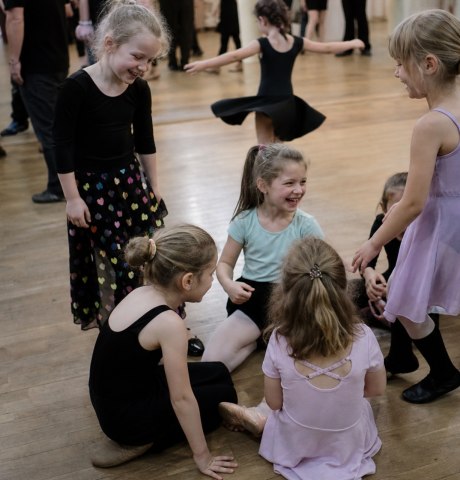
Children's dance and development5 minutes

How children's dance trains motor skills and balance

In short
  • Regular children's dance promotes the motor development of toddlers through varied movement sequences.
  • Balancing to music strengthens the sense of balance and ensures more sure-footedness in everyday life.
  • Coordinating arms and legs to the rhythm trains the interaction between brain and muscles.
  • Playful dance exercises strengthen the entire musculature and support a healthy posture from the very beginning.

Moving the world together, playfully

On udansa, you will find playful dance courses for children that are perfectly tailored to the motor development of the little ones. Discover offers right in your area and let your child experience the joy of healthy movement.

Moving the world together, playfully

The first steps in life are full of discoveries and small stumbling blocks. Here, you can find out how to naturally support your child's physical development through the playful power of music with udansa.

DefinitionPromoting motor skills through children's dance

Promoting motor skills through children's dance describes the targeted support of children's physical development through age-appropriate, rhythmic movement games. Coordination, balance, and muscle strength are trained in a playful way and without any pressure to perform.

How dance strengthens physical foundations in everyday life

In the first years of life, children's physical development happens at a rapid pace. Toddlers learn to consciously control their limbs, estimate distances, and master gravity. Targeted children's dance helps to accompany these processes in a natural way. By learning to move to music in a playful manner, the motor development of children is stimulated holistically. At this age, it is not about rehearsing rigid choreographies, but about testing one's own body in space. Every hop, every turn, and every step trains the neural pathways and strengthens the muscles necessary for a healthy posture.

When dancing, movements are performed that rarely occur in normal everyday life. Bending, stretching, turning, and balancing challenge the entire musculoskeletal system. Through this variety of stimuli, the brain learns to coordinate the different muscle groups precisely and harmoniously. Anyone who learns to move their body in a versatile way early on benefits from it for a lifetime: movements in everyday life become more secure, the risk of injury decreases, and the general sense of body awareness improves noticeably.

Mastering balance and coordination in a playful way

A central building block of physical development is targeted balance training for children. The sense of balance in the inner ear works at full speed when dancing. When children spin, stand on one leg, or lean forward to the rhythm, the brain must constantly recalculate the position of the body in space. Children's dance combines this demanding task with music, which enormously enhances the learning effect. The music provides a temporal framework that helps children keep their movements flowing instead of stopping abruptly.

Additionally, coordination in children's dance is trained through the interplay of different body parts. While the feet perform a simple step, the hands clap to the beat or the arms draw large circles in the air. This coupling ability is a highly complex achievement of the central nervous system. Through constant repetition and the joy of music, these movement patterns become anchored in the subconscious. The child learns to move fluidly and efficiently, which also forms the basis for all other sports in later life.

The right balance between play and structure

How to succeed with encouragement

  • Offer playful movements without performance pressure
  • Incorporate varied changes of direction and turning work
  • Put the joy of your own rhythm in the foreground
  • Establish regular, short movement sessions

This limits the fun

  • Forcing complex, rigid step sequences
  • Constantly repeating monotonous movement patterns
  • Strictly correcting mistakes and creating pressure
  • Demanding overly long, tiring training sessions

Children discover the world through movement, and dance offers them the opportunity to explore the limits and abilities of their own bodies with pure joy.

Dance educator, Hamburg

Body awareness and the joy of your own strength

Children's dance is characterized by the fact that it is free from performance pressure. The focus is on the joy of movement and discovering one's own abilities. When children realize that they have mastered a new movement or land safely on their feet after a turn, it strengthens their trust in their own body. This physical security transfers directly to the mental level: a child who can control their body well moves through the world with more self-confidence. The playful approach ensures that the strenuous training of muscles and coordination is perceived as pure pleasure.

The positive effects on motor skills are far-reaching. Parents often observe that children who dance regularly also act more skillfully in everyday life, trip less often, and develop a more upright posture. If you want to lay the foundations, you will find valuable guidance in the guide for getting started. Ultimately, dancing at a young age is the best foundation for an active, healthy life, as it preserves the natural joy of movement and strengthens the body from the ground up.

Two paths to motor development

Freedom

Creative Children's Dance

Discovering your own movement

This is all about experiencing rhythm and space without fixed rules. Children follow their own impulses, imitate animals, or move freely to the music, which strengthens creativity and the fundamental joy of movement.

Structure

Targeted movement games

Interaction in rhythm

Learning small, age-appropriate step sequences together trains memory and precision. Children learn to coordinate their movements with others in terms of time and space, which promotes targeted body control.

Frequently Asked Questions

  1. Children's dance trains coordination, balance, and muscle strength. Through the varied movements in space, children learn to control their bodies precisely and develop a healthy posture.

Discover children's dance classes near you

Find the right class to playfully develop your child's motor skills.

View all matching classes