

Discover the world of dance together
Find playful courses in your area on udansa that foster your child's creativity. Sign up and discover the joy of free movement.


Find playful courses in your area on udansa that foster your child's creativity. Sign up and discover the joy of free movement.
Creative children's dance opens doors to a world where movement does not need fixed rules. Here, children transform into flying leaves or wild storms and playfully discover their own bodies.
Creative Dance for Kids is a dance pedagogy concept that uses children's natural joy of movement to promote motor skills, body awareness, and imagination without fixed choreographies. Through playful imagery and the use of props, children are encouraged to develop their own forms of movement.
In contrast to classic dance styles like ballet or urban styles like Hip-Hop, creative dance for children avoids rigid step sequences and predefined postures. Here, the focus is on the natural joy of movement. Children use their bodies as a means of expression to tell stories, portray feelings, or translate sounds into movement. A structured sequence in creative dance for children provides the little ones with the necessary framework without limiting their imagination. Every lesson follows a well-thought-out rhythm consisting of a welcome, a playful warm-up, a creative design phase, and a relaxing conclusion.
In a safe environment, the little ones learn how their own bodies move in space. They run like the wind, sneak like cats, or freeze like ice statues. This variety trains coordination and balance in a completely natural way. Those who look into the topic early on will learn in the comprehensive guide Dancing for children: The guide for the perfect start how important these first movement experiences are for overall motor development.
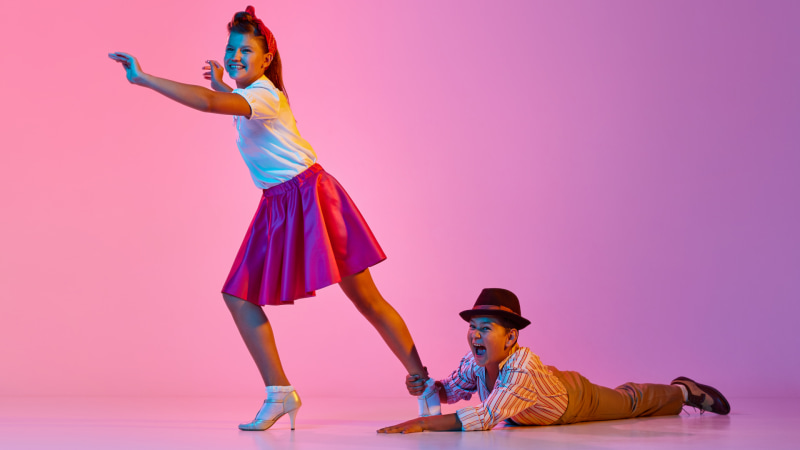
A typical evening or afternoon class at the studio is based on variety. Pedagogically valuable exercises in creative children's dance meet children where they are in their respective emotional worlds. The class usually begins in a circle to settle in and focus attention. This is followed by dynamic movement games that stimulate the circulation. In the main part of the class, props such as colorful scarves, ropes, or balloons are used. These objects serve as visual and tactile stimuli that encourage new forms of movement. In flight, a scarf becomes a butterfly, or on the floor, it transforms into a deep lake that needs to be jumped over.
Through this playful approach, the concept differs fundamentally from other offerings. While classical ballet often works on the precise execution of positions from an early age, as you can read for the older target group in the article Ballet for adult beginners: Basics & posture, the creative approach focuses on exploring one's own dynamics. There is no right or wrong, only different ways to interpret a theme through dance.
Correct
Wrong
Children need to be able to feel themselves, run, spin, and fall. It is only through free experimentation that they find their very own balance and trust in their own bodies.
Parents often ask themselves: at what age is children's dance actually sensible? In principle, children can take part in their first classes without parental accompaniment from about the age of three. At this age, their linguistic and motor development is advanced enough that they can follow simple instructions and integrate into a group. For younger children under three, special parent-child sessions are suitable, where the focus is on experiencing rhythm and touch together.
Creative dance games for children promote not only motor skills, but also social competence. The children interact with each other, have to pay attention to one another, and learn to coordinate themselves in space. Anyone looking for support in deciding which path is best for their own offspring will find valuable guidance in the guide Choosing a dance class for children: The guide for parents. In the end, the child's personality always decides whether they are looking for the structure of a fixed choreography or feel more comfortable in free, creative dance.
Discovering your own movement
In creative dance for children, there are no fixed rules. The children improvise freely to images like falling snow or heavy giants, developing a natural sense of their own body without any pressure to perform.
Learning technique and choreography
Classic dance styles like Ballet or Hip-Hop focus on learning precise techniques and step sequences. They train discipline and synchronous group dancing to fixed rhythms.
Creative dance for children is ideal for kids from about three years old. At this age, the little ones can usually integrate well into a group for an hour and follow imaginative stories through movement.
No, in creative dance for children, no fixed choreographies are rehearsed. The lessons are based on improvisation, dance games, and the playful enactment of stories to promote their own creativity and joy of movement.
The children should wear comfortable clothing like leggings and a T-shirt that offers maximum freedom of movement. Dancing is usually done barefoot, in non-slip socks, or in soft ballet slippers to optimally strengthen the feet.
Find playful dance courses that spark your child's creativity and joy of movement.
Creative Dance for Kids (from age 3)Berlin
Kreativer Kindertanz 3-5 J.Sep 8, 2025
Hebammenpraxis Rahnsdorf
Creative Dance for Kids (from age 3)Berlin
Kreativer Kindertanz 5-7 J.Sep 8, 2025
Hebammenpraxis Rahnsdorf
Creative Dance for Kids (from age 3)Berlin
Kreativer Kindertanz & Tanzakrobatik 3-5 J.Sep 10, 2025
Flow Motion Studio Wedding
 Dance for kids: The guide for the perfect startDance for kids playfully improves motor skills, rhythm, and self-confidence from an early age. Find out how to choose the perfect dance class for your child.
 Ballet for adult beginners: Basics & postureStarting ballet is possible for adults of any age. Learn the most important positions and how to sustainably improve your body posture.
 Choosing a dance class for kids: A guide for parentsFinding the perfect dance school for your child can be a challenge. Our guide shows you what to look for when choosing the right class for children aged 3 to 12.
 Dance styles for kids: The right startDiscover the variety of dance styles for children up to 12 years old. From playful creative dance to Hip-Hop and dance acrobatics, you will find the best guidance here.
 Children's Ballet: Playful exercises for homeDiscover ballet through play: With simple exercises and imaginative explanations, children aged 4 and up can learn their first classical ballet positions in the comfort of their own living room.
 Hip-Hop for kids aged 6+: Rhythm and cool movesHip-Hop offers children aged six and up the perfect introduction to the world of dance. With cool moves, playful choreography, and infectious beats, they will strengthen their coordination and sense of rhythm.
 Quiz: Which dance style suits your child?Find out which dance style perfectly matches your child's strengths and preferences with our simple quiz. Get a first orientation for choosing the right class!
 Acro Dance for Kids: The Perfect Blend of Gymnastics and DanceAcro dance combines the best of two worlds: the athleticism of floor gymnastics and the creativity of dance. Find out how children playfully develop body control.