

Easily find the perfect dance course
On udansa, you can easily find the right dance school for children as well as age-appropriate dance courses in your area. Simply enter your zip code and discover great offers for young up-and-coming dancers.


On udansa, you can easily find the right dance school for children as well as age-appropriate dance courses in your area. Simply enter your zip code and discover great offers for young up-and-coming dancers.
Finding the right dance course for your child requires a delicate touch. Learn what really matters when choosing a course concept, instructors, and the general framework at udansa.
Creative Children's Dance is an educational movement concept for children from about 3 years old. It playfully promotes body awareness and musicality through dance improvisation and imaginative movement games.
The search for the right dance school for children begins with the question of what your child needs in their current stage of life. For the little ones from 3 years old, the focus is on the playful discovery of rhythm and movement. A good dance class for children at this age avoids rigid choreography and fixed step sequences. Instead, it is about imaginatively awakening their own body awareness in space and the joy of music. Parent-child offers often provide a protected environment for a gentle start here.
As they get older, from about 6 years old, the requirements change. In a dance group for children for primary school kids, the first structured sequences are learned. This is about teamwork, translating music into movement together, and learning basic dance techniques. Make sure that the group size remains manageable. Only then can the teacher address each child individually and prevent them from feeling overwhelmed or frustrated.
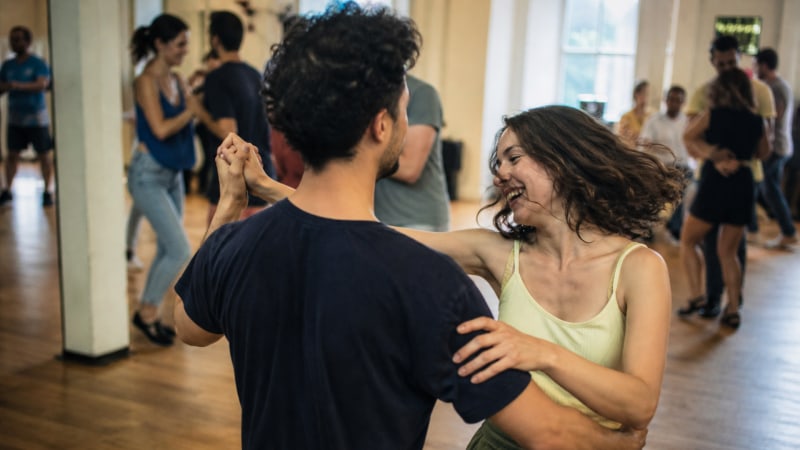
An excellent dance school for children is not defined by shiny trophies in the window, but by a warm, child-friendly atmosphere. When you visit a children's dance school, take a close look at the facilities. Are the floors sprung and non-slip? Is there a safe environment without sharp edges? Even more important, however, is the pedagogical qualification of the team. Dance educators work completely differently than trainers in the adult sector.
A respectful tone and the ability to motivate children in a playful way are the foundation for successful dance lessons for children. A trial lesson is the best way to find out if the chemistry is right. Observe whether the teacher seeks eye contact with the children, gently integrates shy participants, and whether you see smiling faces at the end of the lesson. A good start also makes the transition to more specific courses easier later on, such as your first dance class at a new studio.
How it works
What to avoid
Children's dance is not about perfection, but about children discovering their own bodies and leaving the studio with a smile.
An often underestimated factor when choosing is the organizational flexibility of the dance school. Especially for children aged 3 to 12, interests and leisure schedules change quickly. Rigid annual contracts can then quickly become a burden. Many modern studios offer more flexible terms or course blocks. Similar to flexible models for adults, as you know them from a dance school flat rate, children's dance courses should also offer fair cancellation or switching options.
In addition, accessibility plays a major role in everyday family life. Is the school on your daily route or is it easily accessible by public transport? If the effort for the commute is too great, motivation often fades on both sides. Clarify in advance whether parallel courses are offered for siblings or whether there are waiting areas for parents where you can relax during the training time.
Focus on development and fun
This is all about playfully exploring forms of movement. Children's imagination is stimulated through stories, while set steps and pressure to perform take a back seat.
Focus on technique and choreography
From primary school age, children learn their first fixed choreographies and rhythms. Here, the focus is on coordination, structure, and dancing together in a group.
For children aged 3 and up, creative children's dance is particularly suitable. At this age, it is primarily about playful movement to music and developing body awareness, without any fixed step sequences.
You can recognize a qualified children's dance teacher by their pedagogical training and a patient, appreciative way of interacting with the children. They correct gently, motivate through play, and ensure a positive group atmosphere.
A trial class is extremely important so that your child can get to know the environment and the group without any obligation. You will see immediately whether your child is having fun and whether the chemistry with the teacher is right.
For the first few classes, comfortable sportswear like leggings and a t-shirt is perfectly sufficient. Non-slip socks or gymnastic slippers are enough for their feet, as firm sneakers are usually not yet necessary.
Find the perfect class for your child in a playful way on udansa.
Creative Dance for Kids (from age 3)Berlin
Kreativer Kindertanz 3-5 J.Sep 8, 2025
Hebammenpraxis Rahnsdorf
 Your first dance class in Berlin: How to prepareEvery beginning is easy: With this guide, you can prepare perfectly for your very first dance class in Berlin and get started completely stress-free.
 Dance school flat rate in Berlin: Dance flexibly with a subscriptionIf you want to dance several times a week in Berlin, a flat rate saves you money. We compare the most flexible subscription models from Berlin dance schools for passionate dancers.
 When should children start dance classes?When is the right time for the first dance class? Our guide shows you which age is ideal for each course and how to get started.
 How much does a kids' dance class cost per month?How much does a kids' dance class really cost per month? We examine the price differences between private dance schools and sports clubs and show you what to look for in your contract.
 Finding a dance school for kids: How to chooseFinding the right dance school for your child requires a closer look. Our structured guide helps you make the best decision for your child.
 Trial class for kids' dance: Preparation for parentsThe first trial class for kids' dance is an exciting milestone. With the right preparation and relaxed guidelines for parents, the start will be a complete success.
 The right outfit for kids' dance classesThe first dance class is coming up and you're wondering what your child should wear? Our guide shows you which clothes and shoes are actually useful.
 Holiday dance course for kids or weekly training?Holiday dance course for kids or weekly training? We compare the pros and cons of both formats to help you make an informed decision.
 Choosing the Right Kids Dance Class: A Parent's GuideIf you are not careful when choosing a dance class for your child, you might end up paying for unused contracts or frustrating your little one. Learn about the most common mistakes parents make.