

Find your dance partner for mental fitness
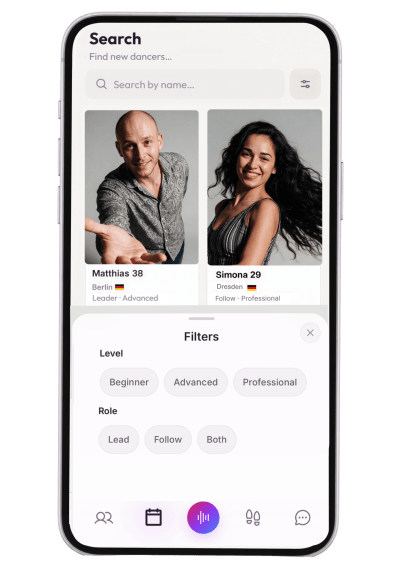
On udansa you will find like-minded people in your region who share your passion for music. Make new contacts and add some momentum to your everyday life together with others.

Moving to the beat of the music does far more than just burn calories. The interplay of steps, rhythm, and social interaction is a true superfood for our brain cells.
Dancing against dementia describes the targeted use of partner dance and rhythmic movement as a preventive measure to halt mental decline and build up cognitive reserve in the brain.
The combination of physical activity and mental challenge makes dancing a unique medicine for the brain. When you move to the music, your brain has to perform at its peak. It processes the rhythm, plans the next movement in a fraction of a second, and balances your equilibrium. Scientific studies show that this complex activity stimulates the formation of new neural connections and can measurably increase brain volume in the hippocampus, the center for learning and memory.
Compared to pure endurance sports or strength training, partner dance challenges the mind on a completely different level. You not only have to focus on your own steps, but also constantly react to your partner's signals. This constant adjustment trains your attention and keeps your gray cells flexible. Anyone who dances regularly is actively investing in their cognitive reserve and ensuring that staying mentally fit in old age becomes a lived reality.
A major advantage of dancing is the connection between cognitive performance and motor implementation. When learning new choreographies or spontaneously combining steps, your working memory is intensively trained. You have to remember sequences of steps, recall them at the right moment, and maintain your balance at the same time. This holistic memory training through dancing strengthens neuronal plasticity, which is the brain's ability to restructure and adapt throughout life.
Additionally, music helps to anchor movement patterns deep in the long-term memory. Even if logical thinking declines with age, the emotional and motor memory for music often remains intact for an astonishingly long time. Besides the memory effect, coordination can be improved in old age, which in turn drastically reduces the risk of falling in everyday life. Anyone who moves in 3/4 time or with a swaying step trains their spatial orientation and reaction speed in a playful way.
Try closing your eyes every now and then while dancing or switching your dance role. This forces your brain to reorient itself completely and strengthens your spatial awareness immensely.
When you dance, you not only train your muscles, but you also build a real protective wall in your brain against forgetting.
Beyond the measurable effects on brain structure, dance for seniors offers benefits for the mind and soul that go far beyond simple brain training. Social interaction in a dance group or with a regular dance partner releases happiness hormones like dopamine and endorphins. These neurotransmitters reduce stress, boost mood, and counteract loneliness, which is often a risk factor for mental decline in old age. The combination of community, physical closeness, and shared joy in music sustainably strengthens the mental fitness of seniors.
It is never too late to start dancing to benefit from these positive effects. Whether you choose classic ballroom dances, a social dance for seniors, or Latin American rhythms: every step counts. On udansa, you can specifically search for like-minded people who want to conquer the dance floor with you and do something for their mental health.
Learn choreographies and fixed routines
Precisely learning fixed step sequences and choreographies challenges your working memory. It strengthens your retention and helps you to train your mental structure and concentration in a targeted way.
Spontaneous leading and following to the music
Reacting freely to the music and the partner's signals trains cognitive flexibility. It promotes the brain's adaptability and ensures mental agility in the moment.
Yes, scientific studies show that dancing can reduce the risk of dementia significantly more than pure brain teasers or other sports. This is due to the unique combination of physical exertion, coordination, and social interaction.
Discover suitable dance courses for your age group and stay mentally fit.
 Remembering dance steps as you age: How to train your memoryStruggling to remember long choreographies as you age? With visual cues and targeted mental training, you can memorize any sequence permanently.
 Coordination test for seniors: How fit is your dance brain?How fit is your brain on the dance floor? Take our fun coordination test for seniors and put your sense of rhythm and reaction time to the test.