Find your dance community
On udansa you will find like-minded people who share your passion for movement. Discover suitable courses in your area or meet dance partners who make dancing even more fun.

By Bernhard De LucaUpdated
On udansa you will find like-minded people who share your passion for movement. Discover suitable courses in your area or meet dance partners who make dancing even more fun.
After a long work week, your thoughts often keep spinning incessantly. With a conscious dance break in your own living room, you create a private retreat to simply shake off the stress of everyday life with udansa.
After a stressful week, the brain is often overloaded, and the body stores the tension of everyday life. A conscious shift from mental effort to physical movement helps to effectively lower cortisol levels. When you dance alone in your own four walls, any pressure to perform disappears. There are no spectators, no fixed sequences of steps that you have to present flawlessly, and no partner you have to adjust to. Instead, the focus is on pure body awareness. This form of movement directs attention away from the circling thoughts in your head and towards the physical sensations in your muscles and joints. The controlled release of blocked energy provides quick relief.
To maximize this effect, a conscious design of the environment is crucial. Dim the lights, turn off distractions like your smartphone, and choose music that appeals to you emotionally without overwhelming you. This practice is not about delivering a perfect performance, but about using the vibrations of the music as a tool for your own mental regeneration. Every movement that feels good in this moment is right. In this way, your own living room becomes a protected space where stress can give way and new energy can flow.
Make space in the room by pushing coffee tables or chairs to the side. Dim the lights or light a candle to create a calming atmosphere that immediately shields you from everyday life.
Start a playlist with songs that make you feel good. Begin by standing, close your eyes, and take three deep breaths in and out to fully arrive in the moment.
Start by moving only small joints like your wrists, shoulders, and neck. Let the movements slowly grow larger until your whole body is gently swaying along.
Give yourself over to the rhythm, without thinking about how it looks. Let your arms and legs feel heavy and actively shake the tension of the week out of your limbs.
Choose a calm track for the final song. Let your movements become smaller and smaller until you come to a standstill, and feel the relaxation while standing still.
Discover new ways to integrate movement into your daily life and meet like-minded people.
No courses for this dance style here yet
Just like that
Don't do this
Preparation
In the meantime
Follow-up
Ten to fifteen minutes are enough to clear your head. In this short time, your stress level drops noticeably, and your circulation is gently stimulated.
It is best to choose instrumental music or songs with calm, flowing rhythms that do not have hectic tempo changes. Music without vocals prevents your brain from starting to process the lyrics.
Yes, because when dancing without a fixed partner, there is no need to adjust to someone else. You can focus entirely on your own needs and your personal pace.
 Dancing against dementia: How movement keeps the brain young
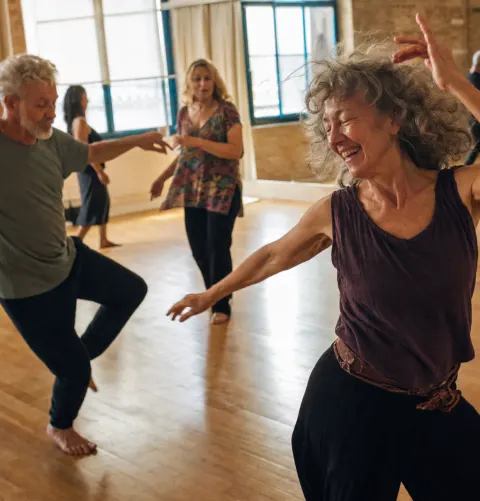 Improvisational dance: How free movement keeps the mind flexible
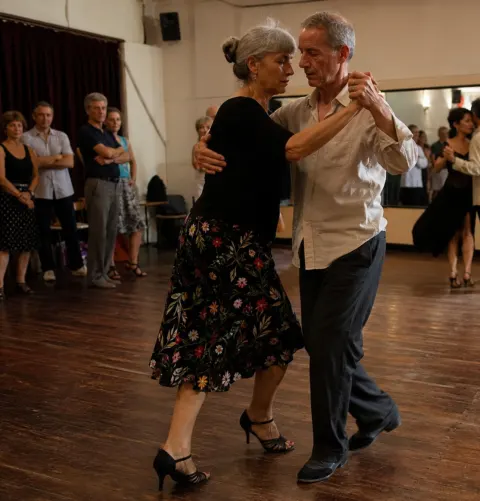 Focus on the dance floor: Tango Argentino as cognitive training for seniors
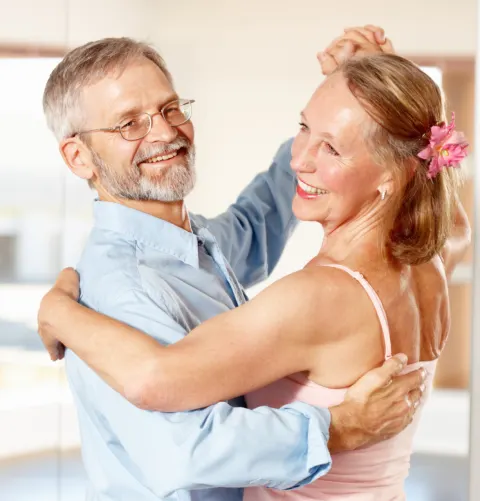 Boost your confidence through dance in your golden years
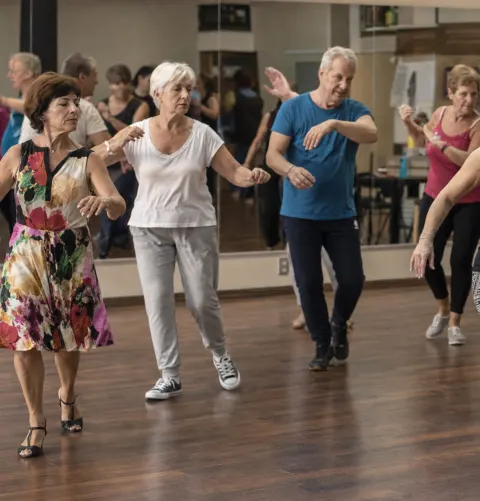 Neuro-Dance Training: Trends in Dementia Prevention 2026
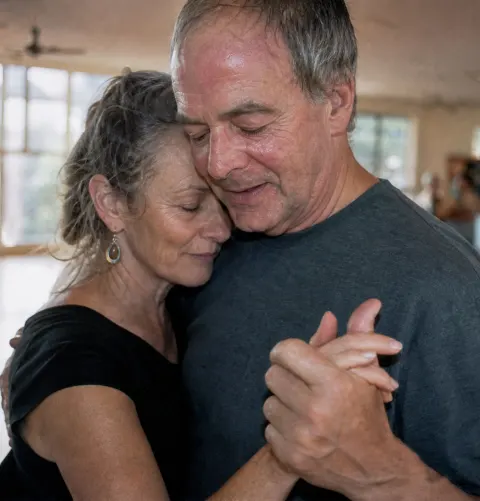 Non-verbal connection: How partner dance touches the soul
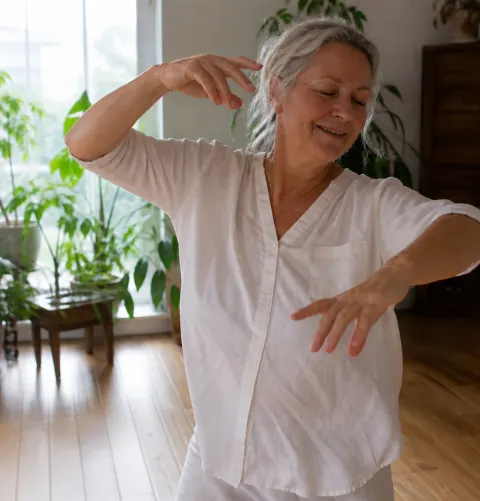 Mindful dancing over 50: Your guide to dance meditation