
Find your partner for a smooth dance flow
On udansa you can find like-minded people who want to practice the perfect dance flow with you, as well as suitable courses in your area.



By Bernhard De LucaUpdated
On udansa you can find like-minded people who want to practice the perfect dance flow with you, as well as suitable courses in your area.
If you want to glide harmoniously across the dance floor in Discofox, you often stumble over choppy transitions. With the right technique, you can connect simple turns into an elegant, uninterrupted dance flow.
Dance flow describes the continuous, harmonious movement of a dance couple across the floor, where individual figures transition into one another without visible pauses or hesitation.
Once you have completed your first dance lessons, you usually master the basic step and a handful of individual patterns. The real challenge begins, however, when these elements are to be strung together on the dance floor. Stuttering movements, sudden changes of direction without warning, or constantly falling back into the basic step are typical signs that the transitions do not yet mesh harmoniously. To dance discofox figure combinations fluidly, it is less about the complexity of the individual figures and much more about the physical connection between the partners.
The basis for every successful transition is constant body tension that transmits signals without delay. As soon as the arms go limp or contact is broken, the lead is lost. The couple must move as one unit, where every action by the leader triggers a logical reaction from the follower. Anyone who wants to learn to lead Discofox quickly understands that gentle pressure and counter-pressure in the hands are the secret language of dance flow. Only when this physical communication is stable can turns and changes of place be strung together seamlessly.
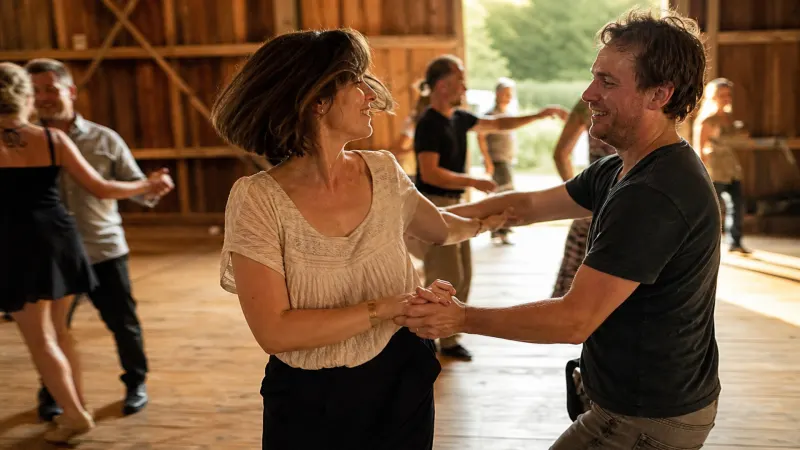
A common misconception in dancing is the attempt to rigidly count every figure in your head and execute them in isolation. This results in jerky movements and visible pauses for thought. If you want to successfully connect figures in discofox, you need to act proactively. This means: while performing the current figure, the leader is already preparing the next step. The hand position at the end of a turn significantly determines which combination is anatomically sensible next and possible without tangling the arms.
For smooth transitions in discofox figures, playing with dynamics is also crucial. Not every step has to be danced with the exact same intensity. Gentle delays before a change of direction or a slight acceleration out of a wrap give the dance a lively structure. It is important that both partners keep an eye on their shared center of gravity and adapt their steps to the space available on a crowded dance floor.
Correct
Wrong
A smooth transition is not a question of spectacular moves, but the result of sensitive leading and the courage to trust your shared momentum.
Especially for beginners, it is advisable to build up a small repertoire of fixed, short sequences. Such discofox combinations for beginners take the stress out of social dancing, as you do not have to improvise every single second. A proven combination consists, for example, of transitioning from a simple sliding door into a basket and then gently turning the lady back into the closed dance position. This sequence uses natural momentum and is easy on the joints.
To perfect the transition between these elements, it helps to focus on your feet. The classic Discofox rhythm, with its characteristic tap, offers an excellent opportunity at the end of every beat to determine a new direction or initiate a turn. If you learn to use the tap as an elastic spring, you carry the momentum of the previous movement directly into the next element and avoid the dreaded, abrupt stopping on the dance floor.
Showing the direction
The leader acts with foresight and initiates the next transition before the current figure ends. The signals are gentle, but precise.
Pick up the impulse
The following person maintains a light basic tension in the body and reacts sensitively to the impulses, without actively anticipating the movement.
Use the tap step at the end of the basic step as an elastic spring. Instead of stopping the movement abruptly, use the momentum to gently push yourself off in the new direction.
Always plan only one or two steps ahead. Start with fixed, short three-step combinations that you learn by heart so you do not have to improvise spontaneously on the dance floor.
Pay attention to your arms, which should neither be completely stretched nor hanging limply. A slight bend in the elbow and gentle counter-pressure in the palms of your hands secure the connection.
Find the right dance school to refine your transitions and figure combinations with professional guidance.
DiscofoxLimbach-Oberfrohna · Germany
Discofox Club - 14-tägigWednesday · 20:30 · Oct 21
Limbach-Oberfrohna
Couple danceLimbach-Oberfrohna · Germany
PaartanzkreisFriday · 18:15 · Oct 23
Limbach-Oberfrohna
Couple danceLimbach-Oberfrohna · Germany
Silberkurs für PaareSunday · 16:15 · Oct 25 - Nov 15
Limbach-Oberfrohna
 Discofox Wrap Figures: The Guide to Perfect ArmworkDiscover how classic Discofox wrap figures work anatomically and how to dance fluid combinations through proper armwork.
 Discofox Figures: The Guide to Wraps and TurnsLearn how to add variety to your Discofox with clever wraps and elegant turns. Our guide shows you the essential basics for creating fluid combinations.
 Learn to lead Discofox: The physics of connectionLearn the physical principles of leading in Discofox. By mastering the interplay between your center of gravity and hand connection, you can execute every movement without effort.Discofox Figures: The Guide to Wraps and TurnsLearn how to add variety to your Discofox with clever wraps and elegant turns. Our guide shows you the essential basics for creating fluid combinations.
 7 Common Mistakes in Discofox Turns and How to Fix ThemNo more tangled arms or dizziness on the dance floor. These seven typical mistakes in Discofox turns can be easily fixed with the right techniques.
 Modern Discofox: Moves in trendy club styleDiscover how to modernize your Discofox with elements from Hustle and Latin styles. Learn everything about the trendy club style for dynamic moves.
 Discofox Figure Trends: New Wraps for the ClubThe Discofox season brings a fresh breeze to the clubs. Learn all about the latest wrap combinations and how to bring them elegantly to the dance floor.
 Discofox Sliding Door: Guide to the position changeThe sliding door is one of the most popular figures in Discofox. With our simple guide, you will master the position change elegantly and in time on any dance floor.
 5 easy Discofox moves for a quick startWith these five easy Discofox moves, you will be ready for any dance floor in no time. Learn the simplest turns and position changes for quick success.
 Lady's solo in Discofox: Leading turns correctlyThe lady's solo in Discofox is a real eye-catcher on any dance floor. In this guide, you will learn how to lead effortlessly with subtle hand signals and how the lady can always maintain her balance.