Street dance technique5 minutes

Learn Tutting: Dance geometric shapes with your arms and hands

By Bernhard De LucaUpdated

In short
  • Tutting is an urban dance style in which arms, hands, and fingers form geometric shapes like squares and right angles.
  • The most important foundation for this style is the clean isolation of individual joints independent of the rest of the body.
  • Beginners start with large arm angles in front of the mirror before they train complex finger combinations.
  • Regular stretching of the wrists and fingers is essential to achieve the necessary flexibility for the figures.

Geometric shapes are fascinating because of their clarity and symmetry. With Tutting, you bring this aesthetic directly to the dance floor and create optical illusions that will leave your audience amazed.

DefinitionTutting

Tutting is a specialized dance style from the street dance scene, where the dancer creates geometric shapes and lines in space using their arms, hands, and fingers. The name is derived from the flat, angular representation of figures in ancient Egyptian art, but today it focuses purely on modern dance technical execution.

The fundamentals of geometric precision in space

Tutting is all about transforming your body into a living work of art made of lines and angles. Anyone seeing this style for the first time is fascinated by the precision with which dancers isolate their joints. The most important foundation for geometric dancing is isolation. This means that you move one joint, for example your wrist or your elbow, independently of the rest of your body. Only when your shoulders do not move while your forearms form a box does the optical illusion of perfect geometry emerge.

To achieve this precision, you should film yourself while training or practice in front of a mirror. The tutting dance technique requires extreme awareness of your own body in space. Every movement stops abruptly to freeze the shape for a fraction of a second before the next position is taken. These short stops emphasize the lines and make the dance look clean and rhythmic. If you would like to learn how to find your own dance style, our guide on finding your own dance style will help you to bring your very personal touch to urban styles.

Step by step to clean angles with your arms

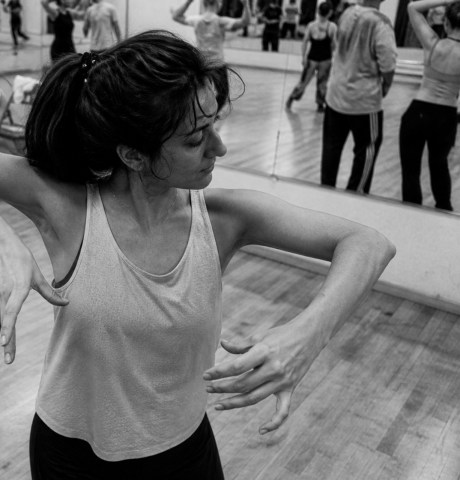
When you start with tutting, you should first focus on the larger joints. A basic tutting guide for the arms starts at the shoulders, moves to the elbows, and ends at the wrists. Try to form exact 90-degree angles with your arms. A typical basic position is the box in front of your chest: your forearms are parallel to the floor, your elbows are bent, and your fingertips point toward each other without touching. From this position, you can shift, fold, or rotate your arms.

Make sure your lines stay clean. A common mistake for beginners is unconsciously bending the wrists or letting the elbows sag. This immediately breaks the geometric illusion. It helps to imagine an invisible grid in the room to align your limbs with. If you are wondering whether urban movements generally suit you, you can look at related styles or playfully test which movement patterns come easiest to you. A similar introductory test can be found in our guide Breaking beginner test, which shows you how to analyze your coordinative strengths in street dance.

The most important do's and don'ts for Tutting

Like this

  • Keep the angle exactly at 90 degrees
  • Stop each position briefly and sharply
  • Keep your shoulders low while isolating
  • Stretch your fingers and wrists regularly

Don't do this

  • Unconsciously bending joints at an awkward angle
  • Making flowing, spongy movements
  • Pulling your shoulders up due to tension
  • Starting to train cold and without warming up

With Tutting, you are the architect of your own body. Every movement builds a new structure in space, which makes time stand still for a moment.

Street dance instructor, Berlin

The fine art of finger geometry in detail

Once you have mastered the large shapes with your arms, you can venture into the details. The finger tutting basics bring a whole new dimension to your dance. Here, you use every single finger joint to create mini angles, squares, or staircase patterns. Since the muscles and tendons in the hands are rarely used in such an isolated way in everyday life, this area requires a lot of patience and regular stretching. The fingers must be able to act independently of each other while the wrists remain stable.

Only combine the fine finger movements with the arm movements once both elements work fluently on their own. A harmonious transition is created when a movement starts in the elbow, runs over the wrist, and finally dissolves into a complex finger figure. Since tutting is an extremely focused form of dance that demands a lot of coordination from the brain, it is excellent mental training. If you are interested in the cognitive benefits of dancing, take a look at our article on Tango Argentino as concentration training, which sheds more light on the mental challenge of complex movement sequences.

Two dimensions of geometric dancing

Arms

Arm Tutting

Large shapes in space

Here you focus on the large joints like shoulders, elbows, and wrists. You form wide frames, boxes, and geometric patterns that are clearly visible even from a distance on stage.

Fingers

Finger Tutting

The microcosm geometry

Here, you work in the absolute close-up range. Every single finger joint is moved in isolation to create intricate patterns, waves, or optical illusions directly in front of your face or the camera.

Frequently Asked Questions

  1. Yes, absolutely. Anyone can learn tutting, as it works independently of your general fitness or flexibility in your lower body. You only need patience for the coordination training of your arms and hands.

Streetdance classes near you

Find the right course on udansa now and learn the best isolation techniques from experienced instructors.

View all matching courses

Find your dance partner for Tutting

On udansa you will find like-minded people in your region who share your passion for street dance, as well as suitable courses to take your techniques to the next level.

Find your dance partner for Tutting