Tournament sports5 minutes

Tournament classes in Latin: The path from D to S class

By Bernhard De LucaUpdated

In short
  • The tournament classes in Latin American dance sport of the DTV are structured hierarchically, from the D-class as an entry level to the S-class as the special class.
  • Advancing to the next class requires collecting a set number of promotion points and placements at official tournaments.
  • With each higher class, the number of Latin dances to be performed increases from initially three in the D-class to all five dances starting from the B-class.
  • In the lower classes, strict step and clothing restrictions apply, which are only lifted from the B-class onwards for maximum artistic freedom.

The path in competitive dance is a fascinating journey full of discipline, elegance, and athletic ambition. Anyone who understands the official performance classes of the German Dance Sport Association can plan and advance their own dance development in a targeted way.

DefinitionDTV Latin tournament classes

DTV Latin tournament classes describe the official performance levels of the German Dance Sport Association, in which couples are classified from D-class to S-class based on their skill level and achievements. This system ensures fair competition among dancers of equal ability.

Entering from the D-class to the C-class

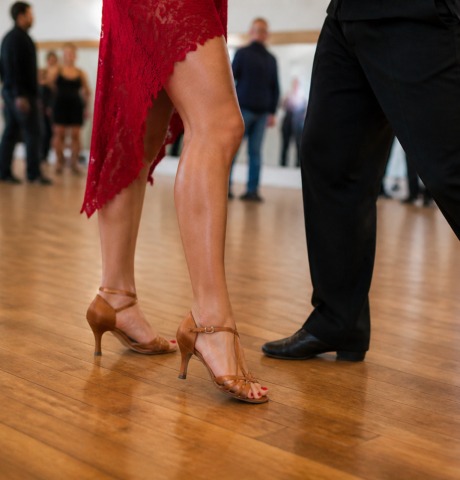
Entering the world of DTV Latin tournament classes starts for every dance couple in the D-class. Here, it is primarily about demonstrating the absolute basics. The dancers present themselves in the three dances Cha-Cha-Cha, Rumba, and Jive. Samba and Paso Doble are not yet danced in this entry-level class, to make it easier for couples to focus on fundamental rhythm and clean footwork. An essential feature of this class is the strict dress code. Anyone who wants to know exactly what may be worn will find valuable details in the guide on the dress code in the D-class.

With the promotion to the C-class, the picture changes noticeably. Samba is added as the fourth dance. The dance performance must now show significantly more dynamics and improved body tension in Latin dance. In addition, a strict step limitation applies here, which ensures that couples focus on the clean execution of basic figures instead of getting lost in complex choreographies. Only upon reaching the B-class does this limitation fall away, and the Paso Doble completes the Latin American tournament spectrum to five dances.

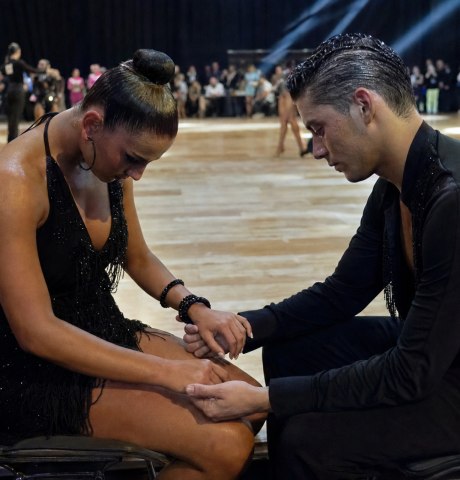
Concentration before being called up: at DTV tournaments, every second on the floor determines important promotion points.

The leap into the performance elite from the B-class onwards

Anyone who reaches the B-class dives deep into real competitive sports. From here on, all five Latin American dances are mandatory. The choreographies can be designed freely, which gives couples room for spectacular highlights and an individual dance identity. The clothing also becomes more glamorous, as the strict restrictions of the lower classes no longer apply. At this level, the presentation on the floor often determines success.

The A-class is considered the second-highest level and is often referred to as the preparatory class for the absolute elite. This is where the wheat is separated from the chaff. The speed, precision, and athletic endurance of the couples must be at an extremely high level. Anyone who succeeds here collects the final necessary placements for the S-class, the special class. In the S-class, the best amateurs in the country dance for state championships and German titles, often with the goal of making the leap into the professional sector.

The path through the Latin classes of the DTV

Advancing successfully

  • Strictly adhere to the step limits of the C-class
  • Consistently work on clean footwork
  • Accurately document points and placements in your competition record book
  • Make targeted use of tournaments within your own regional association

Common mistakes

  • Copying complex B-class show figures too early
  • Ignoring the strict dress codes for D-class
  • Arriving without a license or valid starting card
  • Focusing only on points without paying attention to technique

The climb from D-class to S-class is not a sprint, but a marathon, where mastering the basics in the lower classes lays the foundation for later success.

Adjudicator and tournament coach, Cologne

The promotion principle according to the DTV point system

The path through the D-class to S-class in Latin American dances is strictly regulated and based on a clear system of points and placements, which are anchored in the tournament regulations of the DTV. For every couple beaten at a tournament, your own couple receives one promotion point. In addition, so-called placements must be earned to advance to the next class. A placement is achieved when the couple finishes in the final of a tournament and leaves a certain minimum number of competitors behind them.

This system of promotion points in DTV dance sport ensures that only couples who consistently show performance advance. For example, anyone wanting to advance from the D-class needs 100 points and 7 placements. Since the hunt for points costs a lot of time and energy, a suitable training partner is essential. If you are still looking for the right counterpart, you can use udansa to specifically search for like-minded people who share the same sporting ambitions and want to venture onto the tournament floor together.

The difference between compulsory and optional routines in competitive dance

Basic class

Focus on the basics

Focus on technique and mandatory figures

In the D and C classes, the focus is entirely on the basics. Strict step limitations and clear dress codes ensure that the technical foundation can be evaluated cleanly, without show effects causing distractions.

Performance class

Embrace artistic freedom

Free choreography and full dynamics

From the B-class onwards, all five dances are required and step restrictions are lifted. Couples can design their own choreography, set their own accents, and impress on the floor with their individual charisma.

Frequently Asked Questions

  1. In the D-class Latin, the three dances Cha-Cha, Rumba, and Jive are performed. Samba and Paso Doble are only added in higher classes to make the entry easier.

Find Latin tournament training near you

Prepare optimally for your advancement with the right training.

View all suitable courses

Find your dance partner for tournament training

Whether you are looking for your first dance partner for training or want to prepare for the next competition level: on udansa, you can easily connect with the community in your area.

Find your dance partner for tournament training

Read more