Dance technique5 minutes

Bachata forward step: The correct weight transfer

By Bernhard De LucaUpdated

In a nutshell
  • In Bachata, the step structure of three steps and a final tap remains exactly the same when moving forwards and backwards as it is for the side step.
  • Weight must be shifted completely onto the new standing foot with every step so that the hips can swing freely.
  • The forward step is actively pushed from the ball of the back foot, while the backward step softly cushions the body weight.
  • During the final tap on the fourth beat, no weight should be transferred to the tapping foot in order to prepare for the change of direction.

Switching from side-to-side movement to forward and backward direction gives your Bachata depth and elegance. With the right technique, you will master this change of direction without stumbling and maintain a harmonious connection with your partner.

DefinitionWeight transfer

Weight transfer refers to the conscious and complete shifting of the body's center of gravity from one standing leg to the other. In partner dance, it is the physical foundation for balance, rhythm, and error-free signal transmission between dance partners.

The dynamics of movement in space

Bachata thrives on its fluid, soft movement. While the classic side step forms the basis on many dance floors, moving forward and backward brings a completely new dynamic into play. With the Bachata forward backward basic, the direction changes, but the fundamental structure remains the same: three steps and a tap. The decisive difference lies in the sense of space. While you usually move within a stable comfort zone when moving sideways, stepping into the depth of the room requires increased trust between dance partners.

When you dance the Bachata forward step, you actively move toward your partner or away from them. This fundamentally changes the physical connection within the pair. To make this movement harmonious, leaders and followers must find precise coordination. Anyone who simply places their feet forward indiscriminately here risks painful collisions. It is about using the upper body as a signal transmitter and timing the steps cleanly so as not to disturb the shared flow.

Weight transfer instead of just stretching your legs

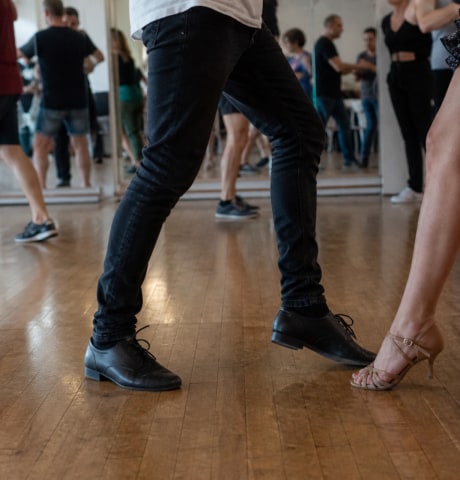
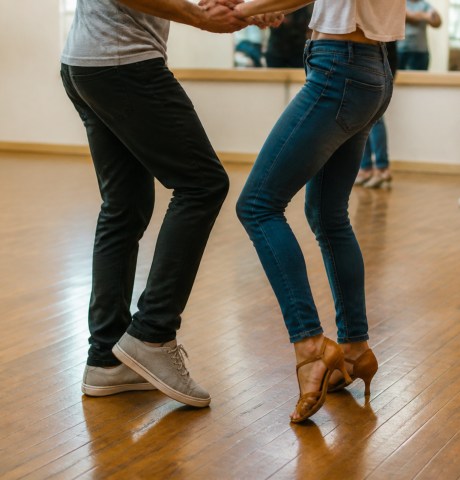
The most common mistake when walking forwards and backwards is not fully shifting your body weight. A correct Bachata weight transfer forwards means that your center of gravity arrives completely over the standing foot with every step. Many beginners tend to just stretch out their leg, while the pelvis and upper body remain back on the supporting leg. This blocks the hip and prevents the typical, smooth Bachata flow.

To execute the weight transfer correctly, you should imagine that your sternum is moving synchronously with your foot. If you step forward with your left foot, your entire body weight moves fluidly onto this leg, so that the back foot is completely relieved for a brief moment. Only this complete relief allows you to start the next step without delay on the next beat. If you feel unsure, a look at our tips for troubleshooting in the article Hips, tap, frame: Avoiding typical Bachata mistakes will help.

Footwork technique in direct comparison

Correct

  • Shift your weight completely onto the new foot with every single step
  • Keep your knees slightly bent and elastic throughout the entire movement
  • Initiate the impulse for the forward step from your whole body
  • Place the tap completely weightless to secure the change of direction

Wrong

  • Only stepping forward with the foot and leaving the pelvis behind
  • Walking across the room with completely straight, stiff legs
  • Pulling or pushing your partner with your arms instead of using your body
  • Unconsciously shifting weight during a tap and losing your balance as a result

Anyone who masters the forward and backward steps in Bachata without losing connection in the upper body not only dances more cleanly, but also feels much lighter to their partner.

Bachata dance instructor, Cologne

The difference between forward and backward steps

Forward and backward steps differ fundamentally in their biomechanics and the feeling of leading. When taking a forward step, you push your movement from your back standing leg. This gives you stability and allows the leader to set a clear direction. The backward step, on the other hand, requires actively catching your weight. Here, the foot that is placed back catches the body softly, with the heel touching the floor only at the very end to prevent an abrupt stumble.

Coordination during the transition to the fourth beat, the tap, is particularly important. When moving forward, you tap the unloaded foot next to the standing leg without shifting weight onto it. Since your center of gravity now rests stably on the standing leg, you can immediately reverse the direction of movement for the subsequent backward steps. By the way, if space becomes too tight for long steps forward or backward on crowded dance floors, this technique can also be adapted wonderfully. You can find out how this works in the guide Dancing Bachata on the spot: Footwork for tight spaces.

Two directions in harmonious interaction

Forward

Focus on the forward step

Push actively and take up space

When taking a forward step, you actively push yourself forward from your back foot. Your upper body initiates the movement, and your weight lands firmly on the front ball of your foot to send a clear signal to your partner.

Backward

Focus on the backward step

Cushion softly and clear the space

When taking a backward step, the foot reaches back and rolls softly from the toe to the heel. The weight is caught in a controlled manner to avoid an abrupt jerk in the dance connection.

Frequently Asked Questions

  1. The upper body always moves in sync with the step. When you step forward, your chest moves slightly with it so that your center of gravity is directly over your new standing leg.

Bachata courses near you

Find the right course to try out your Bachata technique in real life.

View all matching courses

Find your Bachata dance partner online

On udansa you will find like-minded people in your area who, just like you, want to practice the right weight shift or simply dance Bachata in a relaxed way. Sign up and discover dance partners, courses, and socials right near you.

Find your Bachata dance partner online