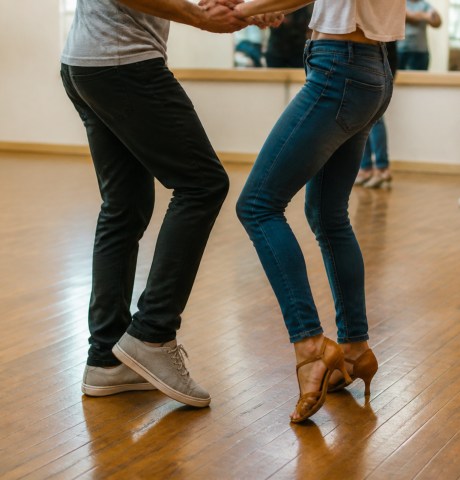
Dance technique5 minutes

Bachata hip movement: The right technique for the tap

In short
  • The Bachata hip movement is not created by active pushing, but as a natural result of a correct weight transfer onto the balls of the feet.
  • During the tap on the fourth beat, the free leg remains completely weightless, while the straightened standing leg guides the hip on that side upwards.
  • The upper body remains stable throughout the entire movement and the shoulders stay on a horizontal plane without tilting.
  • Clean footwork with slightly bent knees forms the technical prerequisite for the typical pelvic movement in Bachata.

The typical hip movement in Bachata fascinates with its apparent effortlessness. However, behind the elegant sway lies no wild circling, but a precise physical weight shift that you can easily learn.

DefinitionBachata hip movement

Bachata hip movement refers to the rhythmic lifting and lowering of the pelvis in partner dance, which is created by the alternating bending and straightening of the knees during weight transfer.

The biomechanics behind the Caribbean hip movement

The characteristic Bachata hip movement is not an artificially added styling, but the natural result of a clean weight transfer. Anyone who tries to actively push the hip outward or force it upward blocks their own balance and quickly falls out of rhythm. The roots of this movement lie in the Caribbean nature of the dance: every step is placed flat on the floor over the ball of the foot, with the knees remaining soft and slightly bent. When you put weight on one leg, the pelvis on that side automatically drops slightly, while the other hip side moves upward.

For beginners, it is crucial to understand this fundamental biomechanics before learning complex figures. As part of Bachata basic step and dance technique, the interplay between footwork and pelvis forms the absolute foundation. Only when the weight transfer flows smoothly from one foot to the other does the typical, wave-like flow in the lower body emerge, which makes Bachata appear so elegant and effortless.

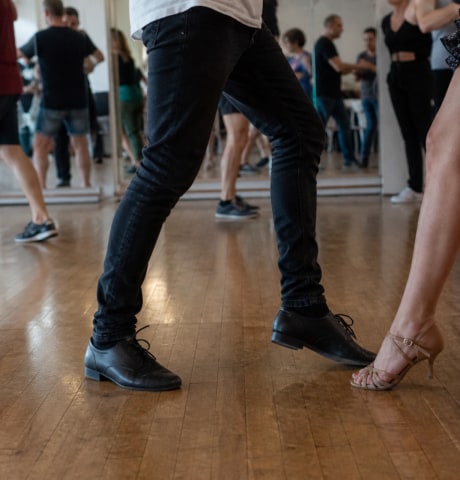
The tap on beat four as a technical highlight

The fourth beat in the Bachata rhythm is the moment when the entire sideways movement comes to a rest: the tap. Technically speaking, the Bachata hip tap is not a step, but purely a tapping of the floor with the ball of the non-weight-bearing foot. At this exact moment, the hip movement reaches its visual highlight. Since the standing leg is fully extended and the free leg remains bent, the hip naturally pushes upwards and outwards over the standing leg. However, there is absolutely no weight transfer onto the tapping foot.

Many beginners make the mistake of forcefully jerking their pelvis upwards during the tap. This looks unnatural and causes the entire body frame to wobble. The correct Bachata hip technique instead requires a conscious release in the hip of the free leg, while the standing leg takes on all the stability. This principle applies equally to leaders and followers, although the movement is often slightly more visible in followers due to anatomical differences.

The most important do's and don'ts for the Bachata tap

Correct

  • Keep your weight completely on the standing leg
  • Let your knees spring softly while walking
  • Keep your shoulders on a straight line
  • Only place your foot down lightly when tapping

Wrong

  • Shift weight onto the tapping foot
  • Dance with locked, stiff knees
  • Tilt the entire upper body to the side
  • Stomp the foot hard onto the floor during the tap

The most beautiful hip movement is useless if it is forced. Only complete relaxation in the pelvis and precise weight shifting create the authentic Caribbean flow.

Bachata dance instructor, Cologne

Practical exercises for pelvic isolation

To anchor the Bachata pelvic movement in your own body, systematic isolation training helps. Start in a hip-width stance and shift your weight slowly from left to right, without lifting your feet off the floor. Make sure that your shoulders remain on a horizontal plane and do not tilt. The movement takes place exclusively below the waistline. As soon as this sequence feels fluid, you can add the classic side step and, quite consciously, only lightly place your foot on the fourth beat while the standing leg gently stretches the hip upwards.

This clean foundation distinguishes the traditional style from other directions. If you are wondering how the different varieties have developed historically, it is worth taking a look at the Bachata styles and history. While expansive upper body waves are often used in the modern Sensual area, the classic Bachata hip movement always remains centered at the pelvis, down-to-earth, and rhythmically precise.

Two roles, one shared rhythm in the hips

Leading

Setting stability and rhythm

The rhythmic foundation in partner dance

The leader executes the steps precisely and provides a clear rhythmic foundation through their own controlled hip movement, which offers orientation to the partner.

Following

Feel flowing elegance in your body

The soft execution of movement

The follower uses the leader's weight shift to let the hip movement flow softly and to emphasize the tap on beat four elegantly and without haste.

Frequently Asked Questions

  1. Your hips move in Bachata all by themselves when you shift your weight completely from one foot to the other. By bending one knee and straightening the other, your pelvis tilts naturally.

Bachata courses near you

Learn the right hip technique directly from experienced instructors in your city.

View all matching courses

Find your Bachata dance partner on udansa

Easily find like-minded people on udansa who want to practice the perfect hip movement with you, as well as suitable dance schools in your area.

Find your Bachata dance partner on udansa