Dance technique5 minutes

Bachata leading: Using tension and compression in your hands correctly

In a nutshell
  • Bachata leading is based on an elastic connection through the hands, which is maintained by a controlled basic tension in the arms.
  • A pull impulse is created by gently hooking the fingertips, while a push impulse is transmitted via the gentle counter-pressure of the palms.
  • When releasing the lead, body tension remains active so that contact immediately springs back elastically when the hands are brought together again.
  • The arms act as shock absorbers that transmit impulses from the upper body directly, without the movement appearing rigid or limp.

Whoever dances Bachata communicates without words. The entire leading and following is based on subtle physical forces that are transmitted through the arms and hands.

DefinitionConnection

In partner dance, connection refers to the physical and energetic bond between partners. It allows you to transmit movements, changes in direction, and shifts in rhythm directly through points of body contact, without the need for visual signals.

The physical bridge between leader and follower

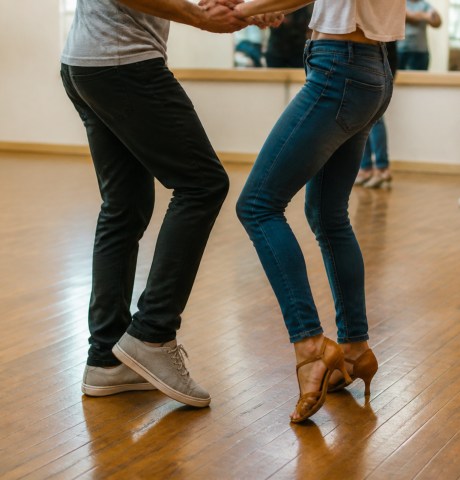
The physical connection between two dancers in Bachata is based on a constant, sensitive interplay of push and pull. This so-called connection is not a static hold, but a dynamic dialogue that takes place purely through the physical contact points of the hands and arms. At its core, it is about building a stable, yet elastic bridge. When the leader gives an impulse, this force spreads like a wave across the sensitive contact surface, comparable to the Argentine Tango hand position: guide for perfect arms. The arms act as shock absorbers: they must neither be completely extended and rigid, nor collapse limply.

To maintain this elastic bridge, both dancers need permanent basic tension in their arms. This tension is not created by raw muscle power in the biceps, but by consciously activating the back and shoulder muscles. Imagine your arms forming a stable frame that transfers every movement of your upper body directly to your hands. If the leader moves back one centimeter, the follower immediately feels this pull because their own frame maintains the distance. Without this basic tension, every impulse dissipates into empty space, and the dancers have to laboriously chase after each other.

Pull and push as precise direction vectors

The actual dance is created through the precise interaction of vectors. A pull impulse occurs when the hands move minimally away from each other and the fingertips gently interlock, without clinging. A push impulse uses the palms as a counter-bearing, where the partners build up a minimal, controlled pressure against each other. It is important that these forces are neutralized immediately as soon as the movement is executed. The art lies in helping to avoid hips, tap, frame: avoiding typical Bachata mistakes by clearly separating the impulses from one another.

The moment when partners release the Bachata lead is particularly sensitive. When a hand connection is released for a solo turn or styling, the body tension must not drop abruptly. Releasing the connection is itself an active impulse: the hands slide gently apart while the imaginary frame of the body is maintained. This way, the follower knows exactly where the partner is located in the room, even when there is no longer any direct skin contact. As soon as the hands meet again, the connection is immediately re-established with an elastic cushion.

Building the right connection

Correct

  • Use your fingertips lightly as hooks
  • Use your arms as elastic shock absorbers
  • Maintain body tension when releasing your hand

Wrong

  • Clench your fingers tightly around your partner's hand
  • Keep your arms completely straight or let them hang limply
  • Let the tension drop abruptly when letting go

Good leading in Bachata never feels like pulling or pushing, but rather like a physical conversation where both partners share the same resistance.

Bachata dance instructor, Cologne

The art of minimal signals on the dance floor

A successful connection in Bachata is characterized by signals that are minimal, yet clear. When the leader initiates a turn, this happens through a continuous, circular pushing or pulling movement that gently guides the follower into the rotation. The follower reacts like a precise pendulum: they only go as far as the impulse reaches and stop as soon as the pressure eases. This physical resonance requires both partners to pay a high level of attention to each other's center of gravity.

To master this fine-tuning, it helps to imagine your hands as magnets. They attract each other, repel each other, but always maintain a tangible connection. When you learn to apply these physical laws on the dance floor, your Bachata becomes effortless, fluid, and extremely precise. Every figure then no longer feels like a mechanical sequence of steps, but like a natural, shared movement in space.

The two sides of physical connection

Pull

Gentle pull over the fingertips

The power of pulling

With the pulling impulse, the fingertips hook into each other slightly. The power flows from the back through the elbows into the hands to gently guide the partner into a movement.

Pressure

Controlled pressure of the palms

The power of pushing away

During the pressure impulse, the palms meet. The light, elastic counter-pressure signals a change of direction or a stop in space to your partner.

Frequently Asked Questions

  1. Your arms should be slightly bent at the elbows and stable. They act like elastic shock absorbers, which should neither be completely rigid and straight nor hanging limply.

Bachata courses near you

Find the right course to take your technique and connection in Bachata to the next level.

View all matching courses

Find your dance partner for Bachata

On udansa you will find like-minded people who want to work on the perfect connection with you, as well as professional dance courses in your area.

Find your dance partner for Bachata