Dance technique5 minutes

Bachata posture: How to achieve the perfect partner connection

In a nutshell
  • The correct Bachata posture requires an upright torso with slightly bent knees and your body weight on the balls of your feet.
  • A stable arm frame ensures that leading signals are transferred directly from the leader's torso to the follower.
  • An elastic connection is created through a subtle, constant interplay of light tension and resistance in the hands and arms.
  • Tense shoulders and limp arms should be avoided, as they block physical communication while dancing.
udansa community

Find the right partner for your posture

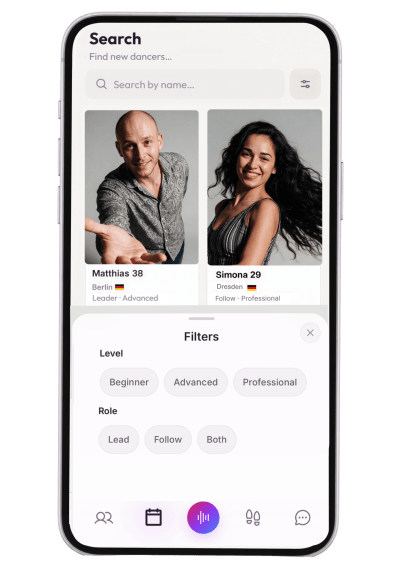
On udansa connect, you will find like-minded people in your region who, just like you, want to work on their posture and share a passion for Bachata. Simply sign up and start your next dance adventure with the perfect connection.

Find the right partner for your posture

The right posture in Bachata determines whether a dance feels heavy and wooden or feather-light and fluid. With the right partner connection, every step becomes a shared dialogue without words.

Definition
Connection

Connection refers to the physical and energetic link between two dancers in partner dance. It allows leading and following signals to be transmitted instantly through the body frame using minimal tension and compression.

The foundation for harmony on the dance floor

Anyone visiting a Bachata party for the first time quickly notices the special magic between the couples. It seems as if two bodies are moving in sync to the music as if by magic. The secret behind this harmony is not an innate talent, but a solid, conscious Bachata posture. Posture in Bachata differs fundamentally from rigid ballroom dances, as it is based on flexibility and constant communication. It is the foundation upon which every step and every subsequent movement is built.

A good Bachata connection is not created through force, but through the subtle interplay of body tension and relaxation. The body remains upright, the knees are slightly elastically bent, and the weight rests on the balls of the feet. This athletic, yet relaxed basic position allows both partners to react lightning-fast to weight shifts. Anyone interested in the basics of other partner dances will find valuable comparisons in the guide on ballroom dance posture, which, in contrast to Bachata, requires a significantly firmer frame.

Open and closed position in detail

The classic Bachata dance posture distinguishes between the open and closed position. In the open position, leader and follower hold hands at about belly button height. The elbows are slightly angled in front of the body, which creates an elastic buffer. In the closed position, the leader places his right hand on the partner's left shoulder blade, while she rests her left hand relaxed on his right shoulder. The free hands hold each other to the side at the eye level of the shorter partner.

Crucial for a functioning Bachata leader-follower posture is the principle of the frame. The arms are not limp ropes, but they are not stiff iron bars either. They maintain their shape stably in front of the upper body. When the leader's upper body moves, the arm moves as a unit with it. This is the only way the impulse is transmitted to the follower without delay. This subtle physical communication requires mindfulness and the right feel for the partner, much like the art of the Argentine Tango embrace, where the connection also forms the heart of the dance.

Avoiding mistakes in dance partnering

Like this

  • Keep your knees slightly bent and elastic
  • Maintain a stable arm frame in front of your upper body
  • Keep a light, constant counter-pressure
  • Balance your weight on the balls of your feet

Don't do this

  • Lock your knees completely and stiffen them
  • Let your arms hang limply or pull them long
  • Push or pull your partner with force
  • Shift your entire weight onto your heels
udansa tip

It is best to practice a stable frame alone in front of a mirror first. Hold your arms in the dance position and move your upper body to the left and right, without changing the angle of your arms.

A good connection in Bachata feels like a silent conversation, where the body speaks the words and the hands set the punctuation.

Bachata dance instructor, Cologne

How tension and compression stabilize the connection

A stable Bachata connection thrives on the physical interplay of tension and compression. This means that both dance partners maintain a minimal, constant base tension in their arms. If the leader presses gently forward, the follower does not give way completely, but resists with a light, elastic counter-pressure. If the leader pulls slightly, the follower's body follows this movement without the arms being stretched out. This constant, invisible connection is called connection.

For beginners, it is particularly important to build this Bachata partner hold without using additional muscle power from the shoulders. The power comes from the core. Once you master the connection in Bachata, you will notice how effortless following becomes. You no longer have to guess which step your partner is planning next, you simply feel it through your shared center. If you want to dive deeper into the world of this sensual dance, you can find inspiration in the article about Bachata styles and history.

Two roles for a perfect connection

Leading

The leader's active frame

Providing clarity and space

The leader sets the direction by transmitting impulses clearly from their core through a stable arm frame. They create a safe space in which the follower can move freely without being pushed.

Following

The follower's active response

Mindfulness and body tension

The follower maintains body tension and reacts elastically to the partner's signals. Instead of anticipating movements, they wait for the impulse and harmoniously fill the frame provided.

Frequently Asked Questions

  1. For good Bachata posture, stand upright, relax your shoulders downwards, and shift your weight slightly onto the balls of your feet. Keep your knees elastic to softly cushion hip movements and weight shifts.

Bachata courses near you

Find the right dance course now to improve your posture and technique directly on the dance floor.

View all matching courses