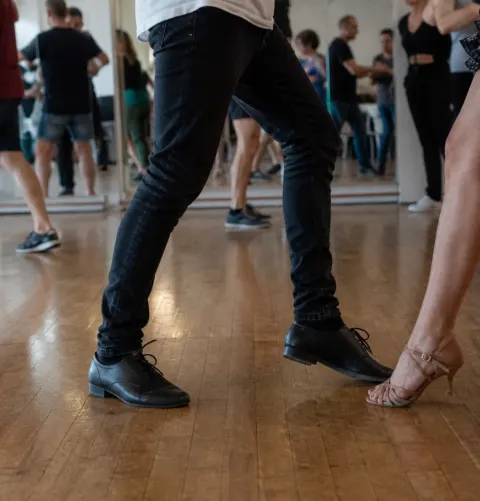
Find your perfect dance partner
On udansa you can find like-minded people in your area who, just like you, want to learn the basics or refine their technique. Sign up and discover dance courses, events, and motivated dance partners near you.

By Bernhard De LucaUpdated
On udansa you can find like-minded people in your area who, just like you, want to learn the basics or refine their technique. Sign up and discover dance courses, events, and motivated dance partners near you.
The Cross Body Lead is the key to moving freely around the dance floor in Bachata. Learn how to lead and follow this fundamental move cleanly, and how to avoid common pitfalls right from the start.
The Cross Body Lead is a fundamental figure in partner dance, where the leading partner steps out of the dance line to allow the following partner to cross the line and change places.
The Bachata place change, usually referred to in the dance world as the Bachata Cross Body Lead, is far more than a simple sequence of steps. It is the fundamental tool for breaking up the rigid movement from left to right and bringing dynamics into the dance. While beginners usually only dance the classic side step on the line in their first lessons, this figure opens the door to a new dimension in space. The principle is simple, but effective: the dance partners exchange places in a controlled manner, as the leading partner clears the path and guides the following partner safely past them.
To execute this movement fluidly, a solid understanding of the timing is essential. If you are unsure whether your sense of rhythm is already sufficient for such figures, the Bachata rhythm test will help you check your beat in your blood. The Cross Body Lead uses the full eight beats of the Bachata measure and requires a continuous weight shift from both partners without haste. Only when this sequence succeeds without stumbling does the couple dance feel harmonious.
For the Bachata Cross Body Lead to succeed, both partners must work together precisely. The leader initiates the figure on counts one to three by stepping slightly out of the dance line with their left foot. This opens an imaginary door. On count four, the characteristic tap occurs while the hand connection remains stable. On counts five to seven, the follower is guided through this opened lane before the final tap on count eight at the new position brings the couple back into a closed hold.
A common misconception is that the leader must pull the follower with force. The opposite is the case: a good Bachata position change is based on clear body tension and gentle pressure at the right moment. If you want to test your general technique and your feel for such transitions, take a look at the Bachata level test, which gives you honest feedback on your current performance level. The art lies in transferring the lead through the torso and not through the arms.
Correct
Wrong
Learn the most important basics and figures directly in the right course for beginners.
Student DanceBurgstädt · Germany
Aufbaukurs Burgstädt Montag Schuljahr 2026/27Monday · 13:30 · Nov 9, 2026 - Jan 25, 2027
Burgstädt
Student DancePenig · Germany
Aufbaukurs Penig Schuljahr 2026/27Monday · 14:30 · Nov 9, 2026 - Jan 25, 2027
Penig
A successful turn pattern feels like a gentle invitation, not a command. As soon as the arms become stiff, the lightness of Bachata is lost.
For a Bachata position change to look fluid and elegant, the correct handling of tension and compression is crucial. Many beginners tend to fully extend their arms or grip their partner too tightly. Instead, the connection should be elastic, like a rubber band. The leader uses a slight weight shift in their own upper body to signal to the follower that the path is now clear. The follower, in turn, maintains their own body tension to be able to translate these subtle signals into forward steps immediately.
Anyone who masters these basics lays the foundation for all further Bachata basic figures. The Cross Body Lead forces the dance couple to reorient themselves in the room and pay attention to one another. During this learning phase, absolutely avoid incorporating complicated turns or styling elements yet. Instead, focus entirely on ensuring the transition works without compromising on rhythm. A cleanly executed, simple position change always looks better on the dance floor than a shaky, overloaded figure.
Clearing the path and leading
The leader actively moves back out of the dance line, opens the lane, and guides the partner past them with gentle, clear body tension, without pulling.
Confidently using the opened line
The follower maintains their own body tension, pays attention to the signals in the hands, and walks in a straight line through the opened alley on beats five to seven.
The cross body lead is danced exactly to the eight beats of the Bachata rhythm. On beats one to three, the leader prepares the movement and opens the lane, while the actual position change takes place on five to seven. Beats four and eight are used for the classic tap.
The most common mistake is pulling with the arms. The leader should not yank the follower around with muscle power, but rather clear the path by stepping out of the line and gently invite the partner to switch places using body tension.
No, as a beginner you should focus entirely on clean footwork and the connection with your partner. Styling elements like arm movements or hip sways are only distracting during the learning phase and quickly lead to you getting out of rhythm.
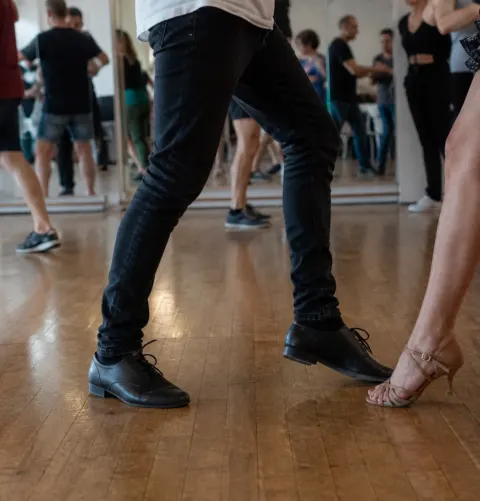 Bachata Basic Step and Dance Technique for Beginners
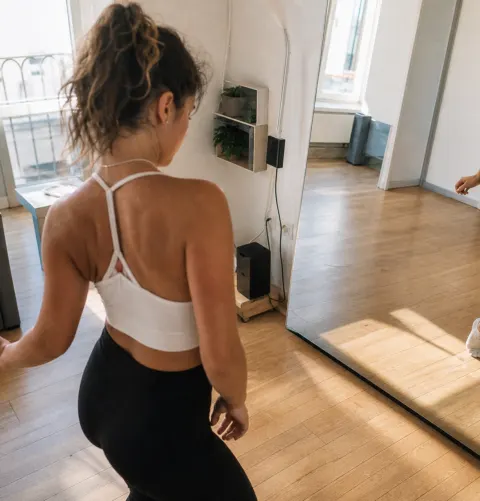 Practicing Bachata solo: Your home training plan
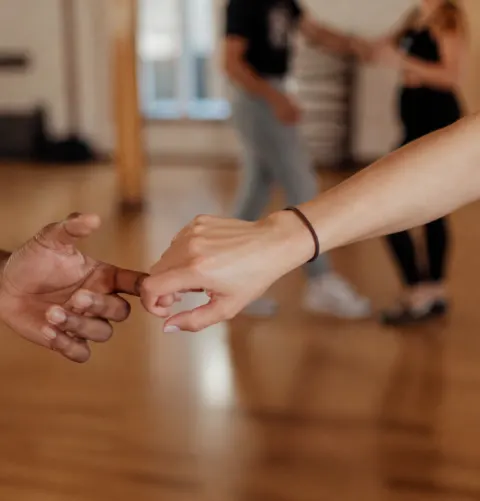 Bachata Leading: Using tension and compression in your hands
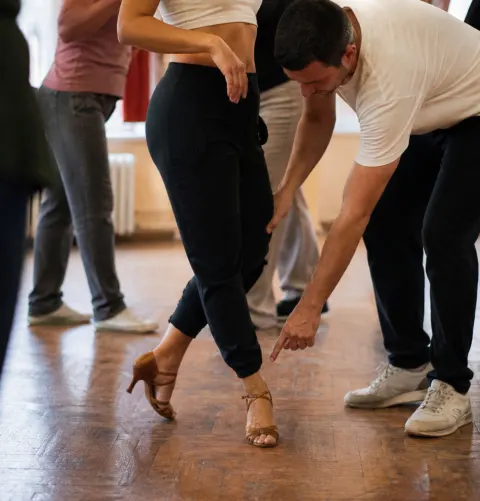 Bachata Forward Step: Mastering Weight Transfer
 Bachata moves for beginners: The 5 best basics
 Bachata Posture: How to Master the Perfect Connection
 Bachata turn guide: Learn to lead and follow cleanly