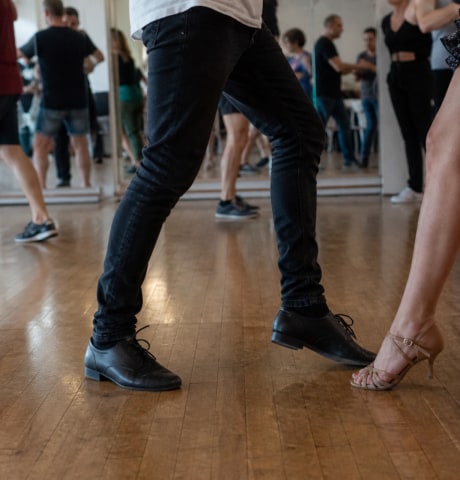
Dance technique5 minutes

Dancing Bachata in place: footwork for tight spaces

In a nutshell
  • Dancing Bachata on the spot requires reducing step size to a minimum directly under the center of gravity.
  • Weight shifts occur precisely on the spot or in minimal forward and backward movements in the familiar rhythm.
  • Space-consuming figures and turns are avoided when space is tight to prevent collisions on the dance floor.
  • The typical hip movement remains active even with the smallest steps, ensuring the characteristic Bachata look.

When the dance floor is bursting at the seams, space becomes a scarce commodity. With the right technique for the tightest spaces, you can dance Bachata elegantly on the spot without getting in anyone else's way.

DefinitionDancing Bachata on the spot

Dancing Bachata on the spot describes an adaptation of dance technique where steps are extremely minimized and performed in place. This method allows couples to dance rhythmically and safely, even on crowded dance floors.

Why small steps have the biggest impact

Anyone who has ever attended a well-attended Latin party knows the scenario: the music is infectious, the atmosphere is perfect, but the dance floor is so crowded that the classic side step is almost impossible. Anyone who tries to claim their usual space now risks painful collisions with other couples. The solution to this problem lies in a conscious adjustment of step size. Instead of placing your feet far outward, the steps are reduced to a minimum. The feet remain almost under your own center of gravity.

This step adjustment in tight spaces requires a high degree of control over your own body weight. Every step is placed precisely and consciously, with the knees remaining slightly bent. This keeps the center of gravity low and stable. Instead of placing your foot far away, you tap the floor almost in the same spot where you are currently standing. In this way, the expansive dance transforms into a compact, highly efficient movement that works without any problems even on the size of a paving slab. Anyone who masters this technique retains full control even in the densest hustle and bustle.

The technique of footwork in the tightest of spaces

To be able to dance Bachata on the spot without losing the typical rhythm, the classic footwork is modified. The traditional sequence of three steps and one tap remains completely intact, but the direction of movement changes. Instead of moving from left to right, leaders and followers use a combination of minimal forward and backward movements or dance the basic step directly on the spot. The feet are barely lifted off the floor, which provides additional stability.

Weight transfer is particularly important here. Each step must be fully weighted so that the partner can feel the movement. Since visual signals are lost due to the tight space, communication takes place almost exclusively through body contact and fine footwork on the spot. If you want to consolidate the basics, you can check your technique with the Bachata level test to see how secure your own dance technique already is. In a tight space, it immediately becomes clear who carries the rhythm in their body and who still has to rely on large lunges.

The direct comparison for full dance floors

How it works

  • Make your steps extremely small
  • Shift your weight precisely in place
  • Actively maintain hip movement
  • Keep compact body contact

What to avoid

  • Forcing large side steps
  • Just tapping without shifting your weight
  • Making your body completely stiff
  • Spinning wildly into the room

On a crowded dance floor, the true quality of a dancer is not shown in wild moves, but in the ability to interpret the music in the smallest of spaces.

Bachata dance instructor, Cologne

How the hips save the rhythm in tight spaces

A common mistake when space is limited is freezing hip movement. Many dancers focus so much on small steps that their entire body becomes stiff. However, especially when dancing on the spot, the hips are the most important element for expressing the dynamics of the music. Since the feet hardly move, the movement in the pelvis becomes even more visible. The typical tap on the fourth beat is not omitted, but rather emphasized on the spot.

To avoid losing your orientation in the room, it helps to imagine an invisible box. Your feet only move within this box. Turns and complex wrapping figures are completely omitted when space is extremely limited. Instead, the couple focuses on the rhythmic connection and experiencing the music together. If you want to prepare for these situations without a partner, you can also train the footwork perfectly on your own. This way, you get your body used to the minimal weight transfer that makes the decisive difference on the social dance floor.

Two paths in Bachata: Save space or use the floor

Compact

Footwork in place

Dancing on the spot

When dancing in place, the movement stays compact under your own body. The steps are tiny, the hips work actively, and the connection to your partner is extremely close and stable.

Spacious

Footwork in space

The classic basic step

Classic steps use space sideways or forwards. They require a lot of room for turns and expansive movements, which quickly leads to collisions on crowded dance floors.

Frequently Asked Questions

  1. You adapt your steps by placing your feet almost in the same spot and reducing the step width to a few centimeters. Keep your knees slightly bent to maintain your balance.

Bachata courses near you

Learn the right technique for every dance floor at a dance school in your area.

See all matching courses

Find your Bachata course on udansa

Here you can find the best Bachata courses and dance partners in your area to try out your footwork directly at the next party.

Find your Bachata course on udansa