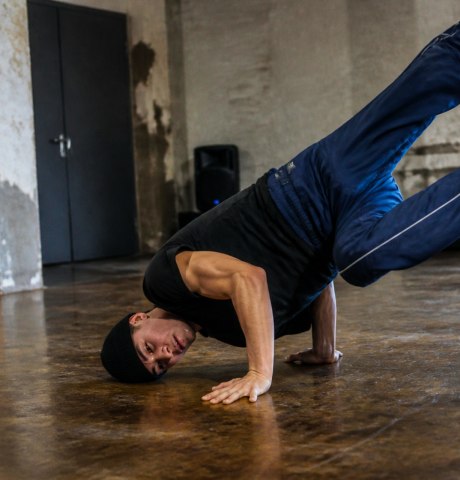
Power Moves3 minutes

Learn the flare in breakdance: A guide to the windmill

By Bernhard De LucaUpdated

In a nutshell
  • The flare in breakdance requires a continuous weight shift from one hand to the other in a circle.
  • The legs must be spread to the maximum during the entire rotation, and the hips must be actively pushed upward.
  • The momentum is created by the energetic kick leg and the clean weight transfer in the upper body.
  • A stable handstand and strong wrists form the physical foundation for injury-free training.

The flare is the ultimate calling card in breaking. With the right technique and clean weight distribution, you can make your legs fly, all without gymnastics equipment.

What you need beforehand

  • Strong wrists and shoulders
  • Good flexibility in the hip area (straddle)
  • Confident handstand without wall support
  • Flat, slippery floor or smooth training clothes

The physics of the flare on flat ground

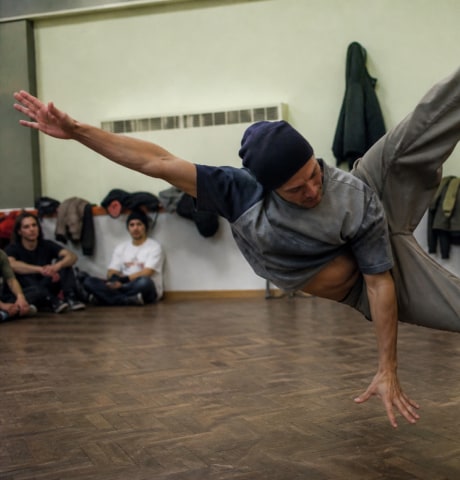
The flare, also known as the Thomas flair in many regions, is one of the most aesthetic and demanding power moves in breaking. Unlike in classic gymnastics, where athletes perform the movement on a pommel horse, b-boys and b-girls in breakdance spin exclusively on flat ground. This means that the clearance for your legs is extremely small and you have to keep your hips high above the ground through pure muscle power and the right technique. To master this sequence of movements without injury, a solid foundation is essential: you should already be able to hold a stable handstand to provide the necessary shoulder strength. For this, it is best to take a look at our guide learning to handstand in breakdance. The flare is not about brute force, but about the perfect interplay of momentum transfer, hip opening, and precise timing when shifting your hands on the floor.

Four steps to your first clean circle

  1. Taking the starting position

    Get into a deep squat and place your hands on the floor behind you. Extend your dominant leg forward, while keeping the other one slightly bent to prepare for the initial momentum of the turn.

  2. Initiating the first kick

    Swing your extended leg forward and upward in a wide circular motion. At the same time, push off the floor forcefully with your other leg to catapult your hips upward.

  3. Shifting and transferring weight

    Shift your entire body weight onto the first hand while your legs swing past your face in a wide straddle. The free hand lifts briefly to make room for your legs.

  4. Lift and close the hip

    As soon as your legs have passed the front, quickly place your free hand back down and actively push your hip upwards to continue the rotation backwards and complete the turn.

Technique check: How to perform the Thomas flair correctly

Like this

  • Spread your legs as wide as possible
  • Actively shift your weight from hand to hand
  • Actively press your hips upward
  • Train on a flat and clean floor

Don't do this

  • Bend your knees while spinning
  • Put all your weight passively on your wrists
  • Let your hips sag downwards
  • Use momentum to jump onto gym equipment

Your checklist for flare training

Before training

Preparation

While executing

Meanwhile

After training

Follow-up

Frequently Asked Questions

  1. For the flare, you primarily need strong shoulder girdle and core muscles, as well as high flexibility in the hips. Good stretching for the splits makes the momentum significantly easier.

Streetdance courses near you

Find the right dance school now and learn the basics from experienced instructors.

View all matching courses

It is easier to train together

Find motivated dance partners in your city on udansa who will work on their technique with you, or discover the best street dance courses right in your area.

It is easier to train together