
Find your perfect dance partner
Whether you are looking for a purely athletic partnership or are open to whatever develops on the dance floor: on our platform, you will meet people who share your passion.


By Bernhard De LucaUpdated
Whether you are looking for a purely athletic partnership or are open to whatever develops on the dance floor: on our platform, you will meet people who share your passion.
When steps turn into feelings, everything on the dance floor changes. Learn how to maintain emotional balance when romance and rhythm collide in the dance hall.
Relationships and partner dance describes the tension and interaction between a romantic love relationship and a sporting or artistic partnership on the dance floor. This constellation requires a conscious separation of roles from the partners.
The intense closeness, moving to the beat together, and deeply sharing successes and failures create a unique connection. When you spend a lot of time training, it is almost inevitable that deep feelings will emerge. A relationship with your dance partner brings a wonderful harmony to the dance floor, as mutual trust and emotional bonding noticeably boost your dance chemistry. Non-verbal communication often works instinctively, and your shared passion brings you closer together in everyday life.
However, this merging also carries risks for your shared hobby. If private conflicts from daily life are brought unfiltered into the dance studio, your dance performance suffers immediately. It is difficult to mimic a harmonious unit in lead or follow after a relationship argument. The biggest challenge is to cleanly separate your emotional couple dynamics from the athletic or artistic work in your dance course.

A common phenomenon in dance schools is that one dance partner falls in love, while the other views the partnership purely as a sporting or friendly arrangement. This asymmetry of feelings creates enormous pressure. Those who secretly hope for more interpret every physical closeness in partner dancing as a romantic signal. Conversely, the unconcerned party suddenly feels uncomfortable and withdraws emotionally or physically. The lightheartedness is lost, and joint training is overshadowed by unspoken expectations.
If you notice that romantic feelings are developing, openness is the only way to save the dance partnership or to redefine it in an orderly manner. A clarifying conversation outside the dance hall prevents misunderstandings from escalating on the dance floor. It is advisable to set boundaries early on, especially if you are already friends privately and do not want to jeopardize this valuable friendship through unresolved tensions.
How it works
How it fails
The greatest art for couples who also dance together is not to take each other's mistakes from the dance floor home into the marriage bed.
To successfully maintain the balance between love and dance, clear ground rules must be agreed upon. Successful dance and life partners strictly separate their roles: in the training hall, they work constructively on technique, while at home, they cuddle and consciously leave the topic of dance aside from time to time. Mistakes made by a partner on the dance floor must never be interpreted as a personal attack on the relationship. Those who possess this emotional maturity experience an enormous enrichment through this dual role.
Should a relationship fail, it does not necessarily mean the end of dancing together, but it does require an extreme amount of discipline. Some couples consciously decide to continue as sports partners, while others prefer a clear separation on all levels. If you notice that a fresh start with a different partner is better for you, you can specifically look for like-minded people and, for example, message a new dance partner to start over unburdened.
Focus on the sport
In the dance studio, focus exclusively on your development as a dancer. Leave relationship issues and private everyday discussions at the door of the dance hall so you do not jeopardize the sporting harmony and your focus.
Nurturing love in everyday life
Enjoy your partnership off the dance floor without any pressure to perform. Consciously create dance-free zones in your daily life, where you don't talk about step sequences, tournaments, or mistakes from the last class.
Yes, it can work, but it requires a high level of emotional discipline. Both partners must be able to keep disappointments from the breakup completely away from their joint training, which often proves to be a major challenge in practice.
Seek a conversation outside of the dance school in a neutral environment. Explain your feelings gently and without putting on pressure, so that you can decide together how to proceed with your dance partnership.
Address it immediately if the line between physical closeness in dance and personal space is crossed. Clear agreements and firm rules for behavior during training help to keep the purely professional level stable.
Discover new courses and find the perfect dance partner for your dance journey.
Couple danceLimbach-Oberfrohna · Germany
PaartanzkreisMonday · 19:30 · Oct 12
Limbach-Oberfrohna
Couple danceLimbach-Oberfrohna · Germany
PaartanzkreisFriday · 18:15 · Oct 23
Limbach-Oberfrohna
Couple danceBurgstädt · Germany
Paarkurs - Goldstar TanzkreisSunday · 15:00 · Oct 25
Burgstädt
 Lead or Follow: Which dance partner role suits you?Find out whether you prefer to lead, follow, or use both roles flexibly in switch dancing. Our self-test helps you find your way.
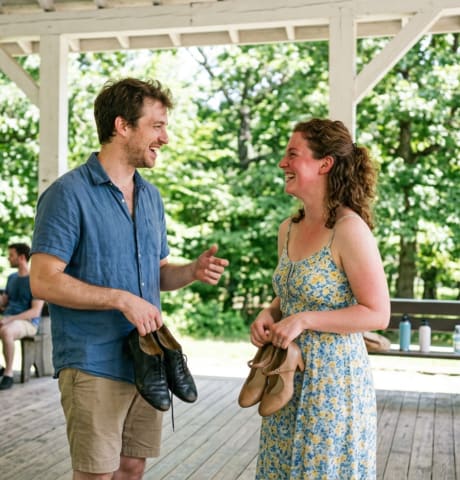 Messaging a dance partner: Templates and psychological tipsThe first step to a new dance partnership starts with the right message. Learn how to connect successfully using psychological insight and effective templates.Messaging a dance partner: Templates and psychological tipsThe first step to a new dance partnership starts with the right message. Learn how to connect successfully using psychological insight and effective templates.
 Giving feedback in dance: Constructive tips for trainingConstructive feedback is the key to harmonious training. Learn in this guide how to critique your dance partner while keeping them motivated, avoiding frustration.
 Dance Partner Etiquette: The 7 Golden Rules for the Dance FloorDiscover the most important rules of conduct for a harmonious and successful dance partnership. Learn how to stay in sync for the long run.
 Dance partners with an age gap: Does it work on the dance floor?Does dancing with a large age gap work? This guide explores the psychology behind it and shows you how to successfully bridge generational differences on the dance floor.
 Organizing dance practice: The tools couples use todayDigital tools are revolutionizing coordination and organization in dance. Learn how to make your training more efficient with modern helpers.
 Which dance partner is right for me? Our self-testFind out with our self-test what you expect from a dance partnership and which personality type best suits you on the dance floor.
 Looking for a dance partner: profile text templatesWith a great template, you can make your profile on udansa appealing in no time and quickly find the perfect partner for the dance floor.