Belly dance technique4 minutes

Belly dance figure eight: guide for soft hips

By Mary De LucaUpdated

In a nutshell
  • The figure-eight in belly dance is based on a precise weight shift from one leg to the other.
  • The movement is created by gently rotating and then shifting the hip outwards or inwards.
  • The upper body remains completely still and isolated during the entire pelvic movement.
  • The knees remain elastic and extended, but never completely locked, so as not to interrupt the flow.

Soft, flowing movements are the heart of oriental dance. With this precise guide, you will master the horizontal figure-eight in your hips purely through the correct weight shift.

What you need for training

  • A non-slip surface for a secure stance
  • Comfortable clothing that makes hip movement clearly visible
  • Barefoot or soft dance shoes for optimal floor contact
  • A large mirror for self-monitoring of isolation

The magic of the infinity loop in the pelvis

The horizontal figure eight, also known as the infinity loop in oriental dance, fascinates with its fluid, almost weightless appearance. To learn this soft pelvic figure eight in belly dance, you need to understand the connection between your feet, knees, and pelvis. It is not a pure hip movement, but a finely tuned interplay of weight shifting and gentle rotation. Many beginners try to force the shape into the air, which often leads to cramping in the lower back. Anyone who wants to learn belly dance technique should therefore always start with a stable, upright posture and feel how the energy for the movement is channeled directly from the floor up through the legs.

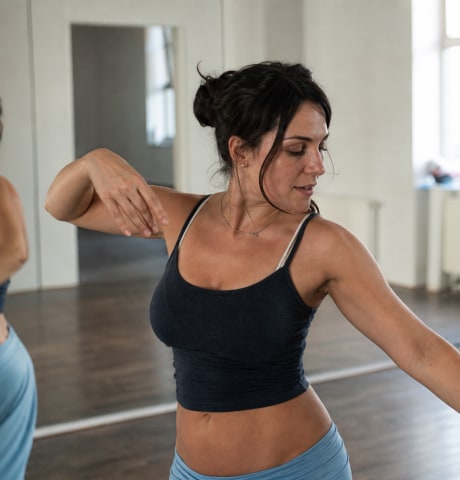
The horizontal figure eight is divided into two directions: the outward figure eight, where the hip pushes from the inside out, and the inward figure eight, which takes the opposite path. Both variations are based on the precise isolation of the pelvis from the upper body. While your hips draw wide loops, your chest remains calm and centered. This separation creates the typical, hypnotic effect of oriental dance. Take enough time to internalize the basic weight shift before you connect the loops with each other. As soon as the movement flows, it feels like a meditative journey through your own body.

6 steps to the perfect figure eight

  1. Finding a stable posture

    Place your feet hip-width apart and parallel. Bend your knees slightly so they can spring elastically, and tilt your pelvis to relieve pressure on your lower back.

  2. Rotate the right hip forward

    Push your right hip bone straight forward without shifting your weight. Your left hip bone will automatically pull back slightly.

  3. Shift your weight to the right

    Shift your entire body weight onto your right foot and gently push your right hip out to the right side.

  4. Pull the loop backwards

    Lead your right hip in a wide arc backwards, while keeping your weight on your right leg, until the first loop of the figure eight is complete.

  5. Let the transition to the left side flow

    Now rotate your left hip forward and shift your weight fluidly onto your left foot to mirror the movement on the opposite side.

  6. Connecting the loops in the center

    Pull your left hip back in a wide arc and connect both loops in the middle to create a continuous, infinite movement.

The most important do's and don'ts at the dance night

Like this

  • Keep your knees soft and bouncy throughout the entire movement
  • Consciously shift your weight from one sole of your foot to the other
  • Keep your chest held proudly and completely still

Not like this

  • Locking your knees completely or keeping them stiff
  • Trying to force the movement using only your upper body
  • Holding your breath and tensing up in your pelvis

Your checklist for the perfect dance night

Before you start

Preparation

While dancing

Meanwhile

Frequently Asked Questions

  1. The hip usually locks up if your knees are completely locked during the movement. Always keep your knees slightly bent and elastic to give your pelvis the necessary range of motion for the rotation.

Your dance journey begins together

On udansa you will find like-minded people and professional studios to refine your moves in a safe space. Sign up and discover suitable offers directly in your area.

Your dance journey begins together

Read more