Belly dance technique4 minutes

Learn belly dance hip accents: Master drops and lifts

By Mary De LucaUpdated

In a nutshell
  • Hip accents in belly dance are created by the isolated muscle tension in the glutes and the oblique abdominal muscles.
  • During a hip lift, the oblique abdominal muscles actively pull the pelvis upward on one side, while the knees remain slightly bent.
  • The hip drop is the sudden, controlled dropping of the hip by relaxing the muscles and pushing the pelvis downward.
  • A clean execution requires a stable stance on one supporting leg and avoiding compensatory movements in the upper body.

Crisp hip accents give oriental dance its rhythmic spice. With the right control of your abdomen and glutes, you will master drops and lifts effortlessly and with absolute precision.

What you need for your training

  • Comfortable training clothes
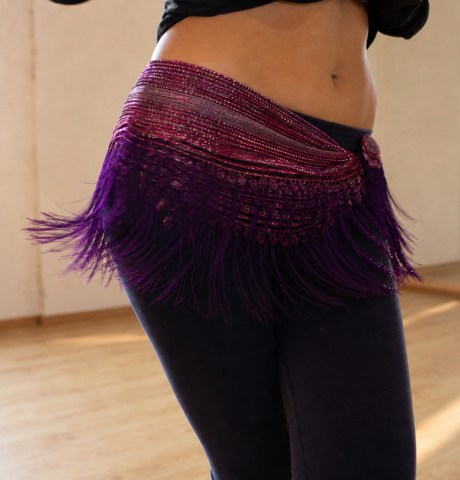
  • A hip scarf without coins for better visibility
  • A mirror for self-correction
  • A non-slip surface

The biomechanics behind crisp hip accents

If you want to impress with powerful, precise accents in oriental dance, you must learn to understand the movement from the ground up. Many beginners make the mistake of forcing hip drops and lifts by frantically bending and straightening their knees. However, this looks restless and robs the movement of the necessary weight. The true power for crisp accents lies deep in the pelvis, more precisely in the targeted activation of the gluteal muscles and the oblique abdominal muscles. If you can activate these muscle groups in isolation, your hip joints move like precise pistons while your upper body remains completely still.

Before you venture into complex combinations, you should check your posture. A stable, upright axis is the most important prerequisite for any isolation. Anyone who builds a solid foundation not only protects their lumbar spine, but also gives the movements the necessary visual calm. If you are interested in the basics of posture, our guide on belly dance horizontal figure eight will help you develop a better feel for the fluid weight shift in the pelvis. For the hard drops and lifts, however, we are now switching from soft to maximally focused.

5 steps to the perfect hip accent

  1. Adopting the basic posture

    Stand up straight, open your feet hip-width apart, and bend your knees slightly. Tilt your pelvis gently backwards to avoid an arched back and to protect your lower back.

  2. Relieving the free leg

    Shift your entire body weight onto your left leg, which becomes your standing leg. Place your right foot slightly forward on the ball of the foot, so that the right hip is unloaded and free to move.

  3. Activating the hip lift

    Engage your oblique abdominal muscles on the right side to pull your right hip straight up towards your ribs. Your upper body remains absolutely stable and does not sway to the side.

  4. Executing the hip drop

    Now let the raised hip drop suddenly by releasing the muscle tension in your abdomen and actively tensing your right buttock. The accent stops crisply at the lowest point.

  5. Switch sides and repeat

    Repeat the switch between lift and drop slowly on one side before you switch your standing leg. Make sure that your knees only cushion the movement and do not actively generate it.

Executing hip accents correctly

Correct

  • Isolate the hip and pull it upwards from the core
  • Always keep the standing leg slightly bent
  • Stop the accent crisply on the beat

Incorrect

  • Force the movement by straightening the knee
  • Lock the standing leg completely
  • Let the movement fizzle out uncontrollably

Your checklist for precise hip accents

Before training

Preparation

While executing

During

After training

Follow-up

Frequently Asked Questions

  1. A hip drop is a downward-directed accent where the hip falls in a controlled manner from a raised position. A hip lift, on the other hand, is an upward accent where the hip is actively pulled upwards.

Find your dance partner online

Whether you are looking for like-minded people for joint technique training or the right dance school for oriental dance: on udansa, we connect you with the entire dance community.

Find your dance partner online