
Find your Samba community on udansa
On udansa you meet musicians, dancers, and Samba enthusiasts in your area. Exchange ideas, start your own Roda, or find the best Brazilian sessions near you.



By Bernhard De LucaUpdated
On udansa you meet musicians, dancers, and Samba enthusiasts in your area. Exchange ideas, start your own Roda, or find the best Brazilian sessions near you.
A traditional Samba-Roda thrives on the collective energy in the circle. With the right setup and respect for the unwritten rules, you create a captivating session full of joy for life.
The Samba Roda, often referred to as Roda de Samba, is far more than a simple concert. It is a social and cultural event where the boundary between musicians and the audience disappears completely. Historically deeply rooted in the Samba history and the origin of the genre, the circular shape symbolizes equality and community. Everyone involved sits or stands at eye level. The Samba Roda sequence follows an invisible dramaturgy: It begins with a gentle warm-up, builds a rhythmic trance over hours, and culminates in an energetic community where everyone claps, sings, and feels the rhythm in their own body.
Anyone hosting a Roda creates a protected space for collective improvisation. Unlike a classic stage show, there is no distance. The energy flows in a circle, is carried by the musicians into the group, and returns as singing and clapping. To make this dynamic authentically experienceable outside of Brazil in 2026, musical direction and adherence to traditional codes of conduct must go hand in hand. Only in this way does the typical, captivating atmosphere that distinguishes a genuine Brazilian session emerge.

Place a round or square wooden table in the center of the room or square. Arrange the chairs for the musicians around it so that they can all look directly at each other. The audience forms a circle standing around this core.
Distribute the instruments in a balanced way. The deep, rhythm-giving drums like the Surdo or Tantan are ideally placed opposite the bright string instruments like the Cavaquinho to create a balanced, natural stereo sound.
Appoint an experienced musician as the leader of the session. They will start the songs, set the tempo, and signal when a song ends or when improvised solo parts for the percussionists begin through hand gestures or eye contact.
Start the session with well-known, medium-tempo Pagode classics. This gives the musicians confidence while warming up and immediately invites the surrounding audience to sing along to the chorus and energetically support the roda.
Use the traditional call-and-response principle. The soloist at the table sings the verses, while the entire audience in the circle answers the chorus as a choir. This creates the inimitable dynamic of a real Roda.
Like this
Don'ts
Preparation
Arrival
During
The Samba Roda sequence is divided into the arrival and tuning of the instruments, a calm warm-up, the main session with increasing dynamics, a break, and the energetic finale. This structure ensures that the energy in the circle can build up organically.
Traditionally, only the active musicians with their instruments sit in the inner circle. Spectators and dancers form around them. Anyone who wants to sing along or clap does so from the front row, without disturbing the space of the instrumentalists.
The most important Samba Roda rules forbid loud chatting directly at the musician's table and playing along on your own instruments without being asked. Furthermore, it is considered impolite to break eye contact with the musical director, as they control the cues.
Clapping is done in the traditional basic Samba rhythm, the so-called Partido-Alto clapping pattern, or on beats two and four. Clapping supports the percussionists, but it must never acoustically drown out the quiet string instruments like the Cavaquinho.
Experience the rhythmic energy of traditional sessions and dance evenings up close.
 festivaludansa tipBachata
 festivalSalsa
 festivalSalsa
 History of Samba: The roots of the Brazilian heartbeatThe history of Samba is a journey full of rhythm, culture, and resistance. Discover the fascinating African roots and the instruments that shaped this global success.
 History of Samba in Europe: The Journey Across the OceanThe journey of Samba from the streets of Rio to European ballrooms is a story full of fascination, misunderstandings, and cultural adaptation. Learn how the rhythm conquered Europe.
 Samba instruments: The sound of the bateria in detailDive into the fascinating world of Brazilian samba instruments. Learn how the surdo, tamborim, and others shape the unmistakable sound of the bateria.
 Counting Samba rhythm: How to hear the beatLearn step by step how to identify the Samba rhythm flawlessly and count the beat like a pro. No dance steps required, just for your ears.
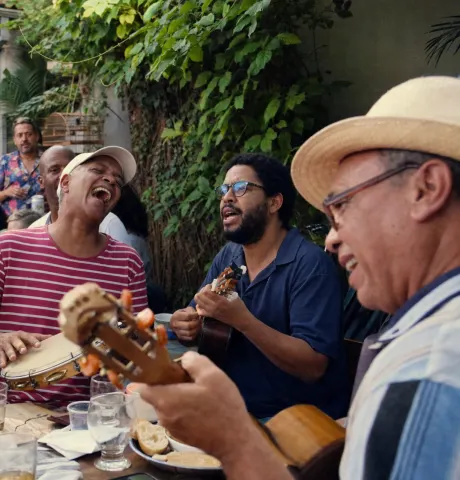 Samba music styles: From Pagode to Bossa NovaSamba is not just samba. Our guide leads you through the fascinating world of samba music styles, from wild Samba Enredo to elegant Bossa Nova.
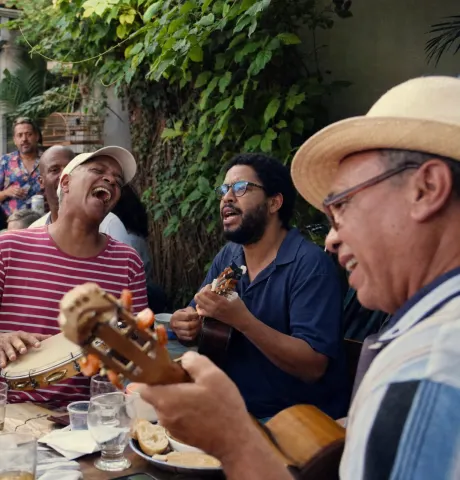 Which Samba style suits you? Take the testFind out which Samba subgenre best matches your musical taste with our quick test. Discover the variety from Bossa Nova to Pagode!
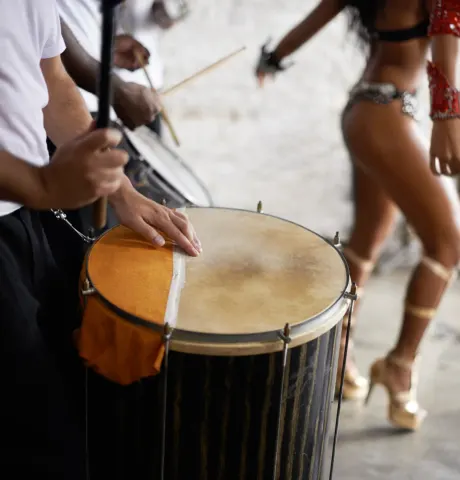 Famous Samba Musicians: The Legends of RhythmDive into the world of the most famous samba musicians in history. Learn how Cartola, Clara Nunes, and other legends made the rhythm of Brazil immortal.